Published
Sources checked through , 5 p.m. Pacific · facts checked and fully reviewed · 26 min read
Evidence at a glance
- Proved by the record
- Microsoft (Nov 12–13), the FAA (Nov 13), JPMorgan Chase and United (Nov 16) and Apple (Nov 17) each confirmed a disruption and named an internal technical cause; a U.S. official described NSA Net degradation during scheduled maintenance (Nov 17).
- Not established
- A cyberattack, a coordinated campaign, an AI-caused failure, a confirmed national 911 outage, or a failure at any particular clinic, hospital or health record system. The FAA's root cause has not been published.
- Our analysis
- Each fault spread because many independent users share one gateway, network, ledger or sign-in layer. Concentration, not coincidence, is the governance question.
Short answer first
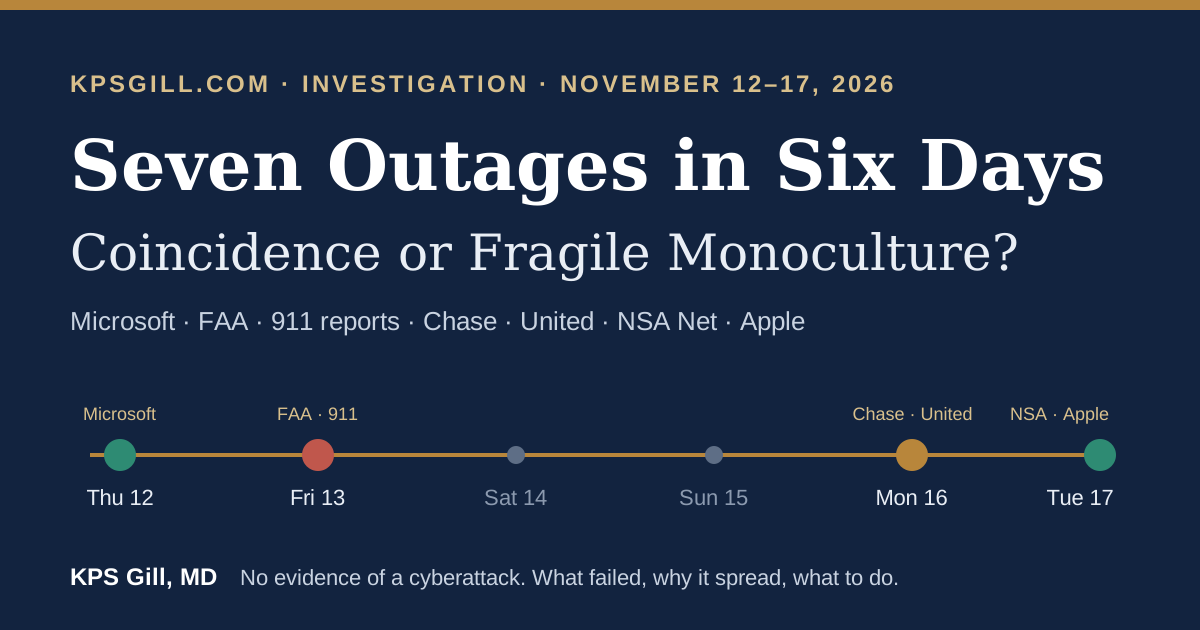
What happened. Between Thursday, November 12 and Tuesday, November 17, 2026, at least seven widely used systems faltered in sequence: Microsoft 365 email and its connected services, a spike of public reports about failed 911 calls, the Federal Aviation Administration’s en-route network, JPMorgan Chase transaction processing, United Airlines’ departure systems, Apple’s account and payment services, and the National Security Agency’s internal classified network.
Why it matters. Every operator that has explained its failure named an internal technical cause: a dormant software defect, a newly installed router, a bank software bug, an internal update, routine maintenance. No operator, and no government official on the public record, has identified a cyberattack. The week did not reveal a single enemy. It revealed how many daily lives, including medical ones, now pass through a small number of shared front doors.
The single takeaway. Build a small offline layer this week: printed medication list, local non-emergency dispatch numbers, Text-to-911 knowledge, a second payment method and the paper trail for any interrupted transaction.
Quick-scan key takeaways
- Seven disruptions, seven stated causes, no shared culprit on the record. Microsoft, the FAA, Chase, Apple and United each attributed their failure to their own systems; the NSA outage was described by a U.S. official as degradation during scheduled maintenance.
- The FAA’s nationwide ground stop lasted more than four hours after a router installed during a copper-to-fiber upgrade at a remote radio site in El Dorado, Arkansas, flooded a network serving 17 of 22 en-route centers.
- Microsoft’s preliminary review traces its outage to a defect introduced in July, exposed by a routine traffic failover and reduced capacity on the gateway that fronts Exchange Online.
- The 911 “outage” was a surge of crowd reports, not a confirmed national failure. Treat Downdetector counts as signals, not findings.
- Airline cash refunds for cancelled flights remain a federal rule (14 CFR 260.6), even while the Department of Transportation considers narrowing its definition of a cancellation.
- California has its own exposure: a 911 network midway through a stalled Next Generation transition, an e-prescribing mandate with a technology-failure exemption, and a state budget the Legislative Analyst has tied to AI-driven stock gains.
Six days of digital dominoes: the verified chronology
The week began at Microsoft. At 01:07 UTC on November 12, an automated system moved Microsoft Teams traffic onto the primary networking gateway that also carries Exchange Online, a routine operation. About fifteen hours later, at 16:20 UTC (11:20 a.m. Eastern), a high-priority alert fired on Exchange Online. Outlook users across the Americas, then the world, could not open their mailboxes. Microsoft’s preliminary post-incident report records the incident window as 16:20 UTC on November 12 to 16:10 UTC on November 13, nearly twenty-four hours, with users in 74 countries affected.
Before Microsoft had recovered, the crowd-reporting site Downdetector began registering complaints about 911. Cybernews reported a peak of 298 user reports early on November 13; Fresno’s GV Wire, later that day, reported more than 5,000 reports nationwide. No carrier, public safety answering point authority or federal agency confirmed a national 911 failure. One Florida sheriff’s office that posted about service problems said its own communications center was unaffected and urged residents to keep dialing 911.
At about 3:30 p.m. Eastern on Friday, November 13, the FAA’s communications network began to wobble. Transportation Secretary Sean Duffy said instability appeared at about 3:36 p.m. The agency reported instability at 17 of its 22 Air Route Traffic Control Centers, spreading into several terminal radar facilities. A nationwide ground stop followed shortly before 4 p.m. Some radio frequencies and radar feeds kept working, and the FAA says every airborne flight landed safely. Departures resumed at 8:15 p.m. Eastern. Cancellation totals vary by source and counting window: Aviation Week reported about 12,000, while Fox television stations reported nearly 20,000.
The cause emerged over the weekend. L3Harris Technologies, which operates the FAA’s telecommunications network under contract, had been deploying a new router at a remote radio site in El Dorado, Arkansas, as part of a move from copper lines to fiber. Investigators also identified a radar site in Amarillo, Texas, where a router had been replaced about three weeks earlier. Duffy said the network recovered when the El Dorado facility was shut down. Hewlett Packard Enterprise, whose Juniper unit made the router, said the device worked as configured. The FAA paused further installations.
Monday, November 16, brought two failures. JPMorgan Chase customers reported trouble viewing balances and moving money; the bank attributed the delays to a software bug in its own on-premise hardware systems and said transactions were posting normally by about 6:30 p.m. Eastern. Customers at other banks saw delays only where a transaction involved Chase. Zelle said its network operated normally. Bank of America, U.S. Bank and Capital One said their own systems were not directly affected. That afternoon, United Airlines reported a “widespread system outage” that held departures for roughly 100 minutes, according to AP.
On Tuesday, November 17, two more systems faltered. Six sources told CNN that NSA Net, the agency’s internal classified network, was experiencing an intermittent outage; a U.S. official later described a “temporary degradation” during regularly scheduled maintenance. Hours later, Apple users were signed out of iCloud, payments failed in Apple Pay and the App Store stalled. Apple said an internal update had caused the outages and that most systems were restored that day. Marriott separately restored sign-in to its website and app.
The official narrative fractured almost immediately. On Monday night, Homeland Security Secretary Markwayne Mullin told Fox News that an unnamed technology contact had suggested artificial intelligence might be overwhelming older systems. “I believe that it’s the SI,” he said, using the administration’s term for “super intelligence.” In the same interview he claimed “98% certainty” that the disruptions were not cyberattacks. Microsoft and the FAA rejected an AI link to their outages. Secretary of State Marco Rubio said on November 17 that officials had no evidence tying the outages together.
| Date (2026) | System | What users experienced | Cause as stated by the operator or officials |
|---|---|---|---|
| Nov 12–13 | Microsoft 365 / Exchange Online | Mailboxes unreachable; delayed mail; Teams, Copilot and SharePoint degraded in 74 countries | July 2026 gateway defect, a routine Teams failover adding load, and reduced capacity (preliminary report) |
| Nov 13 | 911 (crowd reports) | Reports of dropped calls and busy signals | None confirmed; no carrier or agency acknowledged a national failure |
| Nov 13 | FAA en-route network | Nationwide ground stop, 3:54–8:15 p.m. ET; thousands of cancellations | Router at El Dorado, Ark. site flooded the network during copper-to-fiber work; Amarillo site also implicated |
| Nov 16 | JPMorgan Chase | Balances and transfers unavailable; Zelle delays involving Chase | Software bug in the bank’s on-premise hardware systems; not a cyberattack |
| Nov 16 | United Airlines | Departures held about 100 minutes | Internal system outage; pilots cited missing aircraft weight data |
| Nov 17 | NSA Net | Intermittent internal outage; staggered staff arrivals | “Temporary degradation” during scheduled maintenance (U.S. official) |
| Nov 17 | Apple services | iCloud sign-outs, Apple Pay and App Store failures | “Internal update”; not a cyberattack (Apple) |
Why modern infrastructure fails like dominoes, in plain English
None of these systems is a single machine. Each is a chain of dependencies, and a chain is only as reliable as the link every other link must pass through. Engineers call that link a single point of failure. The week’s lesson is that the most dangerous single points are no longer the obvious ones, such as a power plant or a data center. They are quieter shared layers: a gateway, a router, a sign-in service, a core ledger.
The shared front door
When you open Outlook, your request does not go straight to your mailbox. It first reaches a networking gateway, a fleet of servers that accepts millions of connections and routes each to the right service. Microsoft’s preliminary report says a fix deployed to those gateway servers in July carried a latent defect, which reporting describes as lock contention inside an internal Windows process. It had passed load testing, reportedly on hardware weaker than production. It sat harmless until November 12, when extra Teams traffic and reduced capacity met during peak American hours. At the worst point, according to reporting on the report, more than 80 percent of gateway servers were unresponsive.
The decisive detail is architectural. Microsoft acknowledged that Exchange Online cannot switch away from this gateway “for scale reasons.” Efficiency at global scale means sharing; sharing means that when one front door jams, nearly everyone waits outside. That is what “monoculture” means in practice: not that one company is careless, but that millions of independent organizations have quietly accepted the same dependency.
The network that drowns in its own traffic
The FAA failure followed a different path to the same place. The agency’s telecommunications backbone links radios, radars and controllers across the country. A new router, installed to carry a remote radio site from copper lines to fiber, began sending connection traffic that the older network could not absorb. Wall Street Journal reporting, relayed by trade publications, described the routers generating a flood of connection attempts and the FAA switching off the responsible feature on roughly sixty Juniper units. Instability spread until controllers in much of the country could not rely on their links, and safety protocol required a stop.
The router’s maker says it worked as configured. If that proves correct, the question moves from hardware to integration: who tested the configuration against a decades-old network, and why could one remote site destabilize seventeen centers? The FAA has not yet published a root-cause finding; its administrator said on November 19 that findings would come later.
Ledgers, sign-ins and the copper underneath
Banking failures propagate through the ledger rather than the network. Chase is the largest U.S. bank by assets, and a transfer between banks needs both sides to post. When Chase’s processing slowed, customers elsewhere saw delays wherever Chase sat on the other end of a payment. Zelle, which does not hold customer funds, kept running; but its network operator, Early Warning Services, is owned by banks including JPMorgan Chase. Apple’s failure ran through identity. When the sign-in service falters, everything that asks “who are you?” falters with it: cloud storage, purchases, payment cards, even activation of a new phone.
911 has its own architecture. A call travels from your carrier to a routing system that selects the right public safety answering point, then to the dispatcher’s equipment. For decades that path ran on copper. The national migration to internet-protocol Next Generation 911 brings text, data and better location, but every transition creates a period when old and new systems must hand calls to each other. Handoffs are where calls are dropped. That is why credible 911 reports deserve investigation even when, as on November 13, no failure was confirmed.
The common thread is not age alone. The FAA failure happened during modernization; Microsoft’s defect arrived in a fix; Apple’s came in an update. Change is the most dangerous moment in any complex system. A mature operator assumes that every change can fail and keeps a tested way to reverse it before it spreads.
What real redundancy looks like
Engineers have names for the disciplines that limit damage. A staged rollout sends a change to a small slice of servers first, so a defect hurts thousands rather than millions. A rollback is the rehearsed ability to undo a change within minutes. Isolation keeps one customer’s or one region’s traffic from overwhelming another’s. True redundancy means a backup path that shares nothing with the primary: not the same gateway, not the same software build, not the same contractor.
Medicine already understands this logic. A hospital does not run its backup generator on the same fuel line as the main supply, and a pharmacy keeps a manual process for when the claims system fails. The week’s failures suggest that much of the digital infrastructure around care has not been held to that standard. A clinic whose email, telehealth, file storage and identity all run through one vendor has one front door, however many applications sit behind it.
Verified public record vs. disputed claims and open probes
This section separates three levels of evidence: what the record proves, what has been asserted or reported but not established, and what can reasonably be inferred. The distinction matters because the week’s most viral claims were neither proved nor disproved; they were simply unsupported.
| Claim | Status | Basis |
|---|---|---|
| A router at an FAA radio site in El Dorado, Ark., was being replaced by L3Harris when the network destabilized | Proved finding | FAA Q&A; DOT statements; L3Harris statement |
| The router itself failed | Disputed | HPE says it worked as configured; FAA root cause not yet published |
| A July defect, a Teams failover and reduced capacity combined to cause the Microsoft outage | Proved finding (preliminary) | Microsoft preliminary post-incident report; final review due Nov 20 |
| A national 911 outage occurred on Nov 13 | Not established | Crowd reports only; no carrier or agency confirmation |
| Chase’s bug froze other major banks’ systems | Inaccurate as stated | Bank of America, U.S. Bank and Capital One said their own systems were not directly affected; delays arose where Chase was a party |
| The disruptions were a coordinated cyberattack | Unsupported | Operators and officials report no evidence; none has claimed responsibility |
| “Super intelligence” caused the outages | Unsupported allegation | Attributed by Sec. Mullin to an unnamed contact; no technical evidence offered; Microsoft and FAA rejected the link |
| Concentrated shared layers turned local faults into national outages | Analytical inference | Pattern across operators’ own accounts |
What the record proves
Microsoft’s preliminary report, dated November 15, is a self-assessment, but it is specific: a dated defect, a timestamped failover, a quantified window and a promised final review. The FAA’s questions-and-answers page identifies the El Dorado work and the scope of instability. The Department of Transportation told FactCheck.org that more than $4 billion of the $12.5 billion Congress appropriated in July 2025 had been obligated as of November 17, including 48 percent of $4.8 billion for telecommunications. Chase, United and Apple each confirmed a disruption and named an internal cause.
What remains alleged, reported or open
The FAA has not published a root cause, and Senate Commerce Committee Democrats asked on November 16 for evidence of independent testing, redundancy and rollback capability by November 23. Whether contractor error, configuration or architecture is responsible remains open. The NSA has not publicly explained its outage. The administration’s request for $50.1 billion more is a proposal, not an appropriation, and a GAO report in September warned that the FAA’s modernization program needed better cost and schedule planning. Mullin’s AI theory remains an assertion without public evidence.
What the operators have not disclosed
The public record also has visible gaps. Chase has not said how many transactions were delayed or which system failed. Apple has not explained what its internal update changed, why it touched so many services at once, or how many customers were affected. The NSA has made no public statement. Microsoft’s final review was still pending at this report’s cutoff. The FAA’s contractor history also deserves scrutiny: the Dallas Morning News reported that L3Harris had been partially blamed for a 2025 air traffic control outage in Dallas. Each gap is a question for regulators, shareholders and customers, not a basis for suspicion.
One real cyber incident did surface, and it should not be confused with the outages. On November 19 JPMorgan Chase disclosed a cyberattack on third-party vendors that may have exposed some customers’ names and email addresses held for marketing, and the bank expressly distinguished it from the November 16 transaction disruption, according to Reuters. Visa and Mastercard described separate vendor-side incidents and said their payment systems were unaffected. A customer may now face two unrelated events: a delayed transfer and a data-exposure notice. Document each separately.
What can reasonably be inferred
A cluster of unrelated failures in one week is not, by itself, evidence of coordination in a country running on tens of thousands of interconnected systems; what is remarkable is how far each failure spread. The inference this record supports is structural. Market consolidation and engineering efficiency have produced shared layers whose failure no single customer can mitigate. That is a governance problem before it is a technology problem.
The California and Central Valley impact
California felt the week as both customer and host. Apple, whose services failed on November 17, is headquartered in Cupertino, and millions of Californians depend on the cloud, airline and banking systems that faltered around it. For the Central Valley, where distances are long and alternatives few, the practical exposure is sharper than the national headlines suggest.
Fresno: a 1961 tower and a diverted flight
The ground stop reached Fresno Yosemite International Airport within minutes. At least one aircraft, Alaska Airlines flight 533, diverted into Fresno, and Fresno Mayor Jerry Dyer said city officials were coordinating with airport and federal leaders. The episode is a reminder of local infrastructure age as well: the airport’s control tower was commissioned in 1961 and is slated for replacement, a project officials estimate at about $100 million. For Valley patients who fly to specialty care in the Bay Area, Los Angeles or out of state, one ground stop can cancel a surgical consult arranged months in advance.
California’s 911 network is mid-transition
California’s emergency network is in exactly the kind of transition that makes handoffs fragile. The Governor’s Office of Emergency Services paused its Next Generation 911 deployment in early 2025 to reassess after contract problems; its February 2026 legislative report describes 23 answering points already moved onto the new network, and its updated plan targets full statewide deployment by 2030. The good news is that every one of California’s 440 answering points has accepted text messages since 2021. Text-to-911 is a genuine backup, though texts can locate you less precisely than a voice call.
Accountability is diffuse. Since August 2024, when the state’s regional and statewide Next Generation 911 contracts expired, the network has operated under tariffs that each vendor filed with the California Public Utilities Commission, according to Cal OES. That places 911 reliability partly in a utility-regulation proceeding that few residents follow. When a call fails, the question “whose network dropped it?” can have four answers: the caller’s carrier, the routing provider, the state’s contracted network or the local dispatch equipment.
In Fresno County, the Sheriff’s communications center handles more than 900 emergency and non-emergency calls a day and dispatches for six cities: Sanger, Kerman, Kingsburg, Mendota, Orange Cove and Fowler. Rural families in the foothills and on the west side live with longer ambulance times and patchier cell coverage. For them, knowing a ten-digit fallback number is not trivia.
E-prescriptions, pharmacies and payment
Since January 1, 2022, California law has required most prescriptions to be transmitted electronically under Business and Professions Code section 688. The statute anticipated weeks like this one: it exempts prescriptions when electronic transmission is unavailable because of a temporary technological or electrical failure. For controlled substances, the prescriber must document the reason in the record within 72 hours after the failure ends. The Board of Pharmacy recommends that prescribers keep compliant security paper forms. A patient whose prescription “didn’t go through” should know that a lawful paper or oral alternative exists.
Payment is the second chokepoint. Apple Pay failed for some users on November 17, and Chase customers could not see balances on November 16. A Medi-Cal member with a small copay, or a Covered California enrollee paying a first premium during open enrollment, should not have a single phone as the only way to pay or prove coverage. Keep the plan card, or a printed copy, with the medication list.
Clinics, referrals and the email backlog
Many California practices run referrals, scheduling and patient communication through Microsoft 365. During the outage, some messages queued rather than vanished, which means a referral sent on Thursday may have arrived Friday without anyone noticing the delay. The incident records do not establish a failure at any particular clinic, health system or electronic health record. They do establish a question every practice should be able to answer: when an outgoing referral leaves our system, who confirms that it arrived?
Sacramento’s concentration risk
The state’s finances carry a parallel concentration risk. The Legislative Analyst’s Office warned in its November 2025 fiscal outlook, and again in January 2026, that California’s strong income-tax revenue rests disproportionately on AI-driven stock gains concentrated in a few large technology companies. A week of failures at those same companies does not move a budget. It does illustrate the same principle: when one sector carries too much weight, the whole structure inherits its volatility, and Medi-Cal and county safety-net budgets are among the first to feel it.
Consumer and patient protection action guide
None of what follows requires technical skill. It requires an hour this weekend and a sheet of paper.
1. Build the emergency layer
- Call 911 first. If a call fails, text 911. “Call if you can, text if you can’t.” State your location in the first message.
- Save your local non-emergency dispatch numbers. In Fresno County: Sheriff dispatch (559) 600-3111; Fresno Police (559) 621-7000; county EMS non-emergency (559) 600-7800; CAL FIRE (559) 294-2009. Use these only when 911 cannot be reached, never for a test call.
- Turn on Wi-Fi calling so a failed cell signal does not mean a failed call at home.
- Keep a charged battery pack and a written list of family numbers. Phone contacts disappear with the phone.
2. Build the medical paper layer
- Print a medication list with doses, allergies, conditions, your physician’s and pharmacy’s numbers, and your insurance member ID.
- For insulin pumps, glucose sensors and cardiac monitors, learn the manual fallback your device maker documents, and keep backup supplies where your clinician has advised them.
- If a prescription fails to transmit, ask the prescriber’s office about a lawful paper or oral prescription under California’s technology-failure exemption.
- If a referral or result matters, ask the receiving office to confirm receipt rather than relying on the sender’s screen.
3. Protect your money and your trip
| Situation | Your right or best practice | What to keep |
|---|---|---|
| Flight cancelled by the ground stop | Full cash refund if you decline rebooking or credit (14 CFR 260.6); refunds due within 7 business days for card payments, 20 calendar days otherwise | Airline notice, flight number, receipts; do not accept a credit unless you want it |
| Flight merely delayed | No federal cash compensation; check the airline’s own waiver and commitments | Actual departure time; meal or hotel receipts |
| Transfer delayed or duplicated | Under Regulation E, report an error within 60 days of the statement; the bank must investigate | Transaction reference, time, screenshots; do not resend until the first is confirmed |
| Card or wallet failed at checkout | Use a second payment method on a different network or bank | Receipt showing declined and approved attempts |
| Email claiming to “restore messages” | Ignore links; reach the service through your own bookmark or app | Report as phishing to your provider and to reportfraud.ftc.gov |
Check the airline’s own waiver before you rebook. United, for example, said it would waive change fees and fare differences for flights departing November 12 through 20. Waivers differ by carrier and expire; the federal refund right does not depend on them. Pending federal rulemaking may narrow what counts as a cancellation in future, so keep the airline’s written notice of what it changed.
4. Defend against the second wave
Every large outage is followed by impersonation. Criminals send messages styled as service notices, bank alerts or refund offers, timed to reach people already anxious. The defense is simple and absolute: never sign in through a link that arrived during or after an outage. Open the app or type the address you already know. Check the operator’s official status page, not a forwarded screenshot. No bank, airline or software company needs your password or a one-time code to restore service. Enable phishing-resistant multi-factor sign-in, such as a passkey, where your accounts allow it.
5. For clinics and small practices
Run a one-hour tabletop exercise: email is down for twelve hours. Who calls the pharmacy? Where is the paper prescription pad? How do you reach the patients scheduled for telehealth? Which referrals left the building yesterday, and who confirms they arrived? Write the answers on one page, print it and tape it inside a cabinet. Then decide whether email is the right system for time-sensitive clinical handoffs at all.
6. Make a one-page outage card
Put the essentials on one printed page and keep copies in a wallet, a car and a kitchen drawer:
- Emergency: 911 by voice; text 911 if a call fails; your county’s non-emergency dispatch number.
- Health: medications and doses, allergies, conditions, physician, pharmacy and insurance member ID.
- Money: a second card from a different bank, a small amount of cash, and your bank’s phone number.
- Travel: confirmation numbers, the airline’s phone number and the refund rule in one line.
- Accounts: where your recovery codes are stored at home, never on the same phone.
If anyone in your household depends on powered medical equipment, ask your electric utility about Medical Baseline enrollment and outage notifications; internet failures and power failures often arrive together during California storms.
Frequently asked questions
Was the week of outages a cyberattack?
No public evidence shows that. Microsoft, the FAA, JPMorgan Chase, United and Apple each attributed their disruption to internal technical causes, and Homeland Security Secretary Markwayne Mullin said he was highly confident none was a cyberattack. No group has claimed responsibility.
Did artificial intelligence cause the outages?
There is no technical evidence of that. Secretary Mullin relayed an unnamed contact's theory that AI might be overwhelming older systems, but offered no data. Microsoft and the FAA rejected an AI link to their outages.
What caused the FAA nationwide ground stop on November 13?
The FAA and Transportation Department linked it to a new router installed by contractor L3Harris at a remote radio site in El Dorado, Arkansas, during a copper-to-fiber upgrade, with a radar site in Amarillo, Texas, also implicated. The final root cause has not yet been published.
Was there a nationwide 911 outage?
Not one that was confirmed. Downdetector logged a spike of user reports on November 13, but no carrier, 911 authority or federal agency confirmed a national failure. If a 911 call fails, text 911 and use your local non-emergency dispatch number.
Am I owed a refund if the ground stop cancelled my flight?
Yes, if you decline rebooking or a travel credit. Under 14 CFR 260.6, airlines must refund cancelled flights automatically, within 7 business days for card payments and 20 calendar days for other payments. Delays alone do not trigger federal cash compensation.
My Zelle or bank transfer was delayed on November 16. What should I do?
Do not resend the payment until the first one is confirmed. Check the transaction reference with your bank. If an error appears on your statement, report it promptly; Regulation E gives you 60 days from the statement and requires the bank to investigate.
Can my doctor give me a paper prescription when e-prescribing fails?
Yes. California Business and Professions Code section 688 exempts prescriptions when electronic transmission is unavailable because of a temporary technological or electrical failure. For controlled substances, the prescriber must document the reason within 72 hours after the failure ends.
Can I text 911 in California?
Yes. All of California's roughly 440 public safety answering points have accepted text messages since 2021. Call if you can and text if you can't, and put your location in the first message, because texts may be located less precisely than calls.
How do I avoid scams after an outage?
Never sign in through a link in a message about the outage. Open the app or type the address you know, check the company's own status page, and never share a password or one-time code to restore service. Report phishing to your provider and to reportfraud.ftc.gov.
What should a small medical practice change after this week?
Run a short tabletop exercise for a twelve-hour email outage: confirm the paper prescription process, a phone tree for telehealth patients and a way to confirm that referrals actually arrived. Do not rely on a sender's screen as proof of delivery.
Primary source verification checklist
Before relying on, citing or republishing any figure in this article, confirm it against the issuing source. These are the records this report used and the ones still to watch.
- FAA, Nationwide Ground Stop: Questions and Answers (Nov 15) and the forthcoming FAA/DOT root-cause announcement.
- Microsoft’s preliminary post-incident report (Nov 15, Microsoft 365 admin center, incident EX1550543) and the final review due Nov 20.
- Senate Commerce Democrats’ letter and any DOT/FAA response by Nov 23.
- DOT’s $50.1 billion request (Nov 17) and GAO-26-107992 (Sept 14).
- Chase, United and Apple statements as reported by AP and Reuters; Apple System Status history.
- FCC network outage reporting and any California Public Utilities Commission or Cal OES 911 incident notice for Nov 13.
- Cal OES Next Generation 911 legislative report (Feb 2026).
- Medical Board of California e-prescription requirements and Business and Professions Code section 688.
- DOT automatic refund rule and the status of the pending “Refund III” rulemaking.
Related reporting on this site: Who could stop the flight? (November 19 edition), Paid, pending or merely visible?, the flight-disruption records checklist and airline cancellation refund rights.