Published
Editorial date (Pacific) · sources reviewed · each case keeps its own docket cutoff (see the case tracker) · the author's manuscript, prepared for publication with AI assistance; review of the published page has not yet been recorded · 23 min read
An ambient AI system can record a confidential conversation, send it for processing, and turn it into a clinical document that another person later treats as evidence. Each step raises a different question. Was recording authorized? What happened to the information? Does the note faithfully describe the encounter? Who adopted the clinical conclusions? What evidence remains if the patient or physician disputes the result?
The California lawsuits involving Sutter Health, Sharp HealthCare, and MemorialCare bring the recording and consent questions into court. Microsoft's public documentation for DAX Copilot and Dragon Copilot supplies a separate reason to examine the resulting medical record: these products can generate assessment-and-plan diagnoses, reconcile them with Epic, and support additional clinical workflow functions. A physician's eventual signature does not answer every question that arose before the note was signed. [S01–S05, S10]
This investigation distinguishes allegations, reproduced court records, vendor descriptions, and the author's analysis. The California allegations discussed below identify Abridge; they are not presented as lawsuits against Microsoft or Nuance. No final judgment establishing liability in those California cases was independently verified for this update. Public docket snapshots have different cutoff dates, identified below. A proposed class action is not a certified class. [S01–S06]
What the California court records establish
Washington v Sutter Health
Northern District of California case 4:26-cv-03012-HSG concerns alleged unauthorized recording and processing of clinical conversations. The original joint complaint identified Abridge and included MemorialCare entities. The docket records a subsequent separation of those claims and a second amended complaint against Sutter. The original complaint is historical evidence of the allegations at filing; it should not be substituted for the operative amended pleading. [S01, S02]
Status verified 8:49 pm Pacific on 13 November 2026 from the court's PACER docket
| Date | Documented procedural event |
|---|---|
| April 8 2026 | Original complaint filed as Docket 1. The docket's case header lists April 7. |
| August 4 2026 | Court directed a complaint excluding the Memorial defendants and a separate proceeding against them. |
| August 5 2026 | Second amended complaint filed against Sutter as Docket 32. |
| August 19 2026 | Sutter filed motions under Rules 12(b)(1) and 12(b)(6) (Dockets 35 and 36). |
| September 1-2 2026 | The plaintiff's oppositions filed (Dockets 38-40, including an errata). |
| September 16 2026 | Reply briefs filed (Dockets 43 and 44). This is the retrieval cutoff printed on the public docket first reviewed. |
| October 6 2026 | Clerk's notice: both motions taken under submission, the October 8 hearing vacated, a written order to follow (Docket 45). |
| October 27 and November 3 2026 | ADR certifications filed (Dockets 46 and 47). |
| November 13 2026, 8:49 pm Pacific | The court's docket shows no later entry and no order deciding either motion. |
Status verified 8:49 pm Pacific on 13 November 2026 from the court's PACER docket
The April 8 filing date appears both in the actual docket entry and on the complaint's court stamp. The April 7 date belongs in a source note explaining the metadata discrepancy; the case header of the PACER docket report retrieved November 13 also lists April 7. [S01, S02, S38]
Rule 12(b)(1) challenges subject-matter jurisdiction. Rule 12(b)(6) challenges whether a complaint states a claim on which relief can be granted. Neither motion is itself a liability finding. The labels alone do not establish the full arguments in the briefs. [S31]
Added 13 November 2026 from the parties' filings (RECAP copies)
The briefs show what the court has been asked to decide. Sutter's jurisdictional motion argues that the remaining plaintiff lacks standing. It says two of the original plaintiffs were dropped after an earlier jurisdictional motion, relies on a declaration stating that any Sutter provider who may have spoken with her at the three visits she identifies did not have access to the Abridge platform, and points to the complaint's acknowledgement that she was aware a device was capturing speech for transcription or note-taking. It adds that she signed acknowledgements of Sutter's notice of privacy practices on three occasions and describes Abridge as a HIPAA business associate. [S39]
Added 13 November 2026 from the parties' filings (RECAP copies)
The plaintiff's opposition answers that understanding a visible device as internal note-taking is not agreement to an outside ambient-AI provider acquiring, transmitting and processing the live conversation, and that the notice does not name Abridge or describe live recording. It concedes that the medical-information claim presents a closer question because Civil Code section 56.10(c)(3) permits disclosure for medical data processing, and that the federal Wiretap Act allows one-party consent. These are party positions; the court has not resolved them. [S40]
Status verified 8:49 pm Pacific on 13 November 2026 from the court's PACER docket
Secondary reporting had said the motions were taken under submission on October 6. The court's own docket now confirms it: a clerk's notice took both motions under submission without oral argument, vacated the October 8 hearing and stated that the court will issue a written order (Docket 45). The parties then filed ADR certifications on October 27 and November 3. The PACER docket report retrieved at 8:49 pm Pacific on November 13 lists no later entry and no order deciding either motion. The defensible status is therefore: dismissal motions fully briefed and under submission, with no ruling as of that retrieval. Taking a motion under submission is not a ruling on it. [S06, S07, S37, S38]
Saucedo v Sharp HealthCare
The San Diego Superior Court index confirms case 25CU063632C, filed November 26, 2025. KPBS's reporting on the complaint describes allegations that Abridge recorded encounters without sufficient consent and that chart language inaccurately stated that patients had been advised and consented. These remain allegations. [S04, S05]
Rechecked 13 November 2026 against the court's public index
A secondary tracker reports that the demurrer was calendared for October 23, 2026 and that a minute order issued that day, without reporting the outcome. It lists a January 22, 2027 case-management conference. The actual minute order was not obtained; the court's public index, reviewed again on November 13, states that the case has not been imaged. A scheduled hearing, an issued minute order, and a ruling allowing or dismissing claims are different events. [S04, S08]
Matulic v Memorial Health Services
Added 13 November 2026 from the complaint (RECAP copy)
The separate Northern District of California proceeding, 3:26-cv-08206-WHO, was filed August 6, 2026 against Memorial Health Services and MemorialCare Medical Foundation. Its complaint, now read, describes an ambient documentation service supplied by Abridge AI, Inc. and pleads claims under Penal Code sections 632 and 637.2, the Confidentiality of Medical Information Act, the Unfair Competition Law, intrusion upon seclusion and the federal Wiretap Act. Abridge is described in the complaint; it is not a named defendant. [S03, S41]
Status verified 8:49 pm Pacific on 13 November 2026 from the court's PACER docket
The docket has moved since the reproduction first reviewed. On October 23 the court extended the defendants' response deadline, set a motion hearing for January 13, 2027 and reset the case-management conference to February 2, 2027; a November 9 order extended the response deadline again, to November 16. On November 13 the parties filed a stipulation and proposed order to transfer the case to the Central District of California (Southern Division) and vacate the current deadlines. The stipulation states that the parties agree venue is improper in the Northern District because the MemorialCare defendants operate in Southern California; the defendants' supporting declarations are their own account. As of 8:49 pm Pacific on November 13 the court had not acted on it, and a proposed order is not an order. The November 24 conference reported earlier is no longer on the calendar. [S42]
These proceedings warrant continued reporting. Their existence establishes that ambient documentation practices have been challenged; it does not establish that the challenged conduct occurred as alleged or that ambient scribes are inherently unlawful.
Added 13 November 2026 from a secondary report
Outside California: a Pennsylvania complaint
A proposed class action filed in the Court of Common Pleas of Allegheny County, Pennsylvania, H.R. v. Allegheny Health Network and Highmark Health, alleges that the health system used Abridge to record and process patient encounters without informed consent, under Pennsylvania's Wiretapping and Electronic Surveillance Control Act and physician-patient confidentiality. ClassAction.org, which hosts the complaint, lists case GD-26-010882 and a November 3, 2026 filing date. Abridge is described as the tool's supplier, not named as a defendant. The court's own docket was not reviewed, and the case turns on Pennsylvania's statute, not California's; it is noted here only to show that the question is not confined to one state. [S43]
Case tracker
Each case carries its own docket cutoff. A motion, a scheduled hearing, an order, class certification and a final judgment are different events, and none of these cases has reached the last two.
Motions under submission
Washington v. Sutter Health
- Court
- U.S. District Court, N.D. Cal. (Oakland), Judge Haywood S. Gilliam, Jr.
- Number
- 4:26-cv-03012-HSG
- Operative parties
- Christina Washington v. Sutter Health (second amended complaint); the original complaint's MemorialCare defendants were separated in August
- Pleading version
- Second amended complaint, 5 August 2026 (Dkt. 32); original complaint 8 April 2026 is historical
- Vendor identified
- Abridge AI, Inc. (described in the pleadings; not a defendant)
- Latest verified event
- 6 Oct 2026 — clerk's notice: Rule 12(b)(1) and 12(b)(6) motions under submission, hearing vacated, written order to follow (Dkt. 45); ADR certifications 27 Oct and 3 Nov (Dkt. 46–47)
- Source type
- Court docket (PACER docket report; RECAP reproduction)
- Docket cutoff
- 13 Nov 2026, 8:49 pm Pacific
- Next date
- None set; the court said it will rule in writing
- Disposition
- None. Motion stage; no ruling, no certified class, no judgment
Transfer stipulation pending
Matulic v. Memorial Health Services
- Court
- U.S. District Court, N.D. Cal. (San Francisco), Judge William H. Orrick
- Number
- 3:26-cv-08206-WHO
- Operative parties
- Rebecca Matulic v. Memorial Health Services, Inc. and MemorialCare Medical Foundation (and Does)
- Pleading version
- Original class complaint, 6 August 2026 (Dkt. 1), read 13 Nov
- Vendor identified
- Abridge AI, Inc. (described in the complaint; not a defendant)
- Latest verified event
- 13 Nov 2026 — stipulation and proposed order to transfer to the Central District of California and vacate deadlines (Dkt. 17); not yet acted on
- Source type
- Court docket and filing (PACER)
- Docket cutoff
- 13 Nov 2026, 8:49 pm Pacific
- Next date
- Response deadline 16 Nov 2026 (Dkt. 16); motion hearing 13 Jan 2027 and conference 2 Feb 2027 (Dkt. 14) — all subject to the pending stipulation
- Disposition
- None. Pleading stage
Demurrer outcome not verified
Saucedo v. Sharp HealthCare
- Court
- Superior Court of California, County of San Diego
- Number
- 25CU063632C
- Operative parties
- Jose A. Saucedo v. Sharp HealthCare, Sharp Rees-Stealy Medical Group, Sharp Community Medical Group and SharpCare Medical Group (court index)
- Pleading version
- Not obtained; allegations known from press reporting
- Vendor identified
- Abridge (in reporting; not a defendant in the court index)
- Latest verified event
- Filing, 26 Nov 2025 (court index). A 23 Oct 2026 minute order is reported by a secondary tracker; its content was not obtained
- Source type
- Official court index; secondary tracker; press
- Docket cutoff
- Court index reviewed 13 Nov 2026 (case not imaged)
- Next date
- 22 Jan 2027 case-management conference (secondary report; not verified)
- Disposition
- Unknown; do not infer one from silence
Newly reported
H.R. v. Allegheny Health Network and Highmark Health
- Court
- Court of Common Pleas of Allegheny County, Pennsylvania
- Number
- GD-26-010882 (as listed by ClassAction.org)
- Operative parties
- H.R. (pseudonymous) v. Allegheny Health Network and Highmark Health
- Pleading version
- Class action complaint as hosted by ClassAction.org
- Vendor identified
- Abridge (described; not a defendant)
- Latest verified event
- Filing reported 3 Nov 2026 (secondary); court docket not reviewed
- Source type
- Secondary report hosting the complaint
- Docket cutoff
- Not applicable — docket not reviewed
- Next date
- Not verified
- Disposition
- None reported
A disputed consent statement can become evidence about the recording itself
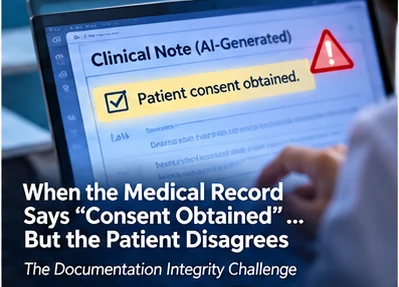
The Sharp allegation connects privacy to documentation integrity. The patient disputes consent, while the chart reportedly says consent occurred. A later reviewer therefore needs to ask how that sentence entered the record. [S05]
Several explanations must remain open until the evidence resolves them. A clinician may have entered the statement after a discussion the parties remember differently. Staff may have recorded an acknowledgement. A template may have supplied the sentence. Software may have generated it from an ambiguous exchange. More than one component may have contributed.
The clinical note cannot be treated as self-validating merely because it contains a consent sentence. Equally, a patient's disagreement does not by itself prove fabrication. The useful evidence includes the disclosure given, its timing and language, the patient's response, the recording start time, the template in use, and the people or systems that created and changed the statement.
This is an authorship question with legal consequences. A physician reviewing a note for symptoms, medications, and follow-up may also be authenticating assertions about events such as consent, counseling, examination, or refusal. Those assertions deserve verification on their own terms.
Microsoft documentation shows why templates belong in the inquiry
A still-public older Microsoft Support guide describes adding standard statements to Dragon Copilot or DAX Copilot notes. Its customizable-template example begins:
Add this statement of patient recording consent unless I say not to include it
The example then supplies a sentence asserting patient consent. The guide also describes inserting static text during transfer to the electronic record. Administrators can prepare templates, but the guide says users must elect to use the customizable template. [S14]
This is a documented configuration example, not evidence of a universal default, spontaneous AI fabrication, or the configuration used by any litigation defendant. The page directs readers to a newer template guide, which does not contain that consent example in the text reviewed. Microsoft's current introductory instructions separately require consent before recording. [S14–S16]
The practical implication is straightforward: a system can reliably reproduce an attestation without independently establishing the event it attests to. Hospitals should connect legally consequential statements to a verifiable encounter action. An unverified template assumption can produce a false record even when speech recognition and language generation perform exactly as configured.
What DAX and Dragon Copilot actually do
Dragon Medical One dictation, ambient capture, generative documentation, and structured clinical suggestions are different functions. Microsoft introduced Dragon Copilot by bringing dictation and DAX's ambient capabilities into a combined experience. The mode, release, integration, and local settings determine which functions a clinician actually uses. Dictation after a visit does not record the patient's conversation; dictation into a generative workflow can still produce transformed draft text. [S09, S16]
| Function | What the public documentation describes | What still requires verification |
|---|---|---|
| Ambient capture | Recording an encounter for draft documentation. | Consent, participants, recording boundaries, and the deployed workflow. |
| Diagnosis generation and Epic reconciliation | Generating assessment-and-plan diagnoses from audio and comparing them with Epic visit diagnoses. | Whether a particular statement came from speech, chart context, normalization, or unsupported inference. |
| Diagnosis specificity suggestions | Suggestions with supporting rationale that users can accept, dismiss, or ignore; no automatic note change in that documented feature. | Local availability and whether a different integrated workflow has additional completion requirements. |
| Proposed orders | Potential orders drawn from the transcript, with availability and EHR integration depending on configuration. | Whether an intention was current, conditional, retracted, or actually authorized. |
Microsoft's diagnosis-retrieval documentation describes retaining generated diagnoses in one mismatch scenario. Its FAQ within that page also says that, without Epic visit diagnoses, the assessment and plan uses diagnoses spoken in the recording. These qualifications matter: the documentation establishes functionality, not that every generated label is an unsupported new diagnosis. [S10–S12, S16]
Clinical summarization can legitimately normalize terminology. The safety question arises when a summary changes clinical meaning: a possibility becomes a confirmed diagnosis, a discussion becomes an order, or another person's history becomes the patient's condition. These are illustrative failure modes to test, not reported findings about the named defendants.
Heard in Visit and the meaning of accepting or rejecting a suggestion
Epic's public data specification describes ambient-detected diagnoses, alternative diagnostic labels, relative confidence rankings, and grouping within its Heard In Visit Recording workflow. That establishes a structured integration capability. It does not establish a particular clinic's configuration, the completeness of its audit trail, or a universal requirement to reject every suggestion before signing. [S13]
This distinction matters when a physician reports being required to disposition suggested diagnoses. The institution should demonstrate the exact workflow using a synthetic encounter: what arrives, what can be edited or discarded, what blocks completion, what the action labels mean, and what survives in the record.
A rejected draft can mean that an item was duplicated, misattributed, insufficiently specific, irrelevant to that encounter, or clinically considered and declined. Those are different events. A later investigator should not infer that a physician ruled out a disease merely because an interface records a rejection.
At the same time, software origin does not make a clinically important finding irrelevant. A physician's response should depend on the actual patient evidence and the information reasonably available. Accountability requires enough context to distinguish document cleanup from a clinical decision.
A useful design would separately identify discarding draft text, correcting source attribution, declining unsupported specificity, and rejecting a clinically considered recommendation. That is a proposed safeguard, not a description of controls available in every current product.
Recording consent and permitted data processing are different legal questions

California Penal Code section 632 generally prohibits intentional electronic recording or eavesdropping on a confidential communication without all parties' consent. The circumstances must support the required expectation of confidentiality, and statutory elements and exceptions still matter. The statute does not establish a universal requirement for a separate signed paper consent form. The adequacy and proof of consent depend on what was communicated and agreed to. [S21]
For a clinical workflow, a defensible consent process should explain the recording and relevant processing before capture begins, identify the patient's choice, and address interpreters or other participants. A notice displayed somewhere in a registration system should be evaluated for what it actually conveyed, when, and in a language the patient understood. These are recommended evidentiary controls, not a claim that section 632 prescribes this exact checklist.
HIPAA permits many treatment, payment, and healthcare-operations uses without a separate patient authorization. California's Confidentiality of Medical Information Act also contains exceptions, including specified medical-data-processing and administrative services. An outside vendor is not automatically an unlawful recipient. Its role, permitted purposes, safeguards, and onward uses require examination. [S23–S25]
A business associate agreement addresses permitted handling of protected information. Its existence does not prove consent to recording. HHS explains that more protective state privacy provisions can continue to apply. Similarly, a physician's later signature does not, by itself, prove what the patient agreed to before recording began. [S21, S24, S26]
Section 637.2 permits statutory recovery without proof of actual damages and provides the greater of $5,000 per violation or three times actual damages, if any, when the necessary legal requirements are established. This does not make an award automatic for every recorded visit. Federal standing is a separate issue; the Supreme Court's TransUnion decision requires concrete injury, while recognizing that certain intangible harms can qualify. A privacy claim need not be a malpractice claim alleging physical injury. [S22, S32]
The signed record can outlast the explanation of how it was created
Consider four hypothetical errors that a deployment should be tested against:
| Encounter event | Incorrect record that must be caught |
|---|---|
| A patient declines a discussed medicine. | The plan instructs the patient to begin it. |
| A clinician discusses a possible condition pending evaluation. | The condition appears as established. |
| A relative describes their own medical history. | The history is assigned to the patient. |
| The patient has not consented to recording. | A standard statement asserts that consent occurred. |
These examples do not estimate an error rate. They explain why a polished note can still require close review. Each changes a fact a later clinician, coder, patient, or investigator might rely on.
Correction should be proportionate to where the error traveled. A narrative correction may be insufficient if the same unsupported assertion entered a structured diagnosis, an order, a referral, or an after-visit summary. An organization should determine which destinations actually received it and correct those records through authorized processes.
California's existing record duties already matter. The Medical Board identifies Business and Professions Code section 2266's requirement for adequate and accurate records and Civil Code section 56.101's protections for the integrity of electronic records and their changes. The Board also identifies Penal Code section 471.5, which concerns false or altered medical records made with fraudulent intent. An AI error alone does not establish that intent. [S27]
Physician responsibility therefore supports meaningful review, while institutional responsibility includes providing a workflow in which review and correction can be performed. Neither a signature nor an employer's technology mandate should be treated as a complete analysis of who controlled a particular failure.
Privacy assurances and retention promises need precise wording
Microsoft's privacy white paper, updated November 12, 2026, describes cloud processing of encounter data and clinician review. It says selected customer data enters a research environment and is anonymized within 90 days; resulting anonymized data is used to improve Dragon Copilot and its models. It describes limited, controlled human access for specified purposes. For a consent-revocation request, it describes purging identifiable linked data while retaining previously created anonymized data. These are Microsoft's representations, not findings from an independent audit. [S17]
Accordingly, an institution should avoid assurances that no information is ever retained, no human can ever access it, or no data is used for model improvement. Its patient explanation should match the applicable contract and actual configuration.
Microsoft's FAQ describes retention of audio, recognized text, transcripts, and flowsheet data for up to 90 days. Its November 6 use-cases paper says Dragon Copilot is not the medical-record repository and assigns customers responsibility for exporting and preserving relevant records. That commercial allocation does not itself decide every legal duty or determine whether a disclaimer is enforceable. [S18, S19]
The governance problem is a mismatch between the lifespan of a signed statement and the lifespan of its supporting material. Organizations should establish lawful, proportionate retention and preservation procedures before a dispute arises. A legal hold, an access request, and routine deletion are distinct processes. Preserving evidence should occur through authorized channels with privacy protections, not through personal copies of patient audio.
A separate DAX case concerns access to the source recording
DAX has appeared in a different kind of courtroom dispute. In Raphael v. Mantei, the American Medical Association reports that a Washington trial court treated DAX encounter audio as an administrative aid under that state's patient-access law in an August 7, 2026 ruling. The patient had sought a preliminary injunction. The AMA and state medical organizations participated as amici supporting the clinic. The complete order was not independently obtained for this article. [S33]
That reported result deserves attention alongside the California allegations. It concerns access to underlying audio, not whether the California defendants obtained consent. It does not establish a nationwide exemption from HIPAA, discovery, or preservation obligations.
It also sharpens a practical question: if a patient or physician challenges the accuracy of a generated statement, what evidence is available to test it? A system should be designed with that dispute in mind, even when a particular access statute does not require delivery of every intermediate recording.
California changes the framework on January 1 2027
Two enacted laws are particularly relevant to this article. Their ordinary effective date is January 1, 2027; they should not be described as already governing November conduct or as having adjudicated the pending lawsuits. [S28–S30, S36]
AB 1637, Chapter 536, adds Business and Professions Code section 2266.1. It places responsibility for patient notes, after-visit summaries, and diagnosis and treatment plans on the physician regardless of setting. It restricts alteration by others while recognizing specified delegated-authority, transfer-of-care, and supervision circumstances. It does not categorically prohibit AI or declare that physicians alone bear every form of liability. [S28]
AB 1979, Chapter 854, adds section 22758.5. It requires covered settings to take reasonable steps to preserve licensed professionals' independent judgment when clinical decision support informs care. It restricts AI independently performing functions legally reserved to licensed professionals and directing unlicensed personnel in such functions. It expressly excludes documentation and communication that do not apply professional judgment. [S29, S34]
The inquiry is therefore functional. Does the software organize an already-made decision, offer a reviewable clinical recommendation, or effectively determine an action? What can the practitioner see, change, decline, and independently assess? The product name alone cannot settle that analysis.
AB 2575's proposed protections should be kept out of descriptions of enacted law: that bill was vetoed. Preserving professional judgment under an enacted statute should not be inflated into a universal immunity for accepting or overriding AI. [S35]
The Medical Board's full quarterly meeting is scheduled for November 19-20, with AB 1637 and AB 1979 implementation discussions on November 20 under Items 12A and 12C. Those are scheduled proceedings, not completed Board actions. [S30]
Human review must be a workable clinical process

Microsoft states that Dragon Copilot supports qualified professionals and excludes autonomous clinical decision-making or substitution for professional judgment from its supported uses. That is a substantial answer to a claim that the product is intended to practice medicine independently. Review and editing are part of the documented design. [S19]
The next question is whether the deployed process delivers those safeguards. A reviewer needs to identify significant generated assertions, see relevant supporting context, correct them, and complete the encounter without adopting an unsupported clinical conclusion. Training should explain what a displayed recommendation means and what accepting, dismissing, or ignoring it actually does.
An organization can assess this with synthetic encounters and a controlled workflow review. Test negations, changed plans, uncertain diagnoses, multiple speakers, and consent language. Measure total review and correction work as well as note-generation speed. Check whether a correction reaches structured fields and patient-facing documents. Evaluate important updates against the functions they add.
Language access deserves its own assessment. A clinician working through an interpreter needs to know whose words were captured and how they were attributed. An ambient scribe should not be assumed to replace a qualified interpreter; Microsoft's use-cases paper excludes use as a translation or interpretation service. [S19]
Benefits should also be measured fairly. A randomized trial of 238 physicians compared DAX Copilot, Nabla, and usual care during November 2024-January 2025. DAX did not significantly reduce time spent writing notes relative to control; Nabla did. Both showed potential improvements in some clinician-reported workload and well-being measures, and clinicians reported occasional significant inaccuracies. Those findings concern the products and workflows studied, not every later diagnosis-aware release. [S20]
What a credible institutional response should demonstrate
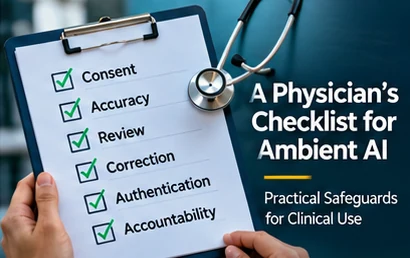
The strongest defenses are factual and deserve examination. An organization may show valid consent, permitted vendor processing, effective human review, and a record that accurately reflects the encounter. A critic should test those propositions rather than assuming that AI use proves a violation.
| Explanation offered | Evidence that would make it assessable |
|---|---|
| The patient consented. | The actual disclosure, timing, language, acknowledgement, and relationship to the recording start. |
| The vendor processed data lawfully. | Applicable agreements, data flows, access controls, purposes, retention, and onward-use restrictions. |
| The clinician remained in control. | Enabled functions, visible sources, edit and decline controls, training, and realistic review time. |
| The signed note is accurate. | Material drafts and edits where available, source attribution, final adoption, and correction history. |
| The source audio is only administrative. | The actual uses of the audio and the specific access, retention, and preservation rules being invoked. |
For institutions and vendors, this means being able to explain the process with evidence. For physicians, it means reviewing consequential assertions and reporting reproducible problems. For patients, it means a clear explanation of recording and a practical way to raise a concern about the resulting record. For regulators, it means examining the distribution of control as well as the final signature.
The policy request is concrete: require demonstrable consent processes, traceable material clinical assertions, effective correction across the record, meaningful professional control, and proportionate evidence preservation. These are proposed governance standards. The unresolved lawsuits do not already impose this entire framework.
Ambient AI can help clinicians document care. Its legitimacy depends on whether the private encounter, the generated text, and the authenticated clinical decision remain distinguishable and accountable. When a record is challenged, the institution should be able to show how it was made.
Where this continues on the site
- Who Owns the Decision?
- When the AI Scribe Starts Shaping the Medical Record
- UNFAITHFUL: Clinical Judgment’s Illicit Affair With Artificial Intelligence
- Dragon Copilot 6.0 and the Next Test of Record Transparency
- The November AI Accountability Turn
- California's next AI oversight discussion: the Medical Board's records and AI items
- Litigation docket: what a court has actually decided
Topics: Sutter Health AI lawsuit · ambient AI scribe · patient recording consent · Nuance DAX · Microsoft Dragon Copilot · Epic Heard in Visit · California medical records · physician accountability
Source register
Sources reviewed November 13 2026 Pacific. Review date does not certify that a docket snapshot contains later filings. Docket reproductions, party allegations, vendor statements, research, statutes, and commentary retain their different evidentiary status. Entries S37–S43 were added on the evening of 13 November 2026 when the court records were retrieved.
- [S01] Washington v Sutter Health docket. Court docket reproduced by Justia; snapshot retrieved September 16 2026; entries 1, 32-36, 43-44. Operative amended complaint text not independently obtained.
- [S02] Original Washington complaint with court filing stamp. Primary pleading copy hosted by Alston and Bird; filed April 8 2026. Historical allegations, superseded by amendment.
- [S03] Matulic v Memorial Health Services docket. Court docket reproduced by Justia; snapshot retrieved October 1 2026. Separate complaint text not independently obtained.
- [S04] Saucedo v Sharp official court index. San Diego Superior Court; confirms filing, case number and parties; does not establish current merits disposition.
- [S05] KPBS report on Sharp allegations. December 11 2025. Secondary reporting on complaint allegations, including disputed documentation of consent; not a court finding.
- [S06] Sutter litigation tracker. Secondary tracker; its review date is October 28 2026. Not a replacement for a complete current docket.
- [S07] Privacy tracker reporting October 6 submission. Secondary commercial tracker. Used only to identify a reported procedural event whose court entry was not independently retrieved.
- [S08] Sharp litigation tracker. Secondary tracker; reviewed October 28 2026. Reports October 23 minute order without its outcome and a January 22 2027 conference.
- [S09] Microsoft introduction of Dragon Copilot. March 3 2025. Vendor description of product lineage.
- [S10] Microsoft diagnosis retrieval from Epic. Updated August 3 2026. Vendor description of diagnosis generation, matching, exceptions and configuration requirements.
- [S11] Microsoft diagnosis specificity suggestions. Vendor description; accept, dismiss or ignore in the documented feature. Does not establish every Epic workflow.
- [S12] Microsoft management of proposed orders. Vendor description; regional and configuration limits apply.
- [S13] Epic EHI specification for received diagnoses. Primary technical schema; ambient diagnosis fields and Heard In Visit Recording grouping. A schema is not a deployment audit.
- [S14] Microsoft older standard-statement guide. Still-public earlier-view guide, sections on static insertion and customizable templates. Configurable example, not universal default or evidence about defendants.
- [S15] Microsoft newer template guide. Successor linked by S14. No consent example in the retrieved text; no inference about when or why it changed.
- [S16] Microsoft Dragon Copilot overview. Vendor instructions requiring consent before encounter recording and describing post-encounter recording as an alternative.
- [S17] Microsoft privacy white paper. Updated November 12 2026. Vendor representations concerning data processing, anonymization, model improvement, human review and revocation.
- [S18] Microsoft data retention FAQ. Updated July 27 2026. Describes up-to-90-day retention for specified data categories.
- [S19] Microsoft use-cases white paper. Updated November 6 2026. Intended use, unsupported autonomous and interpretation uses, and customer preservation responsibilities.
- [S20] Lukac and colleagues randomized trial. NEJM AI, November 26 2025, DOI 10.1056/aioa2501000. Primary research; 238 physicians; study use November 2024-January 2025.
- [S21] California Penal Code section 632. Statutory text reproduced by Justia; confidential communications, recording and consent.
- [S22] California Penal Code section 637.2. Statutory text reproduced by Justia; civil remedies and actual-damages provision.
- [S23] California Civil Code section 56.10. Statutory text reproduced by Justia; disclosure restrictions and exceptions, including subsection (c)(3).
- [S24] HHS business associates guidance. Federal agency guidance on protected information and business-associate arrangements.
- [S25] HHS treatment payment and operations guidance. Federal agency explanation of 45 CFR 164.506.
- [S26] HHS explanation of more protective state law. Federal agency guidance on concurrent obligations and preemption.
- [S27] Medical Board AB 1637 staff analysis. Primary premeeting staff analysis; existing record duties, authorized edits and jurisdiction. Not an adopted adjudication of AI legality.
- [S28] AB 1637 final chaptered text. Chapter 536, approved September 27 2026; statutory text reproduced by LegiScan. Adds BPC 2266.1.
- [S29] AB 1979 final chaptered text. Chapter 854, approved September 30 2026; statutory text reproduced by LegiScan. Adds BPC 22758.5 and includes its subsection (d) exception.
- [S30] Medical Board November 19 and 20 agenda. Primary schedule; November 20 Items 12A and 12C. Schedule subject to change.
- [S31] Federal Rule of Civil Procedure 12. Rule text reproduced by Cornell Legal Information Institute.
- [S32] TransUnion LLC v Ramirez Supreme Court opinion. June 25 2021. Primary opinion on concrete injury and standing; not an ambient-AI decision.
- [S33] AMA account of Raphael v Mantei. September 10 2026. Account by a participating amicus organization; reported August 7 trial-court ruling. Full order not independently obtained.
- [S34] Medical Board AB 1979 staff analysis. Primary premeeting analysis; distinguishes permitted physician use of AI, professional judgment, and separate privacy requirements.
- [S35] Governor veto message for AB 2575. Primary veto message; the bill's proposed protections were not enacted through this measure.
- [S36] California Secretary of State bill chapter explanation. Official explanation of ordinary effective dates. Read with the final chaptered texts and their absence of a special effective-date provision.
- [S37] Washington v. Sutter Health docket, RECAP archive. Court docket reproduced by CourtListener from PACER; last updated 5 November 2026, last known filing 3 November. Entries 35–47 read 13 November 2026, including the 6 October clerk's notice (Dkt. 45). Added 13 November 2026, evening.
- [S38] Washington v. Sutter Health, PACER docket report. Primary court record: U.S. District Court, N.D. Cal., CM/ECF docket report for 4:26-cv-03012-HSG, entries filed since 1 October 2026, retrieved at 8:49 pm Pacific on 13 November 2026. Shows Dkt. 45–47 and no later entry. PACER access requires an account. Added 13 November 2026, evening.
- [S39] Sutter Health motion to dismiss under Rule 12(b)(1) (Dkt. 35). Party filing, 19 August 2026, copy from the RECAP archive. Sutter's arguments and declarations; not findings. Added 13 November 2026, evening.
- [S40] Plaintiff's opposition to the Rule 12(b)(6) motion (Dkt. 39). Party filing, 2 September 2026, copy from the RECAP archive. The plaintiff's arguments; not findings. Added 13 November 2026, evening.
- [S41] Matulic v. Memorial Health Services complaint (Dkt. 1). Primary pleading, filed 6 August 2026, copy from the RECAP archive. Allegations only; identifies Abridge AI, Inc. as the service supplier and names two MemorialCare entities and Does as defendants. Added 13 November 2026, evening.
- [S42] Matulic v. Memorial Health Services, PACER docket report and Dkt. 17. Primary court record: N.D. Cal. CM/ECF docket report for 3:26-cv-08206-WHO, entries since 15 September 2026, and the 13 November stipulation and proposed order (Dkt. 17), retrieved at 8:49 pm Pacific on 13 November 2026. A proposed order is not an order. Added 13 November 2026, evening.
- [S43] H.R. v. Allegheny Health Network and Highmark Health. Secondary report hosting the complaint, Court of Common Pleas of Allegheny County, Pennsylvania; lists case GD-26-010882 and a 3 November 2026 filing date. Allegations only; the court's own docket was not reviewed. Added 13 November 2026, evening.