The Rural Health Transformation Program, created by Public Law 119-21, provides $50 billion over five years, $10 billion a year from 2026 through 2030. CMS announced awards to all 50 states on December 29, 2025 (CMS). The program's first budget period ran from December 31, 2025, to September 30, 2026 (U.S. Chamber of Commerce), and the final week of that period brought a burst of state announcements.
Added 10 November 2026 · funding award
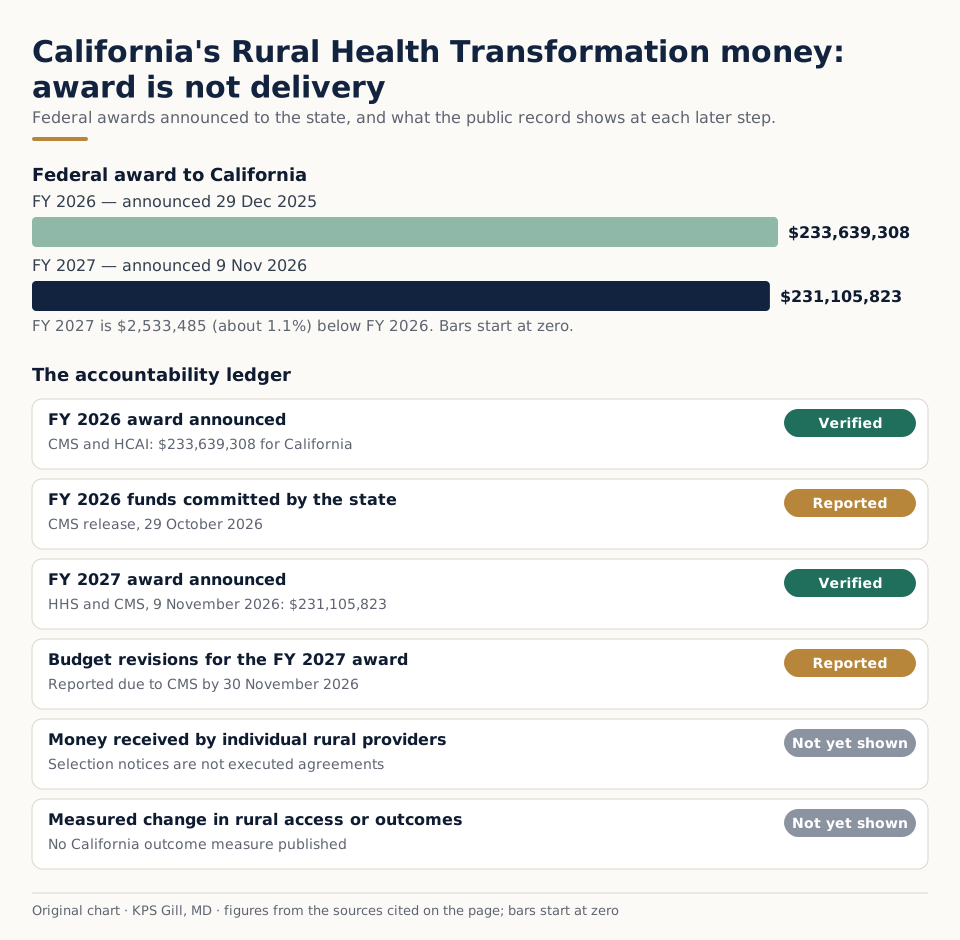
The second-year award: $231.1 million for California
On 9 November 2026, HHS and CMS announced California's fiscal-year 2027 award: $231,105,823, about 1.1% below the fiscal-2026 award of $233,639,308. CMS said on 29 October that California had committed its full fiscal-2026 funding. Neither statement shows money received by a particular rural provider or a change in access. Sources and analysis.
October 10, 2026 edition · Developments from September 25 to October 10
Latest record
Published · Source published · Event
A CalRHT selection notice is not yet an executed grant
HCAI’s late-September FAQ explains the steps between an announcement and payment.
HCAI’s grant-notification FAQ distinguishes conditional selection, continued consideration, required modifications and non-selection. A conditional selection becomes a final award only when the subrecipient agreement is executed. The FAQ also says pre-agreement expenses are not eligible for reimbursement and directs applicants to their individual notifications for required responses.
California’s published federal fiscal-year 2026 CalRHT award is about $233.6 million. That statewide figure does not identify a Fresno award or show that all funds have reached local providers. Applicants should check their grants-system notices, complete stated conditions and retain the executed agreement before treating funds as available. The next listed Rural Health Policy Council meeting is October 27.
Sources: HCAI: CalRHT grant-notification FAQ; HCAI: California Rural Health Transformation
Awards announced · Source published · Event
HRSA announces $89.3 million for rural addiction services
The September 25 awards support treatment, overdose response, planning and technical assistance.
HRSA announced $89.3 million through the Rural Communities Opioid Response Program for communities in 45 states and one territory. The published components are $62.7 million for RCORP-Impact, $12.6 million for overdose response, $10 million for technical assistance and $4 million for planning.
These awards concern service capacity and implementation. They do not by themselves demonstrate improved outcomes or identify a Fresno recipient. Local coverage should follow the award-recipient list, intended population and service-start information before describing a new treatment option as available nearby.
Sources: HRSA: Rural addiction-treatment and recovery awards
Funding and implementation announcements · Source published · Event 2026-10-07 through 2026-10-09
New rural-health announcements show different stages of implementation
North Carolina, Louisiana and Iowa describe different uses and funding stages.
CMS announced more than $17 million for rural North Carolina behavioral-health services on October 7, including clinics, medication access, mobile crisis teams and early or perinatal support. On October 9 it described $37.7 million for Louisiana workforce education, recruitment, retention and career pathways. A separate Iowa announcement described commitment of the state’s $209 million and early implementation involving technology and clinical services.
These are useful comparisons for California’s CalRHT coverage, but the amounts are not directly additive evidence of new national funding. Some announcements describe components of previously allocated state totals. Compare an allocation, an executed award, a commitment, an expenditure and a measured service outcome as separate stages. None of these out-of-state announcements establishes Fresno service availability.
Sources: CMS: North Carolina rural behavioral-health investment; CMS: Louisiana rural workforce funding; CMS: Iowa rural health implementation
California
Primary recordCalifornia's fiscal year 2026 award is $233,639,308.46, administered by the Department of Health Care Access and Information through its CalRHT program; the notice of award is dated February 27, 2026 (HCAI). A March 2026 budget notice to the Legislature states that federal guidance requires the entire award to be encumbered, or legally committed, by October 30, 2026 (Joint Legislative Budget Committee). HCAI's Accelerator Partner grants carry an $8 million award ceiling for federal fiscal year 2026–27 and are paid on milestones (HCAI).
AnalysisThe questions for California are whether HCAI commits the full $233.6 million by October 30, how much reaches San Joaquin Valley providers, and what happens to any amount not committed. This tracker will record each California sub-award as it is announced, with a separate panel for Valley counties.
Recent state announcements
| State | Amount announced | Date | Purpose | Source |
|---|---|---|---|---|
| Colorado | $169,587,181 to 91 grantees (of a $200,105,604 fiscal year 2026 award) | September 28, 2026 | Telemedicine, mobile care, behavioral and maternal health, specialty care, workforce, records modernization; a prehospital whole-blood network reaching 39 counties. 112 applicants sought $250 million for 368 projects | Colorado Governor; Colorado Sun |
| Montana | $8.7 million | September 2026 | Rural EMS: ambulances, cardiac monitors, ventilators, transport systems | CMS |
| North Carolina | $1.25 million for children's preventive, acute and behavioral care, building on $10 million earlier | September 2026 | Fiscal year 2026 total award $213,008,356 | Fierce Healthcare tracker |
| New Mexico | $74 million | September 2026 | — | Fierce Healthcare tracker |
| Missouri | More than $45 million | September 2026 | — | Fierce Healthcare tracker |
| Hawaii | $58 million | September 1, 2026 | — | Fierce Healthcare tracker |
| Arkansas, Connecticut, Delaware, South Carolina, Texas | — | September 2026 | Named in CMS's September 30 roundup | Health IT Answers |
| California | $233,639,308.46 award; sub-awards to be listed as announced | Commitment (encumbrance) deadline October 30, 2026, per the March 2026 Joint Legislative Budget Committee notice | CalRHT | HCAI; JLBC |
How to read this tracker
Each state moves through five stages: awarded, notice of award, sub-awards announced, encumbered, disbursed. An announcement is not a payment. Amounts are shown only when a state or CMS release, or a named trade source, reports them, and the source is listed in the row.
Why it matters in the Valley
AnalysisWith the Kern County medical-school study and the community-college nursing degree pilot both vetoed in September 2026, rural-transformation money is now the main new public lever on physician and nursing supply in the San Joaquin Valley.