Published
Sources read 9–10 November 2026 · prepared with AI assistance; physician review of this update has not yet been recorded
Four federal actions and one surveillance milestone arrived between 3 and 9 November 2026. They share a theme worth stating plainly: Washington is changing how medicine is paid, which protections are mandatory and how program money is distributed, while the public record of what those choices produce in clinics and rural communities lags behind. This update records each development once, with its legal status, and links it to the pages on this site that already follow the subject. It supplements the 7 November issue, which remains the current Weekly issue.
Each item carries one of five labels. A final rule is law on its effective date. A proposed rule is not law. A funding award is a federal decision to make money available, not proof of payments or results. Surveillance data are preliminary counts that are revised. A civil settlement resolves allegations without a finding of liability.
| Date | Development | Legal status | Does not establish |
|---|---|---|---|
| 4 Nov | 2027 Medicare Physician Fee Schedule | FINAL RULE | That any given practice's revenue falls by the same percentage |
| 4 Nov | Medicare provider-enrollment and revocation changes | FINAL RULE | That any provider has been revoked |
| 5 Nov | CMS CARE proposal on participation requirements | PROPOSED RULE | Any change in effect today |
| 5 Nov | Medicare drug price negotiation, 2029 onward | FINAL RULE | Any new negotiated price |
| 6 Nov | 5,182 U.S. measles cases as of 5 November | SURVEILLANCE DATA | A final 2026 total |
| 6 Nov | Quest and Lab Genomics kickback settlements | CIVIL SETTLEMENT | Liability |
| 9 Nov | California's second Rural Health Transformation award | FUNDING AWARD | Money received by rural providers |
The 2027 physician fee schedule: a lower base, a new way to pay for complexity
Final ruleEffective 1 January 2027
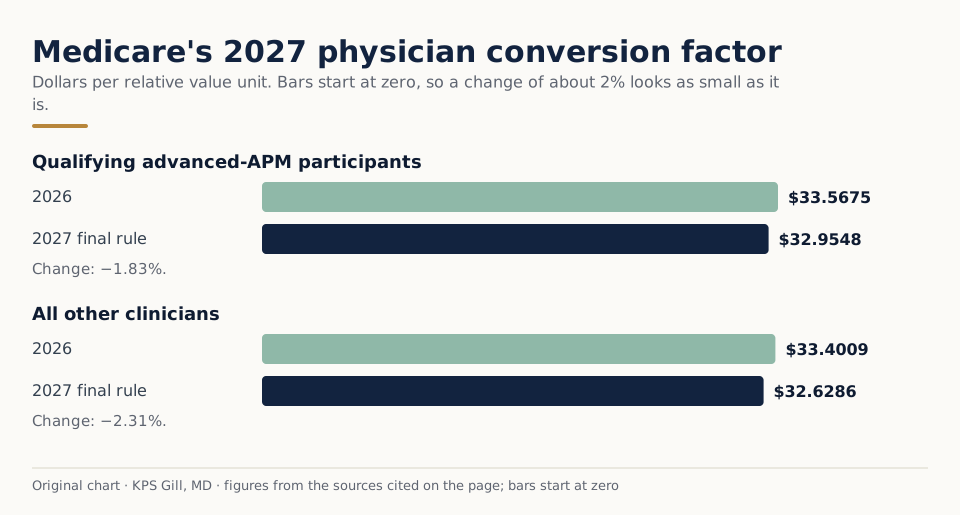
CMS released the calendar-year 2027 Medicare Physician Fee Schedule final rule on 4 November 2026. The conversion factor — the dollar amount that turns relative value units into payment — falls for both of the statutory tracks. For clinicians who qualify through an advanced alternative payment model it moves from $33.5675 to $32.9548; for everyone else, from $33.4009 to $32.6286. Computed from those published factors, the reductions are 1.83% and 2.31%. The final cut is deeper than the July proposal, and the principal reason is arithmetic rather than policy: the one-year 2.5% statutory increase that applied in 2026 has expired. [1, 2, 3]
The more consequential change for primary care is structural. The office-visit complexity add-on, G2211, becomes a modifier. Modifier B1 increases payment for the associated evaluation-and-management visit by 16%. Modifier B2 increases it by 32%, but only for clinicians in Medicare Shared Savings Program accountable care organizations or the new Long-term Enhanced ACO Design model; using it is voluntary, and it can be billed for eligible fee-for-service visits whether or not the patient is assigned to the ACO. The same visit can therefore be paid at two different rates depending on the practice's ACO participation. [4, 3]
Remote monitoring changes as well. The final rule keeps requirements tied to an initiating visit but delays, to 2029, the restriction on payment for monitoring furnished by contracted rather than practice-employed staff — a material reprieve for practices that rely on outside monitoring vendors. [3]
- Established by the record
- The 2027 conversion factors, the B1 and B2 percentages, and the effective date of 1 January 2027.
- Not established
- What any individual practice will receive. Revenue depends on its service mix, locality, ACO participation, the payer mix outside Medicare, and whether commercial and Medicare Advantage plans recognize B1 and B2.
- Analysis
- For a primary-care group, the ACO decision is now partly a fee-schedule decision. A practice weighing B2 should model shared-savings effects with its ACO before treating the higher modifier as free revenue, and should update charge masters and billing rules before 1 January. Congress, not CMS, controls the conversion factor's underlying update; the cut is a policy choice only in the sense that Congress has not acted.
Further reading on this site: who decides what Medicare pays a physician and remote patient monitoring and the evidence gap.
California's second rural-health award: $231.1 million, and what it does not prove
Funding awardAnnounced 9 November 2026
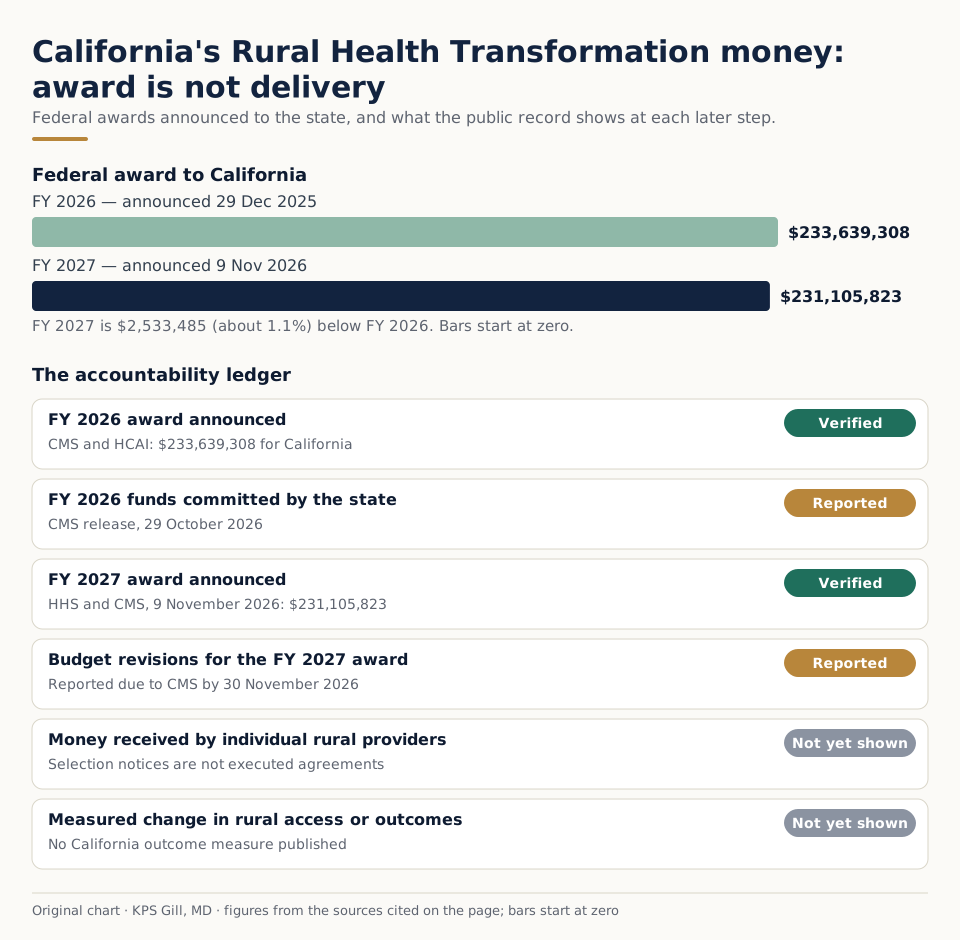
On 9 November 2026, HHS and CMS announced $10 billion in second-year Rural Health Transformation awards to all 50 states. California's fiscal-year 2027 award is $231,105,823. Its first-year award, announced on 29 December 2025, was $233,639,308, so the new figure is $2,533,485 — about 1.1% — lower. Half of each year's $10 billion is divided equally among the states; CMS allocates the other half using factors that, for year two, included states' annual progress reports and specified state policy actions. With these awards, $20 billion of the program's $50 billion has been awarded. [5, 6, 8]
The announcement came after the statutory planning date: CMS had been expected to set fiscal-2027 amounts by 31 October and told states of a delay on 30 October. State budget revisions tied to the new allocations were reported as due to CMS by 30 November. Separately, CMS said on 29 October that California had committed its full fiscal-2026 funding. [9, 7]
- Established by the record
- The two federal award amounts and their announcement dates.
- Not established
- That any particular Fresno or Central Valley provider has received money, or that rural access, workforce or outcomes have changed. A state selection notice is not an executed grant agreement, and an executed agreement is not yet a payment.
- Analysis
- The useful public question is no longer the size of the award but the path of each dollar: from federal award, to state commitment, to executed sub-award, to disbursement, to a measured change in access. The ledger above is kept in that order so that each step can be marked only when a record shows it.
The running California record, including state sub-awards and a Central Valley panel, is on the Rural Health Transformation tracker.
The CARE proposal: administrative savings against mandatory safeguards
Proposed ruleNot in effect
On 5 November 2026, CMS released a proposed rule titled Cutting Administrative Requirements for Excellence in Patient Care. It follows a review of the Conditions of Participation and related requirements for 21 provider and supplier types and proposes to remove or revise requirements CMS describes as obsolete or excessively burdensome. CMS estimates $320 million in savings and more than 3.26 million hours of staff time returned to providers. Reported provisions include rollbacks affecting hospital emergency and obstetric-care requirements adopted under the previous administration and the removal or narrowing of respiratory-illness data reporting, with requests for information on transplant programs and anesthesia supervision. Comments are due 60 days after Federal Register publication, which was scheduled for 10 November 2026 — that is, on or about 9 January 2027. [10, 11, 12]
- Established by the record
- That the proposal exists, its stated scope, CMS's own savings estimate and the comment window.
- Not established
- That any requirement has been removed. Nothing in a proposed rule changes what a hospital must do today, and the final rule may differ.
- Analysis
- The test for each provision is not whether paperwork is burdensome — much of it is — but whether the requirement prevents a harm that would otherwise go unmeasured. Obstetric emergency readiness is the clearest case: the events it addresses are rare in any one hospital, which is exactly why a voluntary standard tends to erode. A savings estimate counts staff hours; it does not count the cost of a readiness failure. Comments that pair a specific provision with the specific harm it guards against will carry more weight than general support or opposition.
Measles: 5,182 confirmed cases, the most since 1991
Surveillance dataPreliminary
CDC's update of 6 November 2026 reported 5,182 confirmed measles cases in the United States in 2026, as of 5 November — 330 more than the 4,852 reported a week earlier, and more than double the 2,289 cases confirmed in all of 2025. Reported details: 562 people hospitalized (about 11%); 43 outbreaks this year; about 96% of cases in people who were unvaccinated or whose status was unknown; 908 cases in children under five. CDC counted four measles-associated deaths in 2026, a figure below the number reported by state health departments. [13, 14, 15]
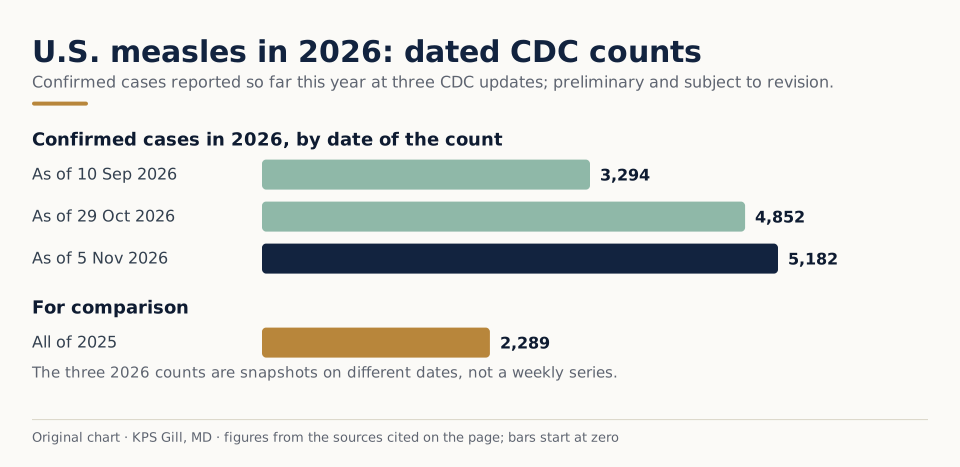
The earlier count published on this site — 3,294 cases in CDC's update of 10 September 2026 — remains on its dated record as a snapshot. The new count has its own record, and the outbreak state page carries both.
- Established by the record
- The count, its date, and the reported hospitalization and outbreak figures, as CDC published them.
- Not established
- The final 2026 total, the true number of deaths (the federal and state tallies differ), or any change to the childhood immunization schedule.
- Analysis
- For a primary-care office the actionable steps are unchanged and well established: check MMR status at routine visits, recognize the prodrome of fever, cough, runny nose and red eyes before the rash, and call ahead so that a possibly infectious patient does not wait in a shared room. Exposure assessment and post-exposure options are time-sensitive and belong with the local health department.
Patients and families: understanding immunizations.
Medicare drug price negotiation moves from guidance to regulation
Final rule
On 5 November 2026, CMS issued a final rule (CMS-4215-F) that codifies the Medicare Drug Price Negotiation Program for the fourth negotiation cycle — initial price applicability year 2029 — and later years, writing into regulation policies that earlier cycles ran through annual guidance. Selection and negotiation under the rule occur in 2027 for prices effective in 2029; CMS's timeline sets 31 October 2027 as the deadline for manufacturers to accept or reject a final offer and 1 November 2027 as the end of the negotiation period. Reporting describes added policies on fixed-combination drugs and a small-biotech price floor. [16, 17]
- Established by the record
- The rule's existence, its scope (2029 onward) and CMS's published 2027 negotiation milestones.
- Not established
- Any new negotiated price, or how pending litigation over the program will resolve.
Provider enrollment: broader revocation authority, inside a home-health rule
Final rule
The calendar-year 2027 Home Health Prospective Payment System final rule, released 4 November 2026, carries Medicare provider-enrollment provisions that CMS says apply to most enrolled provider and supplier types, not only to home health. They expand grounds and effective dates for denial and revocation of Medicare enrollment, add requirements concerning owners and managing organizations, and extend scrutiny of ownership changes for home health, hospice and medical-equipment suppliers. [18, 19, 20]
- Established by the record
- That the provisions were finalized and that CMS describes them as applying across provider types.
- Analysis
- Enrollment is where Medicare's administrative power meets due process. Retroactive revocation can convert past payments into overpayments, so a physician group's enrollment record — owners, managing organizations, reporting of changes — is now a financial-risk document, not a clerical one. Practices should confirm that their enrollment data match their actual ownership and management before an audit asks.
Enforcement Watch: two laboratory settlements, one legal boundary
Civil settlementsNo determination of liability
Quest Diagnostics — District of New Jersey
On 6 November 2026 the U.S. Attorney's Office for the District of New Jersey announced that Quest Diagnostics paid more than $13 million to resolve False Claims Act allegations that, from 25 July 2013 to 3 August 2022, it provided entertainment tied to its New York Giants sponsorship — suite seats and team events among them — to healthcare professionals and executives to generate laboratory referrals billed to Medicare and to New York and New Jersey Medicaid. The whistleblowers will share $2,472,769. Quest entered a five-year Corporate Integrity Agreement and said it denies wrongdoing; it reported that it agreed to the settlement in 2025. The case is United States ex rel. Rabin v. Quest Diagnostics, No. 20-cv-02752 (D.N.J.). [21, 22]
Lab Genomics — Eastern District of California
Lab Genomics LLC, a Fountain Valley, California, molecular laboratory, and its co-owner agreed to pay $1,250,000 to resolve allegations that from January 2020 through September 2022 they paid three independent-contractor marketers commissions based on the volume and value of referred laboratory tests, and structured the marketers' invoices to make the commissions appear to be flat fees. The relators will receive $225,000. The qui tam action was filed in the Eastern District of California, which includes Fresno. [23]
- Established by the record
- The settlement amounts, periods, relator shares and courts.
- Allegations, not adjudicated
- Every description of what either company did. Both matters were resolved without a determination of liability, and Quest denies the allegations.
- Analysis
- The Anti-Kickback Statute makes it a crime to knowingly and willfully offer or pay anything of value to induce referrals of items or services paid for by federal health programs, and a claim resulting from a violation is a false claim. Two features recur in these cases. First, value given to referral sources — tickets, events, travel — is judged by its purpose, not its label. Second, commissions to independent contractors that rise with the volume or value of referrals fall outside the safe harbors that protect fixed, fair-market-value compensation set in advance; falling outside a safe harbor does not by itself make an arrangement unlawful, but it leaves the arrangement to be judged on its facts and intent. A disguised commission — a percentage dressed as a flat fee — is evidence of the intent the statute requires.
The matters are added to Enforcement Watch. A reported 5 November charging action in the District of Columbia could not be matched to a primary Department of Justice release in this window and is not recorded.
Credentialing: NPDB Query replaces One-Time Query on 4 December
Operational deadline4 December 2026
On 4 December 2026 the National Practitioner Data Bank releases NPDB Query, merging Individual One-Time Query and Continuous Query; it will be the only query service available. Continuous Query enrollments transfer automatically. Organizations that still rely on One-Time Query must change their workflow — the NPDB recommends moving to Continuous Query now. [24] Physicians maintaining their own files: credentialing record maintenance.
International: one medication-safety finding
Regulatory testing
Australia's Therapeutic Goods Administration reported on 5 November 2026 that laboratory testing of unapproved Synedica-branded peptide products found products that did not contain what their labels claimed — no TB-500 detected in three products and less retatrutide than labeled in another. The products had not been assessed for quality, safety or efficacy, and their place of manufacture was not approved. The TGA advised anyone who bought them not to use them. [25] The finding generalizes: an unapproved injectable bought online offers no assurance of identity, dose or sterility.
Reported elsewhere, not recorded here
The editorial brief for this week listed further items that could not be matched to a primary source between 9 and 10 November 2026. They are listed so that their absence is a decision, not an oversight; each will be recorded if and when its primary source is read.
- A 5 November District of Columbia Medicaid indictment involving youth behavioral-health billing.
- Three MHRA Innovation Passports said to have been announced on 9 November.
- A Canadian federal budget figure for mental-health, addiction and home-care agreements.
- A change in Australia's listed-medicine ingredient exclusivity period, and an Australian consultation on digital mental-health tools.
- A November phase of Singapore's health-regulatory consolidation.
- Japanese PMDA principles for the use of AI in regulatory activities, dated November.
Sources
Read 9–10 November 2026. Where a primary release could not be retrieved directly, the reporting that quotes it is cited and named as such.
- Centers for Medicare & Medicaid Services — Calendar Year 2027 Medicare Physician Fee Schedule final rule, fact sheet (4 November 2026). www.cms.gov
- American College of Cardiology — CMS releases final 2027 Medicare Physician Fee Schedule and OPPS rules (5 November 2026): published conversion factors. www.acc.org
- Fierce Healthcare — CMS finalizes steeper Medicare physician pay cuts for 2027, delays restriction on third-party RPM vendors (4 November 2026). www.fiercehealthcare.com
- Medical Economics — Goodbye G2211, hello B1 and B2 (5 November 2026). www.medicaleconomics.com
- U.S. Department of Health and Human Services — $10 billion in second year of Rural Health Transformation awards (9 November 2026). www.hhs.gov
- Centers for Medicare & Medicaid Services — Rural Health Transformation Program: Year 2 awards, fact sheet (9 November 2026). www.cms.gov
- Centers for Medicare & Medicaid Services — More than $233 million to improve rural healthcare across California (29 October 2026). www.cms.gov
- California Department of Health Care Access and Information — California State Office of Rural Health (FY 2026 award). hcai.ca.gov
- Becker's Hospital Review — CMS awards $10B in year 2 rural health awards: state breakdown (9 November 2026). www.beckershospitalreview.com
- Federal Register public inspection — Medicare and Medicaid Programs; Cutting Administrative Requirements for Excellence in Patient Care (proposed rule, document 2026-22812). public-inspection.federalregister.gov
- Fierce Healthcare — CMS proposes rollbacks of 'excessively burdensome' Conditions of Participation (6 November 2026). www.fiercehealthcare.com
- Rural Health Information Hub — Public inspection notice of the CARE proposed rule: comments due 60 days after publication scheduled for 10 November 2026. www.ruralhealthinfo.org
- Centers for Disease Control and Prevention — Measles cases and outbreaks (update of 6 November 2026, cases as of 5 November). www.cdc.gov
- Reuters, via Honolulu Star-Advertiser — U.S. measles cases top 5,000 for first time since 1991 (6 November 2026). www.staradvertiser.com
- Contagion Live — Measles update, 6 November 2026 (weekly change from 4,852 to 5,182). www.contagionlive.com
- Centers for Medicare & Medicaid Services — Timeline: Medicare Drug Price Negotiation Program final rule (CMS-4215-F). www.cms.gov
- Pharmaceutical Commerce — How CMS' final negotiation rule treats new drug formulations (6 November 2026). www.pharmaceuticalcommerce.com
- Federal Register public inspection — CY 2027 Home Health Prospective Payment System final rule, including Medicare provider enrollment policies (document 2026-22750). public-inspection.federalregister.gov
- American Hospital Association — CMS releases CY 2027 home health final rule with provider-enrollment provisions for all provider types (4 November 2026). www.aha.org
- Home Health Care News — CMS finalizes 2027 home health Medicare payment rule with 2.4% rate increase (4 November 2026). homehealthcarenews.com
- Dow Jones Newswires, via Morningstar — Quest Diagnostics pays $13 million to settle illegal kickback allegations (6 November 2026). www.morningstar.com
- CentralJersey.com, reporting the U.S. Attorney's Office for the District of New Jersey announcement (7 November 2026). centraljersey.com
- U.S. Department of Justice — Settlement agreement, United States and Lab Genomics, LLC and Leena Dalal (E.D. Cal.). www.justice.gov
- National Practitioner Data Bank — Individual One-Time Query and Continuous Query are merging into NPDB Query. npdb.hrsa.gov
- Therapeutic Goods Administration (Australia) — Testing finds Synedica peptide products did not contain what labels claimed (5 November 2026). www.tga.gov.au