Published
Facts checked through , Pacific · 13 min read
Quick answer. Before you pay a store you don't know, find its legal name and a street address, check how old the web address is and whether it has been flagged, read the return policy and the shipping promise, and make sure the price on the product page is the price at checkout. Then pay with a credit card, never with a gift card, wire, payment app or cryptocurrency, and save screenshots of the listing and the order. If the order never arrives, a written credit-card dispute must reach your card issuer within 60 days of the first statement that shows the charge.[10, 12]
Why this weekend calls for a slower click
Holiday shopping concentrates two things scammers like: urgency and unfamiliar sellers. A countdown timer, a social-media ad for a store that launched last month, and a price well below everyone else's can all look like a normal Black Friday. They are also the conditions in which money is most often lost.
The national numbers explain the caution. In the Federal Trade Commission's 2024 fraud data, online-shopping problems were the second most commonly reported category of fraud.[1] In its review of 2025 reports, the FTC said shopping scams were the scam people reported most often when the contact started on social media.[2] These are reports people chose to file, not a census of every loss, so they understate the total. They do show where the risk sits: on websites and in feeds, at the moment someone decides to pay.
None of this means that a small or new store is a fraud. Plenty of honest independent sellers have thin reviews and modest websites. The aim of the checks below is not to reward big brands or punish small ones. It is to make sure that, whoever you buy from, you can identify them, you know the terms before you pay, and you keep a way to get your money back.
Check 1: Find out who you are actually buying from
A legitimate seller can tell you its legal name and where it does business. That sounds basic, but it is the single most useful fact you can collect, because every remedy later depends on knowing whom to complain about.
On a store's own website. California requires an online vendor selling to a buyer in California to disclose, before accepting payment, its return and refund policy, the legal name under which it does business, and the complete street address from which it actually operates (with limited exceptions for some address formats).[6] Look in the footer, the "About" page, the terms of sale and the order-confirmation page. A business that shows only an email form, or only a brand name with no legal entity behind it, has failed the easiest test.
On a marketplace. When you buy through a large marketplace, the seller is often a third party, not the marketplace itself. A federal law, the INFORM Consumers Act, took effect on June 27, 2023. It requires online marketplaces to collect, verify and disclose certain information about "high-volume" third-party sellers.[4] For sellers with $20,000 or more in annual gross revenue on a particular platform, the marketplace must make the seller's identifying and contact information available to buyers, on the product listing or in the order confirmation.[5] Some sellers working from home can ask that part of the street address be withheld.
So on a marketplace, click the seller's name, not just the brand, and read the seller profile. Note whether the item ships from the marketplace's own warehouse or directly from the seller, because that often decides whose return policy applies. The FTC also reminds buyers that marketplaces differ: some leave payment, returns and disputes entirely to the buyer and seller, while others offer refund processes that may cover only some items and may have short deadlines.[3]
What to write down. The seller's legal name, the street address it lists, a phone number or email you have actually tried, and the web address exactly as it appears in your browser. If you cannot fill in the first two lines, you are not ready to pay.
Check 2: Look hard at the web address
Fraudulent stores often borrow a real brand's look and change one detail in the address: an extra word, a hyphen, a different ending such as ".shop" or ".store", or a letter swapped for a similar one. Type the brand's address yourself, or search for it, instead of following an ad, and compare what you see.
Two free public tools help.
- ICANN Lookup shows the registration record for a domain name, including when it was created when that date is available.[14] A store claiming twenty years in business on a domain registered three weeks ago deserves a closer look. Registration details are often hidden behind a privacy service; that is normal and not, by itself, a warning.
- Google's Safe Browsing site status reports whether Google currently flags a site as unsafe.[15] A clean result is not proof of honesty, because new scam sites may not have been flagged yet. A flagged result is a reason to stop.
Do not treat the padlock as a seal of approval. The "https" at the start of an address means the connection is encrypted. It does not mean the business on the other end is legitimate; scammers can encrypt their sites too.[3]
Check 3: Search the seller's name with the word "complaint"
The FTC's standing advice is to search for a seller's name together with words like "review," "complaint" or "scam" before buying, and to look at what several independent sources say rather than one site's star rating.[12, 3] Read the most recent complaints first. A run of identical complaints about non-delivery, wrong items or vanished customer service in the last few weeks matters more than an old average.
Be careful with the reviews themselves. Star ratings can be inflated by fake or paid reviews, and competitors sometimes post fake negative ones.[3] Reviews printed on the store's own pages are the weakest evidence because the store controls them. Our separate guide on spotting fake reviews explains what to look for.
Check 4: Read the three promises before you pay
Every online purchase rests on three promises: when the item will ship, what you will pay, and what happens if you send it back. Read all three before you reach the payment page, while you can still walk away.
The shipping promise. Under the FTC's Mail, Internet, or Telephone Order Merchandise Rule, a seller must have a reasonable basis to expect it can ship within the time it states, or within 30 days if it states no time at all.[7] If it cannot ship on time, it must tell you, give a revised date and explain your right to cancel and receive a prompt refund for the unshipped item.[8] The rule gives a seller extra time only in narrow cases, such as when you are applying for the seller's own credit to pay. A store that promises "ships in 2–3 days" and then goes silent for three weeks is not just disappointing; it may be violating the rule. Screenshot the promised delivery window.
The price promise. Since July 1, 2024, California's Honest Pricing Law has made it illegal for most businesses to advertise or display a price for a good or service that leaves out mandatory fees. Government taxes and shipping costs can still be added at checkout, but the posted price must include everything else the customer is required to pay.[9] If a "processing," "service" or "platform" fee appears for the first time on the payment page, the listed price was not the real price. Note it, and consider whether you want to do business with a seller that starts this way.
The return promise. Look for the return window (in days), who pays return shipping, whether there is a restocking fee, whether sale or clearance items are excluded, and whether the remedy is a refund to your card or only store credit. In physical stores, California's Civil Code section 1723 sets a baseline expectation: a full cash or credit refund, an equal exchange, or a combination, for at least seven days after purchase with proof of purchase. A retailer whose policy is less generous must post its actual policy conspicuously.[17] For online purchases, the vendor-disclosure law described above requires the return and refund policy to be disclosed before you pay.[6] If you cannot find a return policy at all, assume there is not one you will like.
The import promise. Many low-priced stores advertised on social media ship from overseas, and the rules for small imported parcels changed in 2025. Since 12:01 a.m. on August 29, 2025, U.S. Customs and Border Protection has no longer granted the duty-free "de minimis" exemption that used to let most packages worth $800 or less enter without duties; low-value goods from every country now face applicable duties, with special collection methods for parcels sent by international mail.[18, 19] For a shopper, that has three practical consequences. First, an overseas order can arrive with duties or a brokerage fee that someone has to pay, so look for wording such as "duties included" or "delivered duty paid" and find out whether the carrier will ask you for money at the door. Second, customs processing can add days or weeks, which matters if a gift has to arrive by a date. Third, returning an item to another country can cost more than the item. Trade rules have been changing quickly and some tariff measures have been challenged in court, so treat the seller's current checkout disclosure, not an old blog post, as the thing to read. If a store will not say where an item ships from, that silence is itself information.
Check 5: Choose how you pay with the worst case in mind
How you pay decides what you can do when something goes wrong. The table below summarizes the general position under federal law and FTC guidance. Your own card or account agreement may give more protection, but rarely less.
| Payment method | If the item never arrives or is not what you ordered | If your card number is stolen |
|---|---|---|
| Credit card | Federal billing-error rights: dispute in writing within 60 days of the first statement showing the charge; you may withhold the disputed amount during the investigation | Your liability for unauthorized use is capped at $50, and many issuers waive even that |
| Debit card | Weaker: protection for non-delivery depends largely on your bank's voluntary policy; act immediately | Liability depends on how fast you report: generally $50 within two business days, up to $500 within 60 days of the statement, potentially more after that |
| Secure checkout service with buyer protection | Depends on the service's own rules and deadlines; read them | Depends on the linked funding source |
| Gift card, wire transfer, payment app, cryptocurrency | Usually unrecoverable once sent | Usually unrecoverable once sent |
The credit-card dispute rights come from the Fair Credit Billing Act. The FTC explains that a dispute for goods you never received must be in writing, sent to the card issuer's billing-dispute address rather than its payment address, and received within 60 days of the date the first statement showing the charge was sent to you. The issuer must acknowledge the dispute within 30 days and resolve it within two billing cycles, and no more than 90 days.[10] The debit-card liability tiers come from the Electronic Fund Transfer Act, summarized in the FTC's guidance on lost and stolen cards.[11]
The FTC is blunt about the last row: an online seller that insists on gift cards, wire transfers, payment apps or cryptocurrency is showing you a scam's preferred way of getting paid.[12] On a marketplace, never agree to pay "off-platform" to get a discount. Doing so usually forfeits the marketplace's own buyer protections.[3]
Check 6: Keep the record before you need it
Save the evidence while it still exists. Listings change, prices are edited and some stores disappear. Before and right after you pay, keep:
- a screenshot of the product page showing the model number, price, seller name and promised delivery window;
- the return policy page as it read on the day you bought;
- the order confirmation email and any shipping notices;
- the card statement line once it posts; and
- every message you send or receive, with dates.
The FTC recommends keeping receipts, order details and statements for exactly this reason.[13] Our purchase and complaint organizer gives you one place to keep it all.
A worked example: the same air fryer from two stores
This is a fictional example built to show the method. The stores and prices are invented.
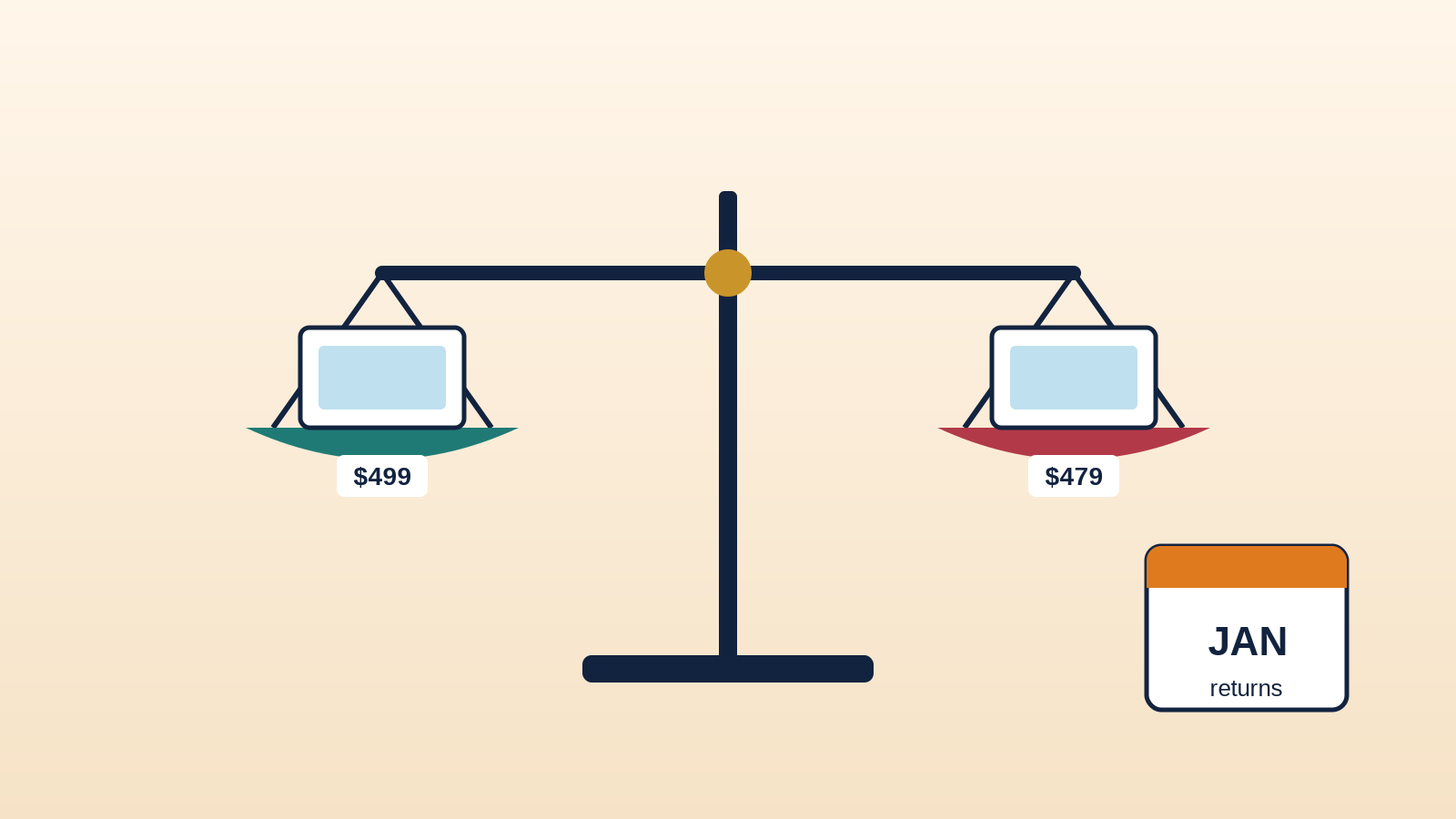
Maria in Clovis wants a particular air fryer. A large retailer lists model AF-500 for $119.99 with free shipping and a 30-day return window. A social-media ad sends her to a store she has never heard of, which shows the same photo at $64.99 and a timer counting down from fifteen minutes.
She spends ten minutes on the checks. The second store's footer lists only a brand name and a contact form. ICANN Lookup shows the domain was registered nineteen days earlier. The product page says "ships in 2 days," but the return policy, buried in the terms, offers store credit only and charges the buyer to ship returns overseas. At checkout a $9.99 "handling fee" appears that was not in the listed price. The payment page offers a large discount for paying with a payment app.
Nothing on that list proves the store is a fraud. Together, they mean Maria could not identify the seller, could not rely on the price, and would have no practical way to get money back. She buys from the retailer she can identify. If she had wanted to take the risk, the right choice would still have been a credit card, a screenshot of the "ships in 2 days" promise, and a calendar reminder 45 days out to check whether the item arrived, well inside the 60-day dispute window.
If something has already gone wrong
Move quickly and in writing. The order of steps matters, but none of them requires waiting for the one before to finish.
- Contact the seller through the channel it lists, quoting your order number and the delivery date it promised. Ask in writing for the item or a refund. If the seller cannot ship on time, the federal shipping rule requires it to offer you the choice to cancel for a prompt refund.[8]
- Use the marketplace's process if you bought through one, and note its deadline. Some marketplace guarantees must be claimed within a short window.[3]
- Dispute the charge with your card issuer. For a credit card, send a written billing-error notice to the dispute address on your statement so it arrives within 60 days of the first statement showing the charge. If a delivery date the seller gave you falls beyond that window, the FTC notes that some issuers will extend it for delayed shipments; send your dispute with the promised and actual dates and any delay notice anyway.[10] For a debit card, call your bank at once and follow up in writing.
- Report it. File a report at ReportFraud.ftc.gov.[16] Reports are how the FTC and other agencies spot patterns and build cases, even though the FTC does not resolve individual complaints. California residents can also complain to the state Attorney General's office about a business.
- Watch for the follow-up scam. People who have just lost money are targeted by "recovery" services that promise to get it back for an upfront fee. Legitimate refunds from your bank or card issuer do not require you to pay anyone.
Red flags, in one list
- A price far below every established retailer for a current, popular product.
- A countdown timer or "only 2 left" banner on a store you have never used.
- No legal business name or street address anywhere on the site.
- A domain registered in the last few weeks, or a near-copy of a famous brand's address.
- Fees that appear for the first time at checkout.
- A return policy that offers store credit only, or charges you to ship returns abroad, or is missing.
- Pressure, or a discount, to pay by gift card, wire, payment app or cryptocurrency, or to pay outside a marketplace's checkout.
- Product photos that are clearly stock images, and no photos of the actual item being sold.
- A customer-service channel that exists only as a form, with no reply to a test message.
What this guide does not do
It does not rate or accuse any particular business, and nothing here should be read as saying that a specific store is fraudulent. It summarizes federal rules and California law as they stood on the date the facts were checked; card agreements, marketplace guarantees and state laws change, so confirm the current terms with your card issuer and the seller before relying on them. It is general consumer information, not legal advice. If you have lost a significant amount of money, a consumer attorney or your local legal aid office can tell you what remedies apply to your situation.
Sources
Accessed through November 26, 2026, Pacific. Numbers in brackets in the text point to this list.
- 1 Federal Trade Commission. New FTC data show a big jump in reported losses to fraud to $12.5 billion in 2024 (2025-03-10).
- 2 Federal Trade Commission. Data Spotlight: Reported losses to scams on social media eight times higher than in 2020 (2026-04).
- 3 Federal Trade Commission. Consumer advice on buying from online marketplaces and third-party sellers (accessed 2026-11-26).
- 4 Federal Trade Commission. Informing businesses about the INFORM Consumers Act (2023).
- 5 Federal Trade Commission. What third party sellers need to know about the INFORM Consumers Act (2023).
- 6 California Legislature (via Justia). Business and Professions Code section 17538 (online vendor disclosures and shipping) (current code).
- 7 Federal Trade Commission. Mail, Internet, or Telephone Order Merchandise Rule (16 CFR Part 435) (amended 2014).
- 8 Federal Trade Commission. Business guide to the FTC's Mail, Internet, or Telephone Order Merchandise Rule (accessed 2026-11-26).
- 9 California Department of Justice, Office of the Attorney General. SB 478 – Hidden Fees (the Honest Pricing Law) (2024).
- 10 Federal Trade Commission. What to do if you're billed for things you never got, or you get unordered products (accessed 2026-11-26).
- 11 Federal Trade Commission. Lost or stolen credit, ATM and debit cards (accessed 2026-11-26).
- 12 Federal Trade Commission. Don't let scammers get in the way of your holiday shopping (consumer alert) (2024-11).
- 13 Federal Trade Commission. Shopping online for college essentials? Add this advice to your cart (consumer alert) (2024-08-16).
- 14 ICANN. ICANN Lookup (domain registration data) (accessed 2026-11-26).
- 15 Google. Safe Browsing site status (Transparency Report) (accessed 2026-11-26).
- 16 Federal Trade Commission. ReportFraud.ftc.gov (accessed 2026-11-26).
- 17 California Department of Consumer Affairs. Legal Guide S-6: Display of return policy by retail sellers (Civil Code section 1723) (2012-06).
- 18 U.S. Customs and Border Protection. CSMS # 66065494 – Guidance: Suspension of duty-free de minimis treatment for all countries (2025-08).
- 19 The White House. Fact sheet: Suspending the de minimis exemption for commercial shipments globally (2025-07-30).
General consumer and household information for education. It is not financial, legal or medical advice and does not replace the official source, your own clinician or a licensed professional. We do not accept payment for coverage and this page contains no affiliate links. In an emergency, call 911.