Published
Facts checked through , Pacific · 4 min read
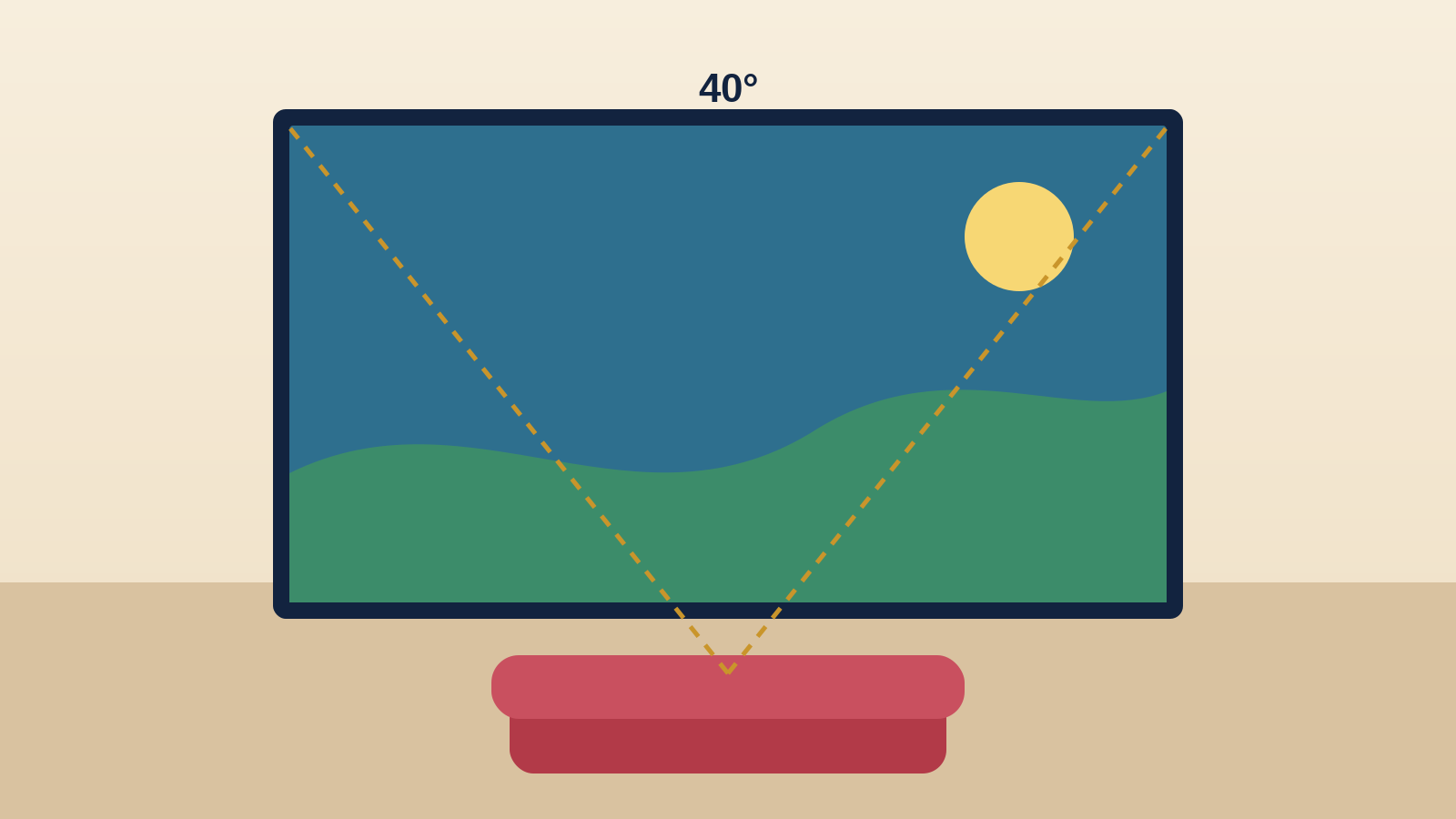
Quick answer. Measure from your eyes to the wall first. For an immersive picture, a common target is a screen that fills about 40 degrees of your view (THX's recommendation); for a comfortable, mixed-use living room, about 30 degrees (SMPTE's minimum) [1, 2]. For a 16:9 screen that works out to sitting roughly 1.2 to 1.6 times the diagonal away. A 100-inch TV suits a seat about 10 to 13½ feet away; a 98-inch, about 9¾ to 13¼ feet; an 85-inch, about 8½ to 11½ feet. Then check the wall, the weight and the doorway. The calculator below does the geometry for your room.
The price change is real
Very large screens have become far cheaper. This month a 98-inch TCL Q-Series QLED was reported at $898 at Walmart — $100 less than the same set's Black Friday price last year, according to Android Headlines [4] — and a 2026 98-inch TCL model was listed at $999.99 at Best Buy on November 13 [5]. Those are prices reported by deal publications on specific dates, not a guarantee of today's price or stock; confirm on the store's page.
Entry-level giant TVs make compromises, usually in brightness, local dimming and processing. That is the trade-off for the price. Whether it matters depends on how bright your room is and what you watch.
Step 1: Size the screen to the seat, not the wall
The geometry is simple. The wider the screen appears from your seat, the more immersive it feels — up to the point where you have to turn your head to follow the action [6]. Two industry reference points are widely used [2, 3]:
| Field of view | Who recommends it | Distance ≈ diagonal × | 65-inch | 85-inch | 98-inch | 100-inch |
|---|---|---|---|---|---|---|
| 30° | SMPTE (minimum, mixed use) | 1.63 | 8.8 ft | 11.5 ft | 13.3 ft | 13.6 ft |
| 40° | THX (cinema-like) | 1.20 | 6.5 ft | 8.5 ft | 9.8 ft | 10.0 ft |
Distances are calculated for a 16:9 screen; we rounded to one decimal place.
If your sofa is 9 feet from the wall, a 100-inch screen will feel very large — slightly beyond the THX target. If it is 14 feet away, even a 100-inch screen sits near the comfortable minimum.
Will you see pixels? With a 4K screen, almost certainly not at these distances. Using the common benchmark of one arcminute of visual acuity, individual pixels on a 100-inch 4K screen become hard to distinguish beyond about 6½ feet [6]. Resolution is rarely the limiting factor for a big 4K TV; brightness, contrast and the source (a streaming service's bit rate, a cable signal) usually are.
TV size and viewing-distance calculator
Measure from your eyes, seated, to where the screen will be. Works for 16:9 screens.
Results appear here as you type.
How this is calculated
For a 16:9 screen, width = diagonal × 0.8716. The distance at which a screen fills an angle θ is width ÷ (2 × tan(θ/2)): about 1.63 × diagonal for 30° (SMPTE minimum) and 1.20 × diagonal for 40° (THX). The 4K pixel distance uses one arcminute of visual acuity: pixel width ÷ tan(1/60°).
Private by design: everything is calculated in your browser, and nothing you type is stored or sent. The site's ordinary page-view analytics apply here as on every page (privacy); they never receive your entries.
Step 2: Check the wall, the weight and the door
- Width. A 100-inch 16:9 screen is about 87 inches (7¼ feet) wide before the frame. Measure the wall, including furniture and windows on either side.
- Weight and mounting. Very large sets are heavy. Use the weight on the manufacturer's specification sheet, a mount rated above that weight, and the correct VESA pattern, and anchor into studs or a structure the mount maker approves. Most people should have a qualified installer mount anything this size.
- The box. The shipping carton is larger than the TV. Measure the doorway, hallway turns and stairs, and ask whether delivery includes carrying it inside.
- Power and cables. Plan where the outlet, streaming box and sound system will go before the TV goes up.
Step 3: Choose the features that matter for your room
- Bright room: prioritize peak brightness and an anti-glare screen.
- Movie nights in the dark: local dimming and contrast matter more than raw brightness.
- Gaming: a 120 Hz or 144 Hz panel and HDMI 2.1 ports for a current console.
- Sound: thin TVs have small speakers. Budget for a soundbar.
- Football at Thanksgiving: motion handling and a wide viewing angle help when people sit off to the side. (Here is this year's Thanksgiving game schedule.)
Before you buy
- Confirm the full model number and compare it with any review you read — sale-only variants exist (see our guide to electronics deals).
- Price the whole project: TV, mount, installation, soundbar, delivery and tax.
- Read the return terms. Returning a 98-inch TV is a logistical project in itself.
We did not test the TVs mentioned here; prices are quoted from the dated reports cited.
Sources
Accessed through November 24, 2026, Pacific. Numbers in brackets in the text point to this list.
- 1 RTINGS.com. TV size to distance calculator (and the science behind it) (accessed 2026-11-24).
- 2 Kaleidescape. Home theater guide: screen size (SMPTE 30° and THX 40° field of view) (accessed 2026-11-24).
- 3 Audioholics. How to find the right size TV (THX vs SMPTE viewing angle) (accessed 2026-11-24).
- 4 Android Headlines. TCL's 98-inch TV drops to $898, cheaper than last Black Friday (2026-11).
- 5 Slickdeals. 98" TCL 98Q5CF 4K QLED Fire TV (2026) — $999.99 at Best Buy (posted Nov. 13, 2026) (2026-11-13).
- 6 Wikipedia. Optimum HDTV viewing distance (visual angle and angular resolution) (accessed 2026-11-24).
General consumer and household information for education. It is not financial, legal or medical advice and does not replace the official source, your own clinician or a licensed professional. We do not accept payment for coverage and this page contains no affiliate links. In an emergency, call 911.