Fictional teaching case · California peer review · §805 · §§809.1–809.8 · NPDB · HCQIA · authorities verified
The Video Wasn’t Made for the Hospital
How a private off-duty encounter, a covert smart-glasses recording and a viral social-media storm can become a California physician-privileging crisis — for a physician whose hospital privileges exist only for the rare post-procedure admission
A fictional California case study examining how an outpatient practice’s narrow hospital privileges, a pending misdemeanor, viral media coverage, physician peer review, §805, the NPDB, HCQIA, Medical Board exposure and future credentialing converge around one off-duty event — and why the institution’s dilemma is as real as the physician’s.
Policy analysis by Kanwar Partap Singh Gill, MD · primary authorities verified · educational analysis, not legal advice.
The encounter
Dr. A practises in one of California’s large metropolitan areas, and the practice is almost entirely outpatient. Procedures are done at an ambulatory surgery centre. There is no inpatient census, no daily admitting service, no call rota, and no ward round. What exists at Pacific Metropolitan Hospital is a narrow, episodic authorisation the medical-staff office calls visiting privileges: the pathway that lets Dr. A follow a patient across the hospital threshold in the rare case where someone needs admission after a procedure, or develops a complication that outgrows the outpatient setting.
One afternoon, off duty and nowhere near the hospital, Dr. A has a public disagreement with an unrelated stranger. Voices rise. The exchange lasts a few minutes. There is no patient. No hospital employee. No treatment decision, no prescription, no chart, no clinical judgement of any kind. Afterwards Dr. A drives away with the ordinary irritation of a bad encounter with a stranger, and by evening has largely stopped thinking about it.
Used perhaps twice in a year, the arrangement is easy to describe as trivial — and it is the only lawful route by which this physician can keep caring for his own patient once that patient is admitted. That is the first thing worth noticing about it, and the reason the ambulatory-surgery dimension matters more than its size suggests.
What Dr. A does not know is that the stranger was wearing consumer smart glasses capable of continuously capturing first-person audio and video. There was no raised telephone. No obvious lens. No reporter, no announcement, none of the social signals that tell a person they have entered the record. Dr. A behaved as though the encounter existed only in the present tense. The other participant knew it was already becoming evidence.
Everything in this article that follows is a consequence of that asymmetry. One participant was having an argument. The other was creating an exhibit.
The recording
The file is longer than the version the world will see. It begins before the disagreement escalates and continues after it ends. Some of it is unambiguous. Some is not: gestures read very differently from a first-person perspective than from across a street; two people talking at once produce audio in which neither is fully audible; the frame moves with the wearer’s head, so the most contested moment happens partly outside the centre of the image.
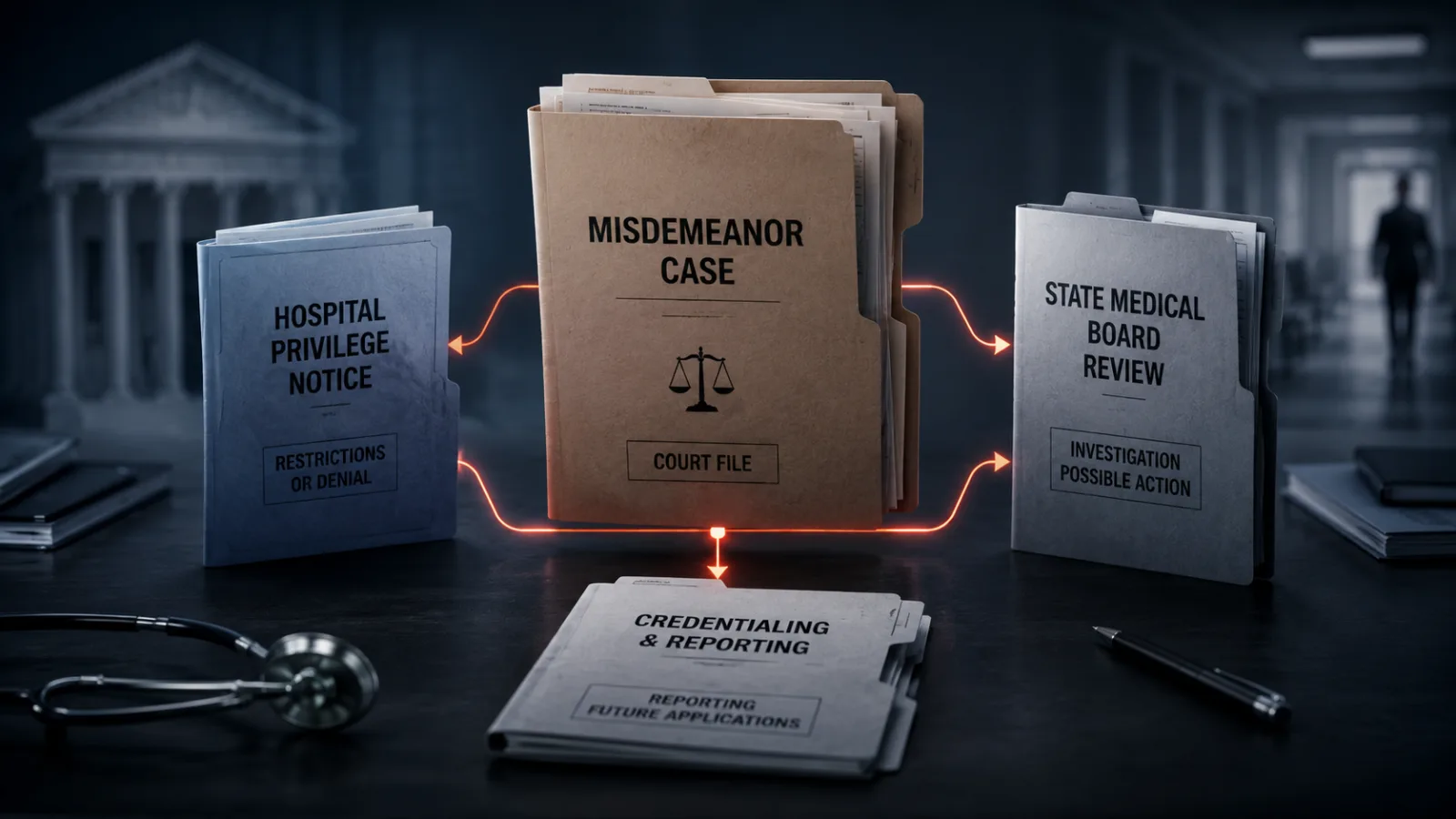
Within hours, a short segment is cut from the middle of that file. A caption is added. The clip is uploaded. The beginning is gone. The aftermath is gone. What remains is the most dramatic ninety seconds of a longer event, framed by a sentence written by one of the participants.
Whether the recording was lawful is a separate question from whether it is reliable, and both are separate from whether a private peer-review body may consider information about the event. California’s eavesdropping statute, Penal Code §632, turns on whether a communication is a confidential communication — a definition that excludes communications made in circumstances in which the parties may reasonably expect that the exchange may be overheard or recorded. So the answer is not it happened outdoors, therefore recording was lawful, and not the physician did not consent, therefore it was unlawful. It depends on the setting, the proximity of others, and the objective reasonableness of any expectation of privacy in that place.
Lawfulness of the recording, admissibility of the recording, and the weight a hospital committee should give the recording are three different questions. A hospital that collapses them has already made its first analytical error.
The viral escalation
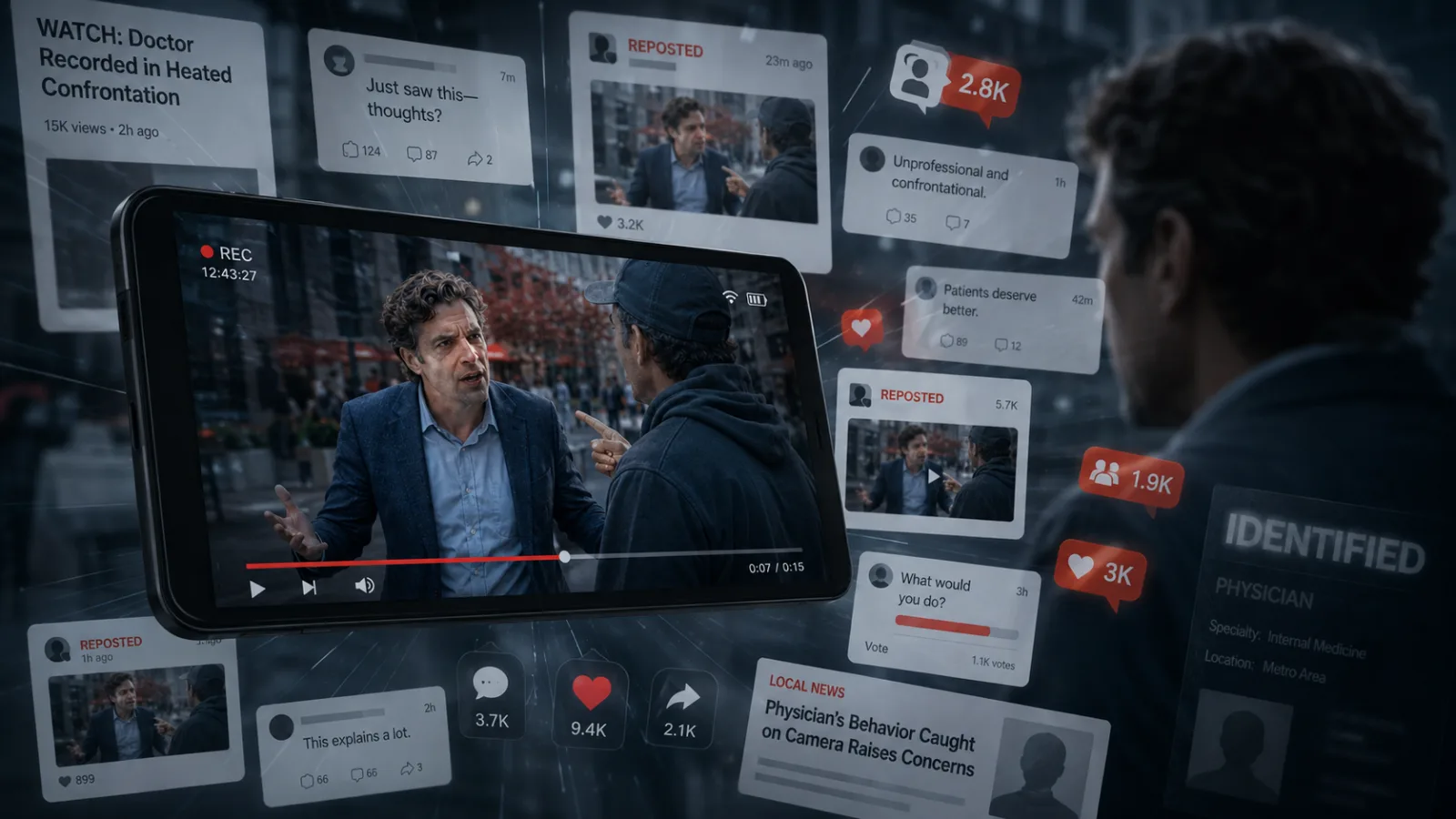
The first audience is small and local. Then someone recognises the person in the clip as a physician, and the story changes category.
Had the subject been an accountant, a contractor, or an anonymous motorist, the video would likely have remained a neighbourhood argument. Instead the caption acquires a more powerful noun. The framing shifts from two people had a public confrontation to look how a doctor behaves. Professional identity begins swallowing private identity, and it does so within a day.
Day one
Local circulation and identification
The clip spreads among local accounts. A commenter names the practice. Another connects the physician to an institution. Some viewers defend Dr. A; others accept the stranger’s description in full; others speculate about events that are not visible in the frame.
Day two
Local television
A newsroom picks up the clip and interviews the person who recorded it. Excerpts air. A second station follows the first. The story now has the authority of broadcast — but much of it still traces back to one recording and one account of what that recording means.
Day three
National framing
A national outlet sharpens the headline, because sharper headlines travel. The most dramatic still frame is selected. The physician’s occupation appears in the first line rather than the fourth.
Week two
International repetition and persistence
Foreign outlets repeat portions of the narrative. Reaction accounts repost it. Commentators discuss it without having spoken to either participant. Search engines begin associating the physician’s name with the incident, and review pages fill with contributors who have never been patients.
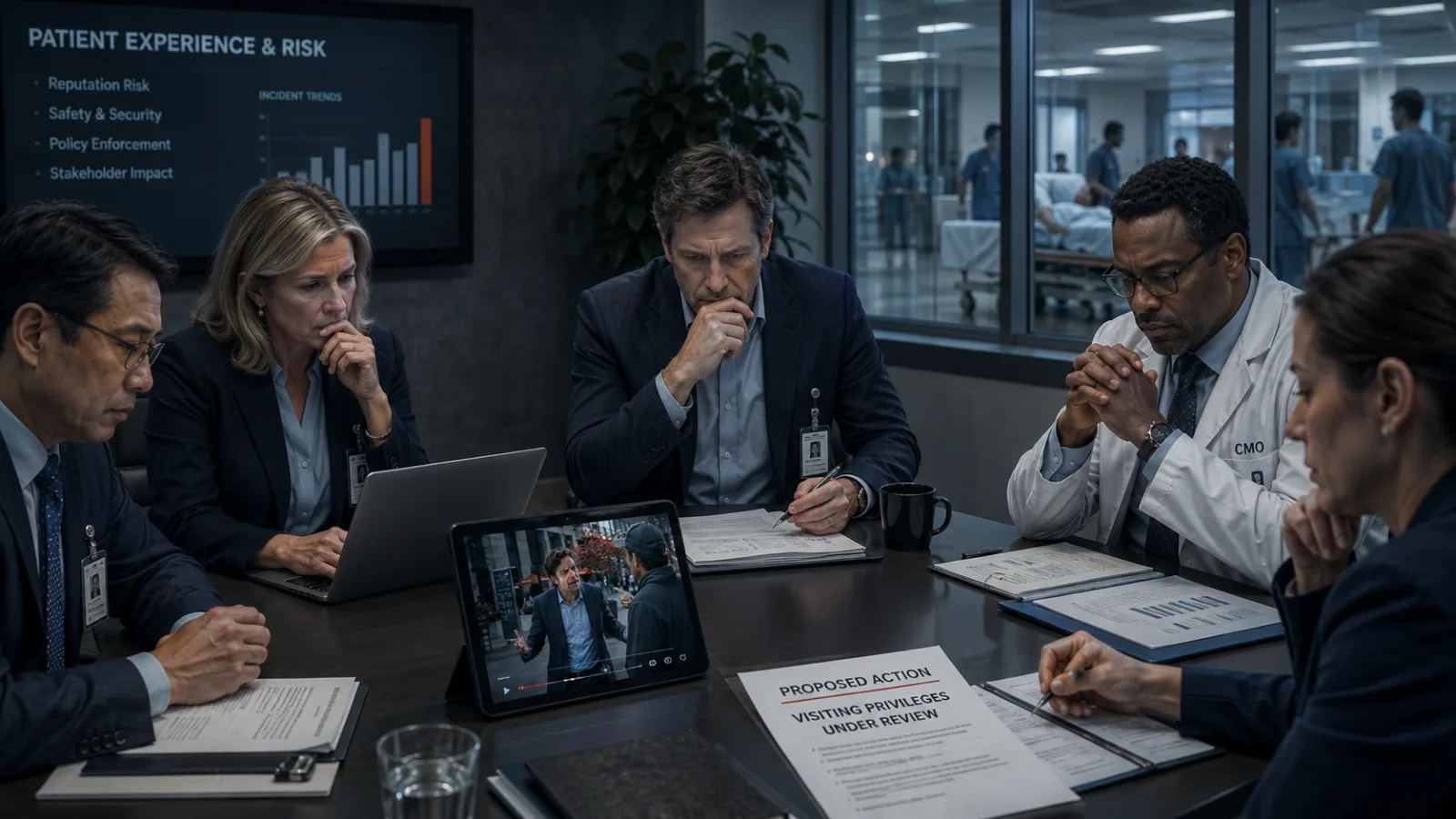
Then the escalation reaches the institution, and it does so through the ordinary machinery of a hospital rather than through anything resembling peer review. Communications receives media inquiries. Patient relations forwards emails. A board member sends the clip to the chief executive. An employee asks whether that physician still works here. Someone posts on the hospital’s own page asking why it lets that doctor near patients.
Eventually the medical-staff office is asked a purely administrative question: what privileges does this physician actually hold? Nothing has been alleged. No committee has met. But that question is the beginning of the process this article is about.
Three versions of one event
After publication there are not one but three distinct objects, and a serious institution keeps them apart.
What actually happened between two people, including the parts no device captured.
What the glasses captured: partial, angled, edited for publication, and authored by a participant.
What captions, reposts, broadcasts, screenshots and comment threads say happened.
The third object grows fastest and is the least evidentiary. It also arrives at the hospital first, because it arrives through email, social tagging and telephone calls rather than through a committee referral.
Evidentiary genealogy
Five news reports, twenty reaction videos and a thousand comments can all descend from one recording and one accuser. Repetition feels like corroboration and is not. Before a peer-review body treats volume as weight, it should trace each assertion back to its origin and ask which claims have any support independent of the original upload.
Ten thousand reposts are not ten thousand witnesses.
The virality fallacy
High visibility is not evidentiary reliability
Public anger is not patient danger
Reputational discomfort is not medical-disciplinary cause
A recording is not complete context
A criminal complaint is not a conviction
Institutional embarrassment is not a clinical finding
None of this means publicity is irrelevant. A hospital may legitimately care about the confidence of the community it serves, and professionalism does not switch off at the car park boundary. But when the institution moves toward a serious privilege action, California ties the analysis to a statutory concept with a patient-facing definition, and the volume of an audience is not one of its elements.
The institutional trap
It is tempting to write this story as a hospital overreacting to a mob. That version is easier and less true. Pacific Metropolitan did not create the controversy, has no clinical complaint against Dr. A, and faces a genuine dilemma in which every available option carries institutional risk.
Option one
Do nothing
Defensible today. If any behavioural event ever occurs later, the clip is resurrected beside a harder question: leadership saw this and did nothing. The institution is then answering for the delay as well as the event.
Option two
Act immediately
Also defensible, and exposed to the opposite charge: that social-media pressure substituted for peer review, and that a professional judgement was made before the facts were established.
Option three
Wait for the criminal case
The misdemeanor may take many months. Throughout, the hospital’s name continues to appear beside the physician’s in search results, and its own staff continue to ask why nothing has happened.
Option four
Ask quietly for a resignation
The apparently merciful path, and the one most likely to create reporting consequences neither side intended. See the hidden danger of the easy solution.
Option five
Open a formal investigation
The defensible route, and the expensive one. It activates physician procedural rights, an evidentiary burden the hospital itself must carry, and a record that will later be read by people who were not in the room.
Virality can create pressure to act faster than due process is designed to move.
The trap is structural rather than moral. A hospital under public scrutiny is being asked to demonstrate responsiveness on a timescale set by the internet, using a process designed to be deliberate, evidence-bound and slow. Recognising that is not an excuse for either party. It is the reason proportionality analysis in these cases has to be done explicitly, on paper, while the pressure is live.
Hospital policy
Assume Pacific Metropolitan’s medical-staff rules resemble the professional-conduct policies that large California hospital systems publish: provisions addressing threats, aggressive physical behaviour, threatening posture, physical confrontation, damage to property, criminal acts, conduct interfering with hospital operations, and conduct adversely affecting confidence in the institution’s ability to provide quality patient care. Assume the same policy describes a graduated response — coaching, collegial intervention, written counselling, documentation in the credentials file, referral to the medical executive committee, formal investigation — and provides that a single sufficiently egregious incident can initiate an investigation without any prior pattern.
That assumption disposes of the physician’s first instinctive defence. This happened once is not an answer to a policy that expressly contemplates one serious event. It also disposes of the loosest institutional assumption — that a policy which permits investigation therefore permits any outcome the investigation prefers.
Authority to investigate is not the same as justification to revoke.
The distinction runs through the rest of this article. It is also the distinction most often lost in the first week of a viral matter, when the question being asked internally is can we act rather than what can we prove, and what response does the proof support. The bylaws are the place both questions are answered; the bylaws carry more operative weight in California than physicians expect, and the definitional sections matter as much as the procedural ones.
The hospital has two cases to prove
A serious off-duty matter requires the institution to establish a chain, not a conclusion. Four links, each of which can fail independently.
Link one
What happened?
Not what the caption says, not what the comment section believes, not what a headline implies. What does reliable evidence establish — and which parts of the account remain contested after the complete recording is obtained?
Link two
What professional obligation is implicated?
Judgement? Aggression? Honesty? Threatening conduct toward another person? Professional demeanour? The policy provision relied on should be identified by name, because different provisions carry different proof requirements.
Link three
What is the patient-care nexus?
California defines medical disciplinary cause or reason as that aspect of a licentiate’s competence or professional conduct that is reasonably likely to be detrimental to patient safety or to the delivery of patient care — B&P Code §805(a)(6). That statutory bridge has to be walked, not asserted.
Link four
Why this sanction?
If misconduct is established, why termination rather than education, counselling, a behavioural agreement, non-restrictive observation or another lesser response? Proportionality is a finding, not a preference.
Link three is where viral cases most often break down, and link four is where they most often become vulnerable on review. A hospital can prove a bad afternoon and still lose the argument that it proved a professional risk.
“Visiting privileges” may still be staff privileges
Several weeks after the clip appears, Dr. A receives a formal letter. Pacific Metropolitan intends to cancel the visiting privileges. The physician’s first reaction is the reason this section exists: cancel what? I don’t even have full privileges there.
California does not define staff privileges by prestige. Section 805(a)(4) defines staff privileges as any arrangement under which a licentiate is allowed to practise in, or provide care for patients in, a health facility, and says those arrangements include but are not limited to:
The word visiting appears nowhere in that list, which is precisely the point: the list is illustrative, and the operative test is functional. So the question is not whether Dr. A was an active-staff physician. It is:
What authority did the physician actually possess to provide patient care — and what exactly is the hospital taking away?
Two further features of the statute close the gap the physician is hoping for. Section 805(a)(5) provides that denial or termination of staff privileges, membership or employment includes failure or refusal to renew a contract or to renew, extend or reestablish any staff privileges, where the action is based on a medical disciplinary cause or reason. And the reporting duties in section 805(b) attach to terminations, revocations and qualifying restrictions of staff privileges as so defined — not to a subset of impressive ones.
The least valuable privilege may be the most dangerous one to abandon casually.
The ambulatory-surgery dimension
An outpatient practice makes the hospital privilege look like a formality. It is used rarely, it generates little revenue, and on any given week it is invisible. That is exactly why it is worth understanding before anyone signs anything.
Start with what the privilege actually does. It is a bridge. The procedure happens in the ambulatory setting; the privilege exists for the day the procedure produces something the ambulatory setting cannot finish — a complication, an unexpected admission, a patient who needs an inpatient bed and who would otherwise be handed to a physician who has never met them. Losing the bridge does not stop Dr. A operating. It converts every complication into a transfer of care.
Which produces an uncomfortable observation for the nexus analysis. A physician whose hospital footprint is limited to post-procedure admissions has an unusually narrow patient-contact surface at that hospital — and the patients he does encounter there are, by definition, the ones whose day has already gone wrong. Narrow exposure is not the same as low-stakes exposure, and both sides can use that fact.
Now the part physicians in outpatient practice most often get wrong: California’s reporting architecture does not stop at the hospital door. Three features of the statutes reach directly into the ambulatory world.
Outpatient arrangements are inside the definition
The §805 definition of staff privileges expressly includes contractual arrangements to provide professional services, including, but not limited to, arrangements to provide outpatient services — B&P Code §805(a)(4). An outpatient-only practice is not outside the framework; it is named in it.
A surgery centre can itself be a peer review body
The §805 definition of peer review body includes the medical or professional staff of a health facility or clinic licensed under Division 2 of the Health and Safety Code or of a facility certified to participate in the federal Medicare program as an ambulatory surgical center. The surgery centre where the practice actually lives has its own peer-review function and its own filing duty.
The report follows the physician into the outpatient setting
Before granting or renewing staff privileges, section 805.5 requires the institution — including a Medicare-certified ambulatory surgical center, and an outpatient setting accredited under Health and Safety Code §1248.1 — to request 805 information from the relevant board. A hospital filing therefore surfaces at the surgery centre’s next credentialing cycle.
The hospital action may be the smaller of the two losses. The practice is at the surgery centre — and that is where a state filing arrives next.
So the strategic picture for an ambulatory physician inverts the intuition. The privilege that feels least valuable is the one attached to the reporting system, and the reporting system is what reaches the setting that matters. A resolution negotiated only around the hospital, without asking what it does to the surgery centre’s own credentialing file and to the next payer enrolment, has solved the visible half of the problem.
Five different meanings of “canceled”
“Your visiting privileges are canceled” is not a legal category. It is a sentence that could describe at least five different events, and the differences decide what happens next.
| What actually happened | Why it matters |
|---|---|
| 1. Early termination | The privilege had time to run and the hospital ends it now. If the reason is a medical disciplinary cause or reason, this is the paradigm §805 termination. |
| 2. Refusal to renew | The privilege is renewable and the institution declines to renew because of the incident. Section 805(a)(5) expressly treats refusal to renew, extend or reestablish as a termination when it rests on a medical disciplinary cause or reason. |
| 3. Natural expiration | A fixed authorisation reaches its stated end date on its original terms. This is the one branch where the limited nature of the arrangement genuinely helps — and only where the terms were truly fixed and non-renewable. |
| 4. Restriction | The physician keeps the privilege but cannot exercise part of it. California counts restrictions imposed or voluntarily accepted for a cumulative total of 30 days or more in any 12-month period for a medical disciplinary cause or reason. |
| 5. Voluntary surrender | The physician is invited to step away instead of receiving an adverse decision. Frequently the most consequential branch of the five, for the reasons in the next section. |
A physician who reads the letter and asks only is this fair? has skipped the more useful question: which of these five things is the institution actually doing, and under which provision of the bylaws? The answer determines the procedural rights available and the reports that may follow. The taxonomy of adverse privileges actions repays close reading before the first meeting, not after it.
The hidden danger of the easy solution
A hospital executive may offer what he genuinely believes is mercy. Doctor, these are only visiting privileges. Why put yourself through a hearing? Relinquish them and we will close the file.
The physician hears: problem solved. California and the federal reporting system may both hear something else.
Section 805(c) requires a report within 15 days where a licentiate, after receiving notice of a pending investigation initiated for a medical disciplinary cause or reason or notice that an application is or will be denied for such a reason, then resigns or takes a leave of absence from membership, staff privileges or employment, withdraws or abandons an application, or withdraws or abandons a request for renewal. There is no duration threshold in that subdivision and no requirement that the physician have understood the significance of the step.
Federal guidance runs in parallel. The NPDB Guidebook chapter on clinical privileges actions addresses surrender or restriction of clinical privileges while a practitioner is under investigation relating to professional competence or conduct, and surrender in exchange for the entity not conducting an investigation. Two features of that framework matter more than any label the parties use: the entity’s own characterisation of what it is doing does not control, and the practitioner may not know that anything called an investigation has begun.
“Voluntary” is one of the most dangerous words in physician peer review.
The practical instruction is unglamorous. Before any surrender, resignation, withdrawal or agreed pause, get the institution to state in writing whether an investigation focused on this physician is currently open. Resignation during investigation is not an exit from the reporting system; it is one of its triggers.
The criminal case enters the room

While the hospital process develops, a misdemeanor complaint is filed arising from the same encounter. The charge is deliberately unspecified here; the teaching point does not depend on it. What matters is that Dr. A now stands before two tribunals asking different questions about one afternoon, on different timetables, under different standards, with different consequences — and neither is bound by the other.
Posture one
Pending charge
An allegation, not an adjudication. A hospital may investigate the underlying conduct independently; it may not treat the filing as proof of the conduct. Nor does the pendency of the case suspend the peer-review clock.
Posture two
Dismissal
Does not bind the hospital. Dismissals happen for many reasons, some unrelated to the merits. But the institution loses the ability to point at an adjudicated event and must prove its own case on its own evidence.
Posture three
Pre-plea diversion
Can be professionally very different from a conviction, and is worth analysing on professional consequences rather than criminal exposure alone. Different programmes produce different records, and the record is what travels.
Posture four
Guilty or no-contest plea
A conviction for California physician-reporting purposes. Under B&P Code §802.1, a physician and surgeon shall report the conviction — including a verdict of guilty or a plea of guilty or no contest — of any felony or misdemeanor, in writing, within 30 days. A no-contest plea is not professionally invisible.
Posture five
Acquittal
Does not resolve the hospital matter either. A private peer-review body applies a preponderance standard to a different question, and one forum’s failure of proof beyond reasonable doubt is not the other forum’s finding of no professional concern.
Posture six
Criminal case still pending at the hearing
The hardest configuration in practice, and the subject of parallel proceedings below.
One asymmetry deserves emphasis, because the pasted wisdom on this point is often too broad. A physician’s own reporting duty under section 802.1 attaches to the bringing of an indictment or information charging a felony, and to any felony or misdemeanor conviction. A pending misdemeanor charge is not itself a section 802.1 self-report trigger.
The prosecutorial channel is likewise narrower than commonly described. Under B&P Code §803.5, a prosecuting agency must notify the relevant board of filings charging a felony against a licensee, immediately on learning that the defendant is a licensee, and must alert the clerk of the court, who records the licensee’s status in the file. Section 803.5(b) then requires the clerk, within 48 hours after conviction of a crime, to transmit a certified copy of the record of conviction to the board.
So the correct statement is narrow and useful: a pending misdemeanor may reach the Medical Board through several routes, but the felony-filing notification duty is not one of them. A misdemeanor conviction, by contrast, travels twice — once through the physician’s own 30-day report, and once through the clerk of the court within 48 hours.
Which reframes the criminal question for physician counsel. It is not only how much punishment. It is also: what document will the licensing authority receive, on what date, and what will the hospital be able to put in front of its panel?
The Medical Board layer
If either the criminal matter or the hospital action reaches the Medical Board, the agency performs its own analysis rather than adopting anyone else’s. Three propositions should be stated carefully, because over-broad versions of each circulate freely.
- A section 805 report does not automatically produce licence discipline. It produces a record and, frequently, an inquiry.
- A misdemeanor filing does not automatically produce licence discipline. The Board is not required to act on an unadjudicated allegation.
- A misdemeanor conviction does not automatically determine the degree of discipline. Whether an offence is substantially related to the qualifications, functions or duties of a physician is a question the agency examines on the circumstances, not a conclusion that follows from the label of the charge.
What each of these does do is create an occasion for scrutiny by a body that was not present at the encounter and will read about it in documents produced by others. That is the strongest practical argument for building a careful factual record early, in the first weeks, when the temptation is to say as little as possible and hope the matter evaporates. It is also why the routes by which peer review reaches licensing systems should be understood before the first internal interview, not after it.
The California reporting clock
Section 805 is a filing statute with named duty-holders and short deadlines. The chief of staff or other chief executive officer, medical director or administrator of a peer review body, and the chief executive or administrator of a licensed health facility or clinic, must file an 805 report with the relevant agency within 15 days after the effective date of a qualifying event.
| Trigger | Threshold and timing |
|---|---|
| Application denied or rejected | For a medical disciplinary cause or reason — report within 15 days of the effective date. |
| Membership, staff privileges or employment terminated or revoked | For a medical disciplinary cause or reason — report within 15 days. Includes failure or refusal to renew, extend or reestablish, per §805(a)(5). |
| Restrictions imposed or voluntarily accepted | Cumulative total of 30 days or more in any 12-month period, for a medical disciplinary cause or reason — report within 15 days. |
| Resignation, leave, withdrawal or abandonment | Taken after notice of a pending investigation initiated for a medical disciplinary cause or reason, or notice of denial for such a reason — report within 15 days of the licentiate’s action. No duration threshold. |
| Summary suspension | Where the summary suspension remains in effect for a period in excess of 14 days — report within 15 days following imposition. |
| Satisfaction of imposed terms | A supplemental report is due within 30 days after the licentiate is deemed to have satisfied the terms, conditions or sanctions imposed. |
Two further features of the statute change how a physician should think about the downstream consequences. An 805 report is maintained electronically by the agency for dissemination purposes for three years after receipt. And section 805.5 requires institutions to request 805 information from the relevant board before granting or renewing staff privileges — which is how a single filing becomes a question at every future credentialing committee. The 805 report and when a privileges dispute becomes reportable work through the counting problems in detail.
Note also what the statute does not do. It does not make every institutional response reportable. Counselling, education, a letter of concern, a behavioural expectation letter and documentation in the credentials file are not, without more, privilege-affecting actions taken for a medical disciplinary cause or reason. The line between internal remediation and privilege-affecting action is the most valuable line in this entire area.
Why §805.01 is different
It is a common error to treat section 805.01 as the general reporting mechanism for serious physician conduct. It is not. It is a narrower, additional duty attached to four enumerated categories.
Section 805.01 requires a report within 15 days after a peer review body makes a final decision or recommendation resulting in a final proposed action, following a formal investigation, that any of the following may have occurred: incompetence or gross or repeated deviation from the standard of care involving death or serious bodily injury; self-use or self-prescribing of controlled substances, or use of dangerous drugs or alcohol, to a degree dangerous or injurious or impairing safe practice; repeated acts of clearly excessive prescribing or prescribing without a good-faith prior examination; or sexual misconduct with one or more patients during treatment or examination. The duty applies regardless of whether a hearing is held, and the relevant agency becomes entitled to inspect and copy the statement of charges, documents, charts and exhibits, opinions, findings and conclusions in the investigation record.
An off-duty argument with a stranger does not fall within any of those four categories. In this hypothetical, section 805.01 is not the operative provision — and an institution that cites it is describing a different case from the one it has. Section 805.01 reporting is expressly in addition to any report required under section 805; neither absorbs the other.
The federal reporting clock
The National Practitioner Data Bank operates alongside California law and does not mirror it. Reporting to the NPDB turns on federal criteria, and the two systems can produce different answers on identical facts.
The ordinary professional-review-action category concerns actions that adversely affect a practitioner’s clinical privileges for a period of more than 30 days, based on professional competence or conduct that adversely affects, or could adversely affect, the health or welfare of a patient. Alongside it sits a separate category with no such duration threshold: surrender or restriction of clinical privileges while under investigation relating to professional competence or conduct, or in exchange for the entity not conducting an investigation.
Federal concept one
Clinical privileges are read broadly
The federal concept is not limited to the lay notion of full hospital privileges. It is why “only visiting privileges” is a weak starting position rather than a defence.
Federal concept two
The entity’s label does not control
Whether something was an investigation, an administrative step, a precaution or an interim measure is assessed on substance. Calling a measure administrative does not make it so.
Federal concept three
Awareness is not an element
A practitioner may be under investigation for reporting purposes without having been told. This is the single most consequential asymmetry in the surrender analysis.
Federal concept four
Temporary privileges
Where privileges were granted for a fixed period with no opportunity for renewal, and they simply expire on their original terms, that expiration is treated differently from a surrender or a non-renewal of renewable privileges. The original privilege letter therefore becomes as important as the recording.
Federal concept five
Monitoring is not automatically restriction
Observational proctoring that leaves the practitioner exercising independent clinical judgement is analysed differently from a measure that requires approval before acting. The difference is functional, not nominal.
California §805 and the NPDB are related but not interchangeable systems. Two separate analyses, two separate thresholds, two separate answers.
For a physician, the practical consequence is that a resolution designed around one system can trip the other. For an institution, the consequence is that reportability should be analysed before the resolution is drafted, not discovered afterwards. What gets reported to the NPDB and the dispute process set out the mechanics.
The fair hearing becomes a trial
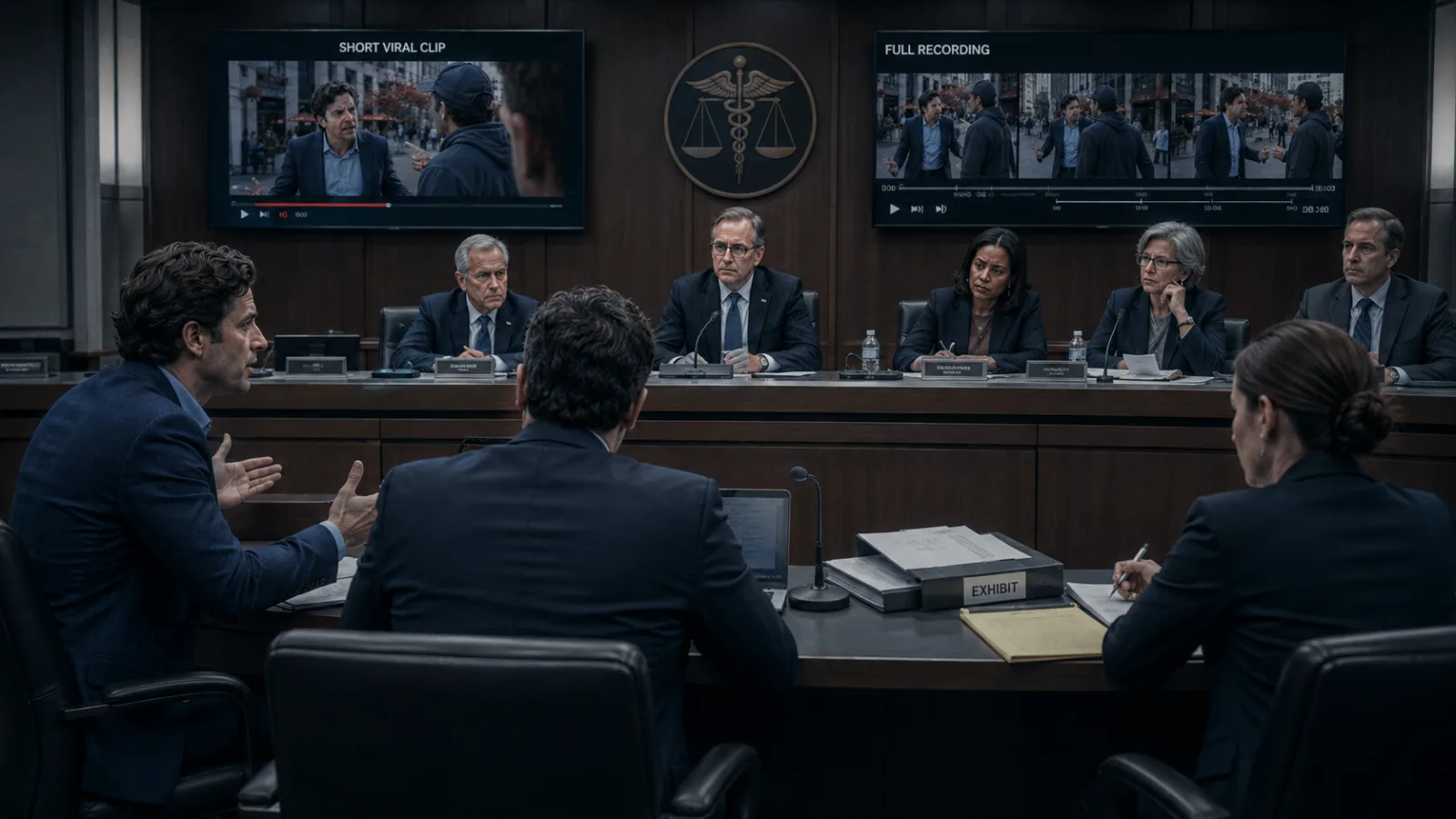
Dr. A requests review, expecting a conference room and a conversation with the chief medical officer. What arrives instead resembles litigation: a hearing officer, physician panelists, counsel on both sides, marked exhibits, witnesses under examination, the short viral clip as one exhibit and the complete recording as another, policies, court documents, medical-staff records, opening presentations, cross-examination, rebuttal, a written record, findings, and an internal appellate step.
California’s architecture for that proceeding is statutory. Where a licentiate timely requests a hearing concerning a final proposed action reportable under section 805, section 809.2 supplies the machinery and section 809.3 supplies the rights and the burden.
| Feature | What the statute provides |
|---|---|
| The trier of fact | An arbitrator or arbitrators selected by a process mutually acceptable to both sides, or a panel of unbiased individuals who gain no direct financial benefit from the outcome and who have not acted as accuser, investigator, factfinder or initial decisionmaker in the same matter — including, where feasible, an individual practising the same specialty. |
| The hearing officer | Gains no direct financial benefit from the outcome, does not act as prosecuting officer or advocate, and is not entitled to vote. |
| Impartiality | A reasonable opportunity to voir dire the panel and any hearing officer, and the right to challenge impartiality, with challenges ruled on by the presiding officer. |
| Documentary access | The right to inspect and copy, at the licentiate’s expense, documentary information relevant to the charges in the peer review body’s possession or control, as soon as practicable after the hearing request. Failure to provide access at least 30 days before the hearing is good cause for a continuance. Access does not extend to confidential information referring solely to other identifiable licentiates. |
| Witnesses and exhibits | On request, exchange of witness lists and copies of documents expected to be introduced; failure to disclose at least 10 days before the hearing is good cause for a continuance. |
| Timing | The hearing shall be commenced within 60 days after receipt of the request for hearing, and the peer-review process completed within a reasonable time. |
| Hearing rights | To be provided with all information made available to the trier of fact; to have a record made; to call, examine and cross-examine witnesses; to present and rebut relevant evidence; and to submit a written statement at the close of the hearing. |
| Burden | The peer review body has the initial duty to present evidence supporting the charge or recommended action. Except for initial applicants, the peer review body bears the burden of persuading the trier of fact, by a preponderance of the evidence, that its action or recommendation is reasonable and warranted. |
That last line changes the entire posture of the case. Dr. A is not an applicant asking to be trusted. Dr. A is an existing licentiate, and the institution has to persuade its own panel that cancelling these particular privileges, for this established conduct, is reasonable and warranted. Fair hearing rights works through the allocation in more detail, and the structure of who is actually deciding matters as much as the standard being applied.
Two adjacent provisions complete the frame. Notice of a proposed action and the right to request a hearing are governed by section 809.1, and the review or appellate step within the institution by section 809.4. Objections not made and preserved inside that structure are frequently unavailable later, which is the practical reason for insisting on specificity in the notice at the outset: a charge described as conduct unbecoming cannot be defended, and cannot usefully be found either — the general form of that problem is worked through in professionalism as a standard.
The internet enters the hearing room
Panel impartiality is a statutory requirement and, in a viral matter, a practical problem. A panelist may have already seen the clip. Another may have read the national headline before the local one. A third may have been asked about it by a neighbour. A fourth may know Dr. A professionally and have formed a view months before voir dire.
None of that necessarily disqualifies anyone. The statutory disqualifications are specific: direct financial benefit from the outcome, and having acted as accuser, investigator, factfinder or initial decisionmaker in the same matter. Prior exposure to publicity is not on that list. But it is exactly what voir dire exists to surface, and a record that shows the question was asked is worth more than an assumption that it did not need to be.
The evidentiary counterpart arrives with the exhibits. The hospital’s file may have begun with a downloaded clip of well under a minute. Once the complete recording is produced, the case usually changes: the clip started after the exchange was already underway; some language reads differently with the preceding minute audible; one allegation looks weaker and another may look worse; a contested physical act occurs at the edge of the frame rather than in its centre.
Peer review should investigate the event, not authenticate the internet’s conclusion about the event.
Imminent danger and the summary route
There is a faster path, and its threshold is narrow. Under section 809.5, notwithstanding the ordinary notice-and-hearing sequence, a peer review body may immediately suspend or restrict clinical privileges where the failure to take that action may result in an imminent danger to the health of any individual, provided the licentiate is subsequently given the notice and hearing rights in sections 809.1 to 809.4.
Section 809.5 also addresses the case where no person authorised by the peer review body is available: the governing body of an acute care hospital, or its designee, may immediately suspend privileges if failure to do so is likely to result in imminent danger to the health of any individual, provided the governing body first made reasonable attempts to contact the peer review body — and a suspension not ratified by the peer review body within two working days, excluding weekends and holidays, terminates automatically.
Public-relations urgency is not automatically imminent danger to the health of an individual.
That is not the same as saying the summary route is unavailable in a case like this one. It is to say that the statutory ground is a prospective health risk to a person, and that a record consisting of media inquiries, board-member emails and negative reviews does not itself establish it. The reporting consequence is separate again: California requires an 805 report where a summary suspension remains in effect for a period in excess of 14 days, so a measure adopted for institutional breathing room can become a filing if it is left running. Summary suspension and interim and emergency action cover the interval and its dangers.
HCQIA behind the hospital
The institution is not proceeding without federal protection. The Health Care Quality Improvement Act was enacted to encourage effective professional peer review by extending substantial immunity from damages to qualifying professional-review actions. Under 42 U.S.C. §11112, a professional-review action must be taken:
- in the reasonable belief that the action was in furtherance of quality health care;
- after a reasonable effort to obtain the facts of the matter;
- after adequate notice and hearing procedures are afforded to the physician, or after such other procedures as are fair to the physician under the circumstances; and
- in the reasonable belief that the action was warranted by the facts known after such reasonable effort to obtain facts and after meeting the notice and hearing requirement.
A professional-review action is presumed to have met those standards unless the presumption is rebutted. That presumption is why the quality of the investigative record matters to the hospital’s own interests: the damages protection in §11111 is earned by process, and the process is documented or it is not.
Two cautions. HCQIA is not absolute immunity, and damages immunity is not immunity from every form of judicial relief. And the federal floor is not the California ceiling — a California hospital must satisfy the section 809 scheme as implemented in its own bylaws, whatever the federal analysis shows.
We investigated reasonably, we followed fair procedures, and we acted in the reasonable belief that the action furthered quality health care and was warranted by the facts we found.
The institution reacted to public embarrassment on a publicity timetable, and constructed a patient-care nexus afterwards to support a decision it had already taken.
Peer-review confidentiality, and the physician’s own access
Suppose the stranger also sues. The civil claim will look for the hospital investigation, the executive committee minutes, the internal assessments, the deliberations. Evidence Code §1157 generally protects the proceedings and records of qualifying medical-staff and peer-review committees from discovery in civil actions, on the legislative judgement that candid peer review cannot survive routine exposure to litigants.
Two boundaries on that protection matter here. First, it is a protection against outside civil discovery of the committee’s own process — it is not a rule that the physician under review has no access to relevant documentary material. Section 809.2 gives the licentiate an affirmative statutory right to inspect and copy documentary information relevant to the charges in the peer review body’s possession, with the presiding officer ruling on requests and able to impose safeguards. The two provisions answer different questions and should not be run together.
Second, independently created evidence does not become privileged merely because someone later hands it to a committee. The smart-glasses recording is the clean example: it existed before any committee, was created by a participant with no institutional role, and circulated to millions. Delivering a copy to the medical executive committee does not retroactively wrap it in section 1157.
The same recording can be public to millions while the hospital’s discussion of it is strongly protected. Confidentiality attaches to the process, not to the facts.
Which produces one of the stranger features of a viral peer-review case: the least protected object in the matter is the one everybody has seen, and the most protected is the record of what the institution concluded about it. Discovery in disciplinary proceedings maps the access rules from both directions.
Parallel proceedings and the migration of statements
The hearing is scheduled before the criminal matter resolves, and Dr. A now has advisers whose correct advice conflicts.
Criminal counsel
Create no unnecessary statements
Every sworn or recorded explanation is a document a prosecutor may later read. The safest criminal posture is silence, and silence has a cost in the other forum.
Peer-review counsel
The panel needs the physician’s account
A panel that hears only the institution’s evidence may find the institution’s version established. The burden sits with the peer review body, but burdens are carried more easily against an empty chair.
Civil counsel
Say nothing that concedes an element
A stranger’s civil claim may turn on characterisations the physician is being urged to volunteer in a professional setting.
Licensing counsel
Assume the Medical Board will read all of it
Every admission, apology and stipulation should be drafted as though its ultimate audience is the agency, because it may be.
None of those positions is wrong. They are answers to different questions, which is why the choice cannot be delegated to whichever adviser is most confident.
The best answer in one forum can be the worst answer in another.
The mechanism worth naming is migration. A plea colloquy, a declaration, a written apology, deposition testimony, hearing testimony, a settlement recital, a behavioural agreement, a sentencing memorandum — each is drafted for one audience and then travels. Institutions change; documents do not.
Documents often outlive the tactical reason they were created.
Everything short of revocation
Peer review is not binary, and the most common error in a viral matter is to argue only about the top and bottom of the ladder.
No action
Physician coaching
Collegial intervention
Written counselling or letter of concern
Professionalism or conflict-management education
Behavioural expectations agreement
Non-restrictive observation
Formal corrective action
Restriction of privileges
Suspension
Termination or revocation
The steps above the line and the steps below it differ in kind, not merely in degree: the lower rungs address behaviour without affecting what the physician may clinically do, and the upper rungs affect clinical authority and therefore engage the state and federal reporting analyses.
A negotiated resolution in the fictional case might record: no finding of clinical incompetence; no finding of unsafe patient care; no admission of criminal conduct; no termination; no suspension; no reduction of clinical authority; professionalism and conflict-management education; written behavioural expectations; formal closure of the investigation; and carefully drafted language for future credentialing inquiries. That permits the institution to say we responded without asserting this physician was unsafe to practise medicine.
No such resolution should be described to a physician as guaranteed non-reportable. Whether anything is reportable depends on its substance under section 805 and under the federal criteria, not on the heading the parties put on the document. What can honestly be said is narrower and still valuable: remediation without restriction is a different regulatory object from remediation through loss of privileges.
Judicial review, and why the hearing record decides it
If the internal process ends against the physician, the next forum is not a fresh trial. California peer-review decisions are ordinarily tested by administrative mandamus under Code of Civil Procedure §1094.5, a record-based proceeding in which the court examines the fairness of the procedure, whether the body proceeded within its authority, and the sufficiency of the findings and the evidence supporting them under the applicable standard of review. Section 809.8 confirms that the peer-review article does not displace the availability of judicial review.
The practical consequence runs backwards through everything above. The record that a court will read is the record the hearing produced. Objections not made are usually not preserved. Evidence not offered is usually not considered. Requests for documentary access not made under section 809.2, and not ruled on, leave no trace of the asymmetry the physician later wants to describe.
The judicial-review case is built during the internal hearing, by the party who understands that the transcript is the appeal.
The credentialing afterlife
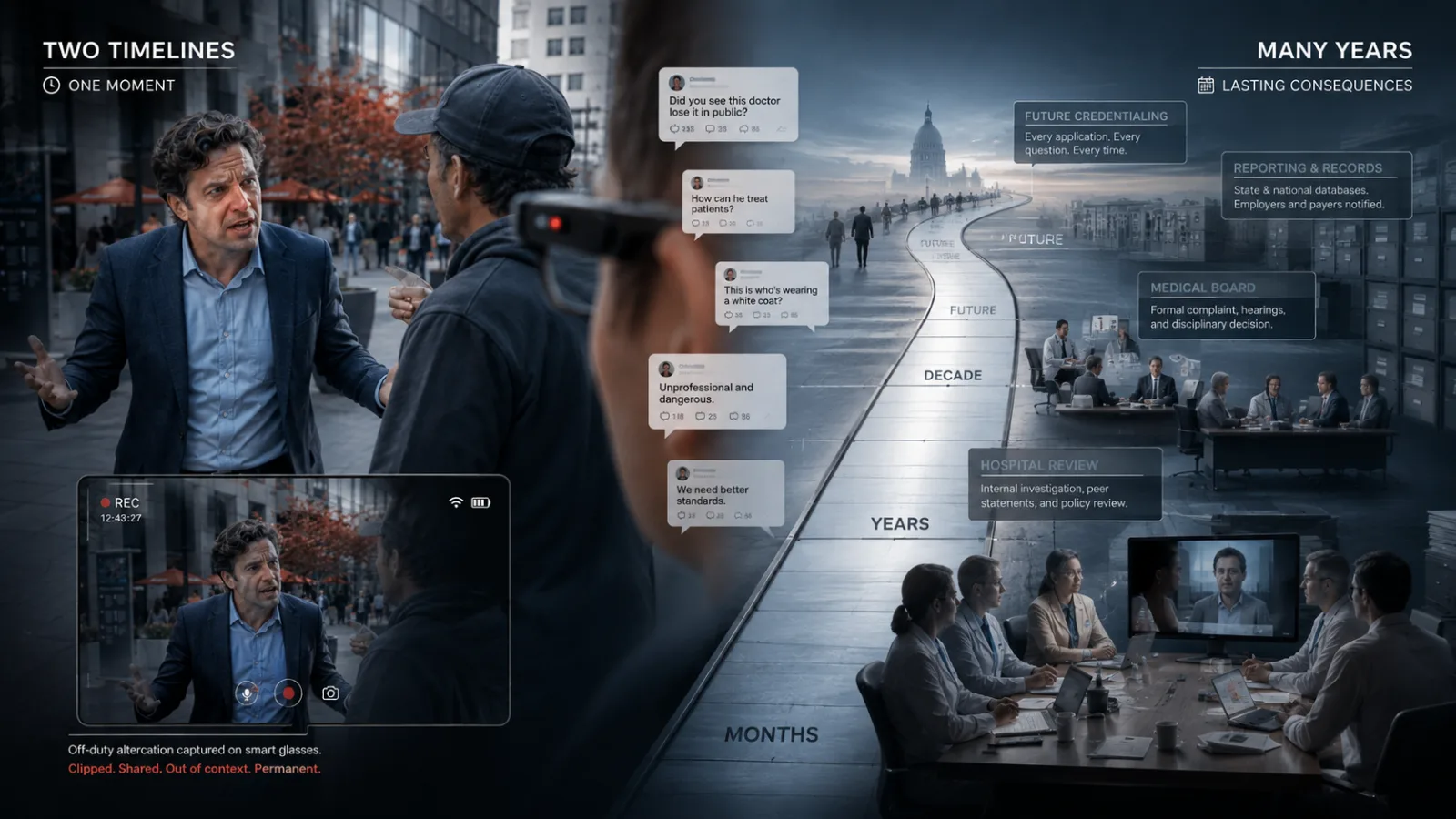
Move the clock forward several years. The clip is forgotten. The stranger has moved on. The criminal file is closed and old. The comment threads are archived somewhere nobody visits. And Dr. A applies for privileges at another institution, where a credentialing committee reaches the standard question:
Have you ever had privileges denied, restricted, suspended, terminated, revoked, surrendered, or not renewed?
That question is answered in the presence of records the physician does not control: an NPDB query returning any federal report; a section 805 inquiry to the relevant board, which section 805.5 obliges the institution to make before granting or renewing privileges; the physician’s own explanation of an event that will be read years after the emotional context has evaporated. Payer credentialing, health-system employment screening and later medical-staff applications each ask their own version of it.
An argument between two strangers lasting a few minutes on an ordinary afternoon.
A question on every subsequent application, and a document to be explained for as long as the physician practises.
This is the part of the analysis physicians most consistently discount at the moment of decision, and the part that most reliably determines how the episode is experienced a decade later. It is also the reason the apparently trivial privilege is worth defending properly: the size of the thing lost bears almost no relationship to the length of time it must be explained. Recredentialing and continuous monitoring describes how such records surface on a recurring cycle rather than once.
Hospital X’s strongest case
Stated at its strongest, and without the caricature. The institution does not argue that the internet is angry.
- Professionalism does not stop at the hospital boundary; medical staff obligations address conduct, not only technical competence.
- Behaviour described as threatening or aggressive bears on judgement and impulse control, which are professional attributes rather than private tastes.
- A hospital is not required to wait until a patient is harmed before concluding that behaviour has professional significance.
- A visiting physician still encounters patients, families, nurses and colleagues; limited access is not absence of contact.
- The policy permits a single sufficiently serious event to initiate investigation, and this event is at least serious enough to look at.
- Confidence in the institution’s ability to deliver quality care is part of the care environment, not merely a marketing concern.
- The institution has obligations to future patients who cannot participate in this hearing.
That is a legitimate peer-review theory, and any analysis that cannot state it fairly is not an analysis.
Dr. A’s strongest case
Equally, stated at its strongest.
- No patient was involved; no hospital employee was involved; no clinical decision was involved.
- There is no allegation of clinical incompetence, and none of impairment.
- There is no analogous history in the clinical environment across the physician’s time at the institution.
- The material that generated the institutional response was an edited excerpt, not the complete recording.
- A pending allegation is not a conviction, and the institution is proposing to act before either forum has resolved anything.
- The severity of the proposed response tracks the size of the audience rather than the strength of the evidence.
- The privileges are narrow and episodic, which cuts both ways: it also means the asserted risk is correspondingly narrow.
- Lesser measures — education, counselling, behavioural expectations, observation — would address any legitimate professionalism concern.
- Cancellation is disproportionate to the proven professional risk, and creates career-long consequences the proven facts do not support.
The article does not resolve this. Neither side is entitled to win on the strength of its framing, and the tension between these two lists is the actual policy problem the wearable-camera era has handed to hospital governance.
The headline test and the patient-safety test
Hospital administrators live, unavoidably, partly in the world of the headline test: how will this look tomorrow? Peer review is supposed to live in the world of the patient-safety test: what does the evidence tell us about this physician’s ability to provide safe care? The two questions overlap often enough to be confused and are not the same question.
At closing argument, counsel for Dr. A asks the question the whole matter has been circling:
If exactly the same conduct had been reliably established, but nobody had posted it online, would Hospital X have proposed exactly the same privilege action?
Hospital counsel gives the only answer that keeps the institution’s case intact:
Visibility is not the professional concern. The conduct revealed by the evidence is.
That exchange is where the case stops being the internet versus a doctor and becomes something a panel can actually decide: professional nexus versus private conduct. And it cuts in both directions, because hospital counsel is entitled to ask the mirror-image question — must an institution wait until concerning behaviour appears in front of a patient before it may conclude the behaviour has professional significance? Neither question has a categorical answer. Both have to be answered on evidence, on this record, for this physician, about these privileges.
The role of peer review is not to satisfy the comment section. It is to determine professional risk.
The KPSGILL off-duty viral conduct nexus test
| Finding | The question it forces the institution to answer |
|---|---|
| 1. Source integrity | What is the original recording, who created it, and does the institution hold it or only a derivative? |
| 2. Completeness | Has the entire relevant recording been obtained, and what is missing from the version that circulated? |
| 3. Evidentiary genealogy | Which reports, posts and accounts are independent, and which merely repeat the original allegation? |
| 4. Established facts | What conduct is actually proven, stated separately from what is alleged or inferred? |
| 5. Recording context | What happened immediately before and after the published segment? |
| 6. Professional nexus | Which professionally relevant attribute is implicated, identified by name rather than by adjective? |
| 7. Patient-care nexus | How is the proven conduct reasonably likely to be detrimental to patient safety or to the delivery of patient care? |
| 8. Clinical corroboration | Is there any analogous evidence from the physician’s actual clinical practice? |
| 9. Pattern | Is the conduct isolated or recurrent, on evidence rather than impression? |
| 10. Publicity independence | Would the same action have been proposed had the event never been published? |
| 11. Privilege classification | What category of privileges does the physician hold, and under which granting document? |
| 12. Duration and renewability | Are the privileges ongoing, renewable, fixed-term or genuinely non-renewable? |
| 13. Lesser alternatives | Which lesser measures were considered, and on what basis was each rejected? |
| 14. Reporting impact | What state and federal reporting consequences would the proposed action carry? |
| 15. Proportionality | Does the professional consequence bear a reasonable relationship to the proven professional risk? |
Finding 10 is the one institutions resist and the one that protects them. An action that survives it is defensible on review; an action that cannot survive it was probably always going to be characterised as publicity management. The KPSGILL due-process proposal and the credentialing dossier set this alongside the rest of the reform agenda.
Questions this case answers
General answers about the California and federal framework, not advice about any particular matter. Each answer links to the governing text.
Are “visiting privileges” real staff privileges in California?
Usually yes. B&P Code §805(a)(4) defines staff privileges as any arrangement under which a licentiate is allowed to practise in, or provide care for patients in, a health facility, and lists full, active, limited, auxiliary, provisional, temporary and courtesy privileges, locum tenens arrangements and contractual arrangements to provide professional services, including arrangements to provide outpatient services. The label the institution uses is not the test; what the physician was permitted to do is.
Does it matter whether the hospital says “canceled” instead of “revoked”?
Not by itself. Section 805(a)(5) provides that denial or termination of staff privileges includes failure or refusal to renew, extend or reestablish privileges where the action is based on a medical disciplinary cause or reason. What matters is which of five events actually occurred — early termination, refusal to renew, natural expiration, restriction or surrender — and why. Five meanings of “canceled” works through each.
If the criminal case is dismissed, must the hospital drop its case?
No. Peer review asks a different question under a different standard, and may proceed on its own evidence. But the institution loses the ability to point to an adjudicated event, and must then persuade its own panel, by a preponderance of the evidence, that its proposed action is reasonable and warranted — §809.3(b)(3).
Is a pending misdemeanor charge reportable to the Medical Board?
Not through the two statutory channels most often cited. A physician’s own duty under §802.1 attaches to a felony indictment or information, and to any felony or misdemeanor conviction — in writing, within 30 days. The prosecutorial notification duty in §803.5(a) applies to felony filings. A misdemeanor conviction, by contrast, travels twice: the physician’s 30-day report, and the clerk’s transmission of a certified record of conviction within 48 hours.
Can I resign to avoid a report?
Frequently the opposite. Section 805(c) requires a report within 15 days where a licentiate resigns, takes a leave of absence, or withdraws or abandons an application or a renewal request after notice of a pending investigation initiated for a medical disciplinary cause or reason. Federal guidance separately addresses surrender or restriction while under investigation. Ask, in writing, whether an investigation focused on you is open before you sign anything.
Who has to prove what at the hospital hearing?
The peer review body has the initial duty to present evidence supporting the charge or recommended action, and — except for initial applicants — bears the burden of persuading the trier of fact, by a preponderance of the evidence, that its action or recommendation is reasonable and warranted. An existing physician is not in the position of an applicant asking to be trusted.
How quickly must the hearing happen, and what can I see beforehand?
Section 809.2 provides that the hearing shall be commenced within 60 days after receipt of the hearing request, gives the licentiate the right to inspect and copy documentary information relevant to the charges in the peer review body’s possession, and makes a failure to provide that access at least 30 days before the hearing good cause for a continuance. Witness lists and exhibits are exchanged on request, with a 10-day rule of its own.
Does a viral video justify an immediate suspension?
The statutory ground is narrower than public pressure. Section 809.5 permits immediate suspension or restriction where the failure to act may result in an imminent danger to the health of any individual, with notice and hearing rights to follow. Media inquiries and online criticism are not that finding. Note also that a summary suspension remaining in effect more than 14 days carries its own §805 report.
My practice is outpatient. Does a hospital privilege action still matter?
Yes, and often more than the hospital privilege itself. Section 805’s peer-review-body definition reaches the medical staff of a facility certified to participate in Medicare as an ambulatory surgical center, and section 805.5 requires institutions — including such centres and accredited outpatient settings — to request 805 information before granting or renewing privileges. The filing arrives where the practice actually is.
Bottom line
A physician in this fictional case does not lose professional rights because a video is ugly or because an audience is large. A hospital does not lose the right to investigate because conduct occurred off duty. Both propositions are true, and the difficult work lies entirely between them.
A recording is not complete context.
Virality is not evidentiary reliability.
Public criticism is not automatically patient danger.
Authority to investigate is not authority to revoke.
Limited and temporary arrangements can still be staff privileges under §805(a)(4).
“Cancellation” may function as termination, non-renewal, restriction, expiration or surrender — five different analyses.
A fixed, non-renewable privilege that expires on its own terms is not a surrender.
A voluntary step taken during an investigation can be more consequential than an adverse decision.
§805 and the NPDB are related but not interchangeable, and §805.01 is narrower than either.
The peer review body, not the physician, bears the burden of showing its action is reasonable and warranted.
And the question the wearable-camera era has actually put to hospital governance, which no statute currently answers:
When an off-duty moment becomes viral, should the size of the audience determine the severity of professional discipline — or should evidence, patient-care nexus, due process and proportionality still control?
Primary authorities
Statutory text verified against the official California source on . Links open the governing text rather than commentary about it.
California Business & Professions Code §805
Definitions of peer review, staff privileges and medical disciplinary cause or reason; the 15-day filing duty; termination, restriction, resignation-after-notice and summary-suspension triggers; three-year dissemination period.
California Business & Professions Code §805.01
The separate, narrower report following formal investigation into four enumerated categories, and the agency’s inspection rights in that record.
California Business & Professions Code §805.5
The obligation to request 805 information from the relevant board before granting or renewing staff privileges.
California Business & Professions Code §802.1
Physician reporting of a felony indictment or information, and of any felony or misdemeanor conviction including guilty and no-contest pleas, within 30 days.
California Business & Professions Code §803.5
Prosecutorial notification of felony filings against a licensee, and transmission by the clerk of a certified record of conviction within 48 hours.
California Business & Professions Code §809
Legislative findings and the framework for peer review implemented through medical-staff bylaws.
California Business & Professions Code §809.1
Notice of a proposed final action and the right to request a hearing.
California Business & Professions Code §809.2
Trier of fact and panel composition; hearing-officer limits; voir dire and impartiality challenges; documentary access and the 30-day rule; witness and exhibit exchange; commencement within 60 days.
California Business & Professions Code §809.3
Hearing rights and the allocation of burden — the peer review body must persuade the trier of fact by a preponderance that its action is reasonable and warranted.
California Business & Professions Code §809.4
Findings and the review or appellate step within the institution.
California Business & Professions Code §809.5
Immediate suspension or restriction where failure to act may result in imminent danger to the health of any individual; governing-body action and the two-working-day ratification rule.
California Business & Professions Code §809.8
Preservation of judicial review.
California Evidence Code §1157
Protection of the proceedings and records of qualifying medical-staff and peer-review committees from discovery in civil actions.
Eavesdropping on or recording confidential communications, and the reasonable-expectation limits of that definition.
California Code of Civil Procedure §1094.5
Administrative mandamus: the record-based review through which peer-review decisions are tested.
HCQIA standards for a protected professional-review action, and the rebuttable presumption that they were met.
The scope and limits of HCQIA damages immunity.
Federal reporting duties of health care entities with respect to professional-review actions.
NPDB Guidebook — adverse clinical privileges actions
The more-than-30-day professional-review action; surrender or restriction while under investigation; temporary privileges; monitoring and proctoring distinctions.
What must be reported, by whom, and on what timetable.
How and when credentialing bodies query the Data Bank.
Medical Board of California — 805 reporting form (ENF-805)
The state form itself, which shows the categories a reporting institution actually completes.
Related analysis on this site: professionalism as a standard · the 805 report · what gets reported to the NPDB · fair hearing rights · summary suspension · interim and emergency action · hospital peer-review structure · medical-staff bylaws as a source of rights · adverse privileges actions · when a privileges dispute becomes reportable · resignation during investigation · disputing an NPDB report · discovery in disciplinary proceedings · how peer review reaches licensing systems · economic versus patient-safety credentialing · recredentialing and continuous monitoring · a complaint is not a finding · standards of proof · the credentialing dossier · the KPSGILL due-process proposal