Published
Sources checked through · facts checked against the linked sources · 15 min read
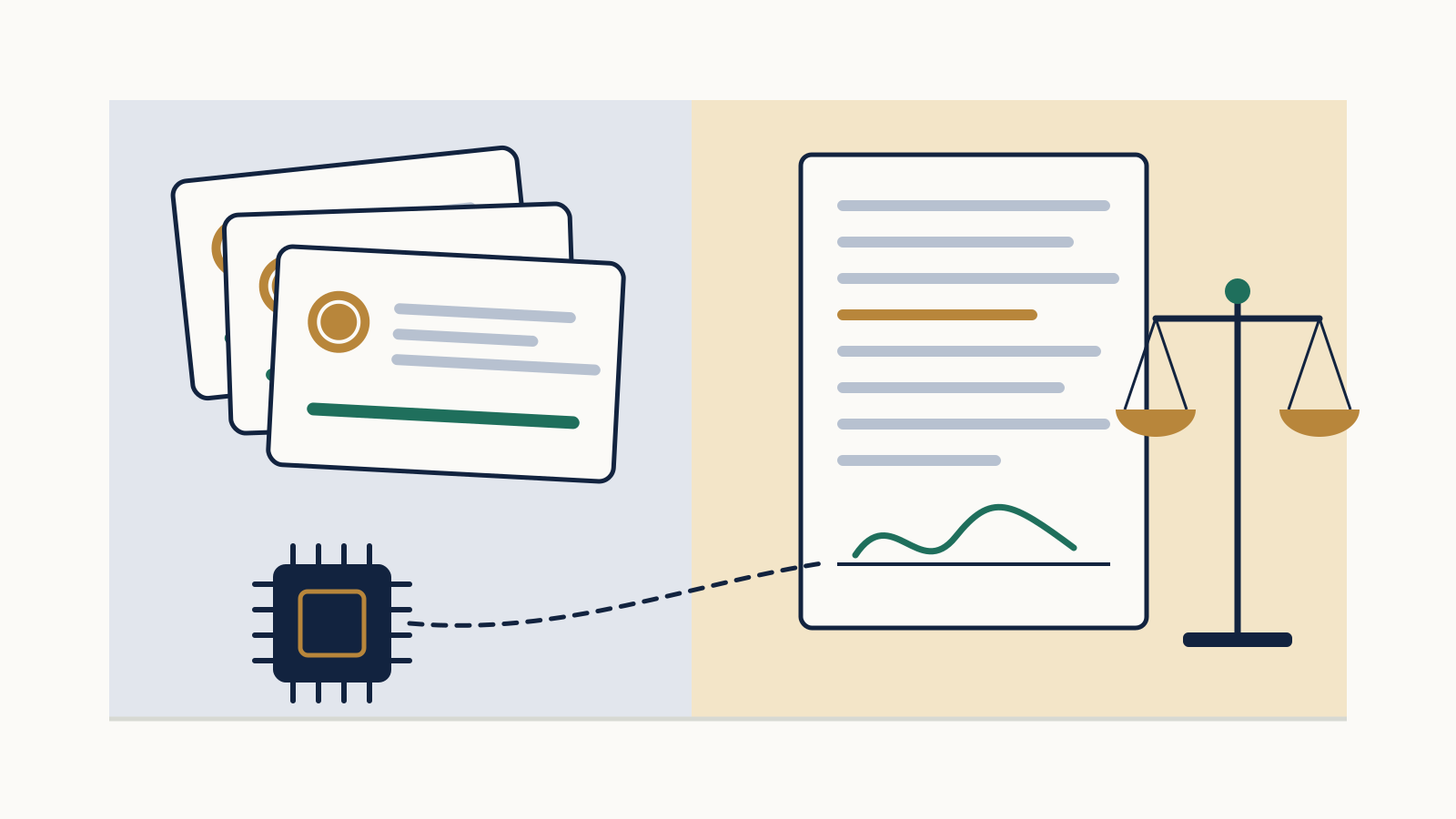
On January 1, 2027, California will become one of the first places in the country where a statute says, in plain terms, that a health care organization may not let artificial intelligence independently perform work the law reserves to a licensed professional, and must take reasonable steps to keep licensed people able to exercise their own judgment whenever an algorithm informs a patient's care. On the same day, a second statute makes a physician's notes the physician's responsibility in every setting and bars anyone else from changing them without authority. A third makes the clinics and practices that deploy clinical algorithms responsible, alongside the companies that build them, for looking for bias and acting on it.
None of these laws licenses software. None bans clinical AI. What they do is move a question that has been argued in hallways, union halls and vendor demonstrations into the domain of licensing law: when software drafts the note, scores the patient or schedules the visit, who exercised the judgment, and can anyone prove it?
This investigation answers that question license by license. It covers every principal health care credential issued by the boards of California's Department of Consumer Affairs, the health credentials issued elsewhere in state government, the facilities where licensees work, the federal rules that bind them in 2027, and the Department's licenses outside health care. It examines how enforcement will actually work and sets out what to watch through May 27, 2027. The research cutoff is November 27, 2026.
What we found
- The new laws regulate organizations as much as clinicians. AB 1979 places its duty on health facilities, clinics, physician offices and group practices, not on the person who signs the chart. SB 503 makes those same organizations "deployers" responsible for monitoring clinical algorithms for biased impacts. For the first time, the institution that configures the system has an express statutory duty about the clinician's ability to exercise judgment.
- Function decides coverage, not product labels. A tool that faithfully records a clinician's decision is documentation and falls outside AB 1979. A tool that adds a diagnosis, proposes treatment or decides how soon a patient is seen is clinical decision support, because the statute's definition expressly includes "timing of care." Calling a product an ambient scribe settles nothing.
- The setting limits are real, and they leave gaps. AB 1979's duties reach defined facilities, clinics and physician offices. Pharmacies, private therapy practices, standalone home health agencies and many allied offices must be analyzed separately, and the Board of Pharmacy has said publicly that the law misses pharmacies. A gap in this statute is not a gap in the licensee's own practice act.
- Enforcement will run through existing machinery. Physician violations of AB 1979 go to the Medical Board and the Osteopathic Medical Board; every healing-arts board may seek an injunction where AI amounts to unlicensed practice; every other remedy is preserved. The Physician Assistant Board expects few complaints and absorbable costs. There is no evidence of a statewide sweep, a uniform penalty for using AI, or a grace period.
- The supervisory structure of each profession does not change on January 1. PAs still need a supervising physician and a practice agreement, with an eight-PA ceiling in force since January 2026. Nurse practitioners must be analyzed under three distinct pathways, with independent "104" practice available since January 2026. Nurse anesthetists in California are not automatically physician-supervised. LVNs and psychiatric technicians still practice under direction that software cannot supply.
- The vetoes matter as much as the signatures. AB 2575, which would have protected clinicians who override an algorithm, and SB 903, which would have restricted AI in psychotherapy, were vetoed on September 30, 2026. Existing whistleblower and physician-advocacy protections remain; an AI-specific shield does not exist.
- The federal government is moving the other way on transparency, but not on responsibility. ONC's HTI-5 rule removes federal "model card" requirements from certified health IT effective December 28, 2026, four days before SB 503 requires California developers to give deployers comparable documentation. Medicare's 2027 fee schedule says AI may prepare an Annual Wellness Visit but the clinician must retain responsibility for judgment and approve the plan. No federal statute preempts California's laws, and an executive order cannot.
- Outside health care, AI reaches licensees through general law. Engineers, accountants, architects, contractors, appraisers and court reporters have no "AB 1979" of their own. They answer to their own signature-and-stamp rules, to California's employment and privacy rules on automated decisions, and to AB 316, which since 2026 has barred any defendant from arguing that AI acted autonomously.
How to read this investigation
| Label | What it means |
|---|---|
| Enacted | Chaptered statute or approved regulation, with its effective date from the official text |
| Existing law | A practice act, privacy rule, facility standard or federal condition already in force |
| Agency signal | A board analysis, agenda, advisory, fact sheet or proposed rule; it shows thinking, not a decision |
| Analysis | Our application of a rule to a workflow; not a finding that any workflow is unlawful |
| Forecast | Our judgment about the next six months; it may prove wrong |
Clinical examples are synthetic. No clinic, employer, vendor or individual is accused of wrongdoing. This is an independent analysis by a family medicine physician; it is not legal advice, and this site is not a law firm.
The chapters
- The January 2027 legal map: what California actually enacted — the full text of AB 1979, AB 1637 and SB 503, the laws already in force beside them, and what was vetoed.
- Physicians and their specialties — MD and DO duties, documentation failures, a 33-service specialty comparison and twelve questions for the medical boards.
- Physician assistants and nursing — practice agreements and attestation language, RN assessment, the three NP pathways, CRNAs, CNMs, CNSs, LVNs and psychiatric technicians.
- Allied health licenses — dentistry, pharmacy, psychology and behavioral health, rehabilitation, respiratory care, communication disorders, optometry, acupuncture, chiropractic, naturopathy, podiatry, midwifery, and health credentials outside the DCA.
- FQHCs, hospitals and home care — corporate practice, federal medical direction, hospital record conditions, hospice and home health dates, privacy and recording, and a preparation schedule.
- The federal layer in 2027 — preemption efforts, executive orders, CMS and ONC rules, Section 1557, FDA, HIPAA and the DEA telemedicine deadline.
- Beyond health care — accountants, architects, engineers, contractors, appraisers, court reporters and the DCA's other licensees.
- How the state will enforce — the path from concern to case, defenses and the evidence that answers them, clinician protections, and the six-month watch list.
The three statutes in one table
| Law | Chapter and code | What it requires | Who enforces |
|---|---|---|---|
| AB 1979 (Bonta) | Ch. 854, Stats. 2026; Bus. & Prof. Code § 22758.5; Civ. Code §§ 56.05, 56.06 | Health facilities, clinics, physician offices and group practices must take reasonable steps so licensed providers keep the ability to exercise independent judgment when clinical decision support informs care; may not use AI to independently perform licensed clinical functions or to direct unlicensed staff in them; documentation and communication without professional judgment excluded; health care chatbots brought under the CMIA | Medical and Osteopathic Medical Boards for physicians; any healing-arts board by injunction under § 125.5 where conduct is unlicensed practice; other remedies preserved |
| AB 1637 (Caloza) | Ch. 536, Stats. 2026; Bus. & Prof. Code § 2266.1 | A physician's notes, after-visit summaries and diagnosis and treatment plans are the physician's responsibility in every setting; no one else may alter them except a delegate, a receiving physician after transfer, or a supervising physician editing a physician trainee's notes | No penalty of its own; sits within the Medical Practice Act and existing record-integrity law |
| SB 503 (Weber Pierson) | Ch. 857, Stats. 2026; Bus. & Prof. Code § 22758 | Developers and deployers must identify clinical decision support systems with known or foreseeable risk of biased impacts; developers mitigate and document; deployers monitor and mitigate in proportion | No dedicated agency or penalty; compliance is no defense to a discrimination claim |
All three take effect January 1, 2027. Their chaptered texts are on the official California Legislative Information site, which we read in full; Chapter 1 sets them out subdivision by subdivision.
Impact by license: the comparison
Analysis. The table below summarizes how the January 2027 framework lands on each principal license. It is a guide to the chapters, not a substitute for them.
| License or credential | Regulator | The licensed act AI must not displace | What changes in practice in 2027 |
|---|---|---|---|
| Physician and surgeon (MD) | Medical Board | Diagnosis, treatment, prescribing after appropriate examination, the physician's own record | AB 1637 authorship and editing rules; AB 1979 judgment duty for owned practices; SB 503 deployer duties for solo and group practices |
| Physician and surgeon (DO) | Osteopathic Medical Board | The same functions, under the osteopathic act | The same; AB 1703 adds title protection for osteopathic terms |
| Postgraduate training licensee, resident | Medical or Osteopathic Board | Supervised training functions | AB 1979's trainee exception applies to the use-of-AI prohibitions only; AB 1637 lets supervisors edit physician-trainee notes |
| Physician assistant | Physician Assistant Board | Services authorized by the practice agreement, under supervision | Practice agreements and attestations should separate PA authorship from physician review; AI cannot be the supervisor |
| Registered nurse | Board of Registered Nursing | Assessment, nursing diagnosis, care planning, delegation, evaluation, advocacy | Institutions must leave a usable escalation path when an algorithm disagrees with the nurse |
| Nurse practitioner (traditional, 103, 104) | Board of Registered Nursing | Functions under standardized procedures, or under §§ 2837.103 and 2837.104 | Policies must record which pathway each NP holds; SB 1302 order-routing changes; 104 owners are also AB 1979 operators and SB 503 deployers |
| Certified registered nurse anesthetist | Board of Registered Nursing | Selection and management of anesthesia, on a practitioner's order | No general physician supervision in California; device and record design must show who decided |
| Certified nurse-midwife | Board of Registered Nursing | Midwifery care, consultation, transfer | AB 1696 and AB 1973 clarify authority; algorithms cannot certify competence |
| Clinical nurse specialist, public health nurse | Board of Registered Nursing | Expert nursing practice; population nursing | Protocol design and visit prioritization tools carry clinical consequence |
| Licensed vocational nurse, psychiatric technician | Board of Vocational Nursing and Psychiatric Technicians | Care under direction; certified IV or blood-withdrawal tasks | Task routing must check license and certification; software is not direction |
| Dentist, RDA, RDAEF, RDH, RDHAP and permit holders | Dental Board; Dental Hygiene Board | Diagnosis, treatment planning, consent, sedation monitoring, delegated duties | Many dental offices fall outside AB 1979's settings; practice acts and AB 489 still apply |
| Pharmacist, advanced practice pharmacist, intern, technician | Board of Pharmacy | Clinical review, counseling, furnishing | AB 1979's setting gap for pharmacies; pharmacist judgment still reserved by the Pharmacy Law |
| Psychologist, associates, testing technicians | Board of Psychology | Assessment interpretation, diagnosis, treatment | AB 489 advisory already in force; SB 903 vetoed |
| LMFT, LCSW, LPCC, LEP and associates | Board of Behavioral Sciences | Assessment, therapy, supervision | Staff report AI-related complaint allegations; no psychotherapy-specific AI statute |
| PT, PTA; OT, OTA | Physical Therapy Board; Board of Occupational Therapy | Evaluation, plan changes, discharge; advanced-practice procedures | PT Board to discuss AB 1979 and 2027 rulemaking calendar in December |
| Respiratory care practitioner; polysomnographic staff | Respiratory Care Board; Medical Board | Assessment and ventilation management; physician sleep interpretation | Data collection must stay distinct from assessment |
| SLP, audiologist, hearing aid dispenser and assistants | Speech-Language Pathology and Audiology and Hearing Aid Dispensers Board | Assessment, dysphagia decisions, diagnosis, dispensing | AB 489 advisory on AI title misuse |
| Optometrist and dispensers | Board of Optometry | Examination, diagnosis, prescribing | Board newsletter: AI does not replace practitioner decision-making |
| Acupuncturist, chiropractor, naturopathic doctor, podiatrist | Their respective boards | Scope-specific diagnosis and treatment | Chiropractic draft AI standard pending; SB 1303 tools against unlicensed ND claims |
| Licensed midwife | Medical Board | Midwifery assessment, consultation, transfer | Risk scores cannot replace mandatory consultation and transfer |
| Laboratory personnel, genetic counselors, radiologic personnel, CNAs and home health aides, EMS | Department of Public Health; EMS Authority | Field-specific qualified review | Outside DCA, but some sit in Business and Professions Code Division 2 |
| Veterinarian and registered veterinary technician | Veterinary Medical Board | Animal diagnosis, prescribing, surgery | Human-health AI statutes should not be presumed to apply |
| Accountant, architect, engineer, contractor, appraiser, court reporter and other DCA licensees | Their boards and bureaus | Signed, stamped or certified professional work | No AI-specific licensing statute; general AI, privacy, employment and liability law applies |
Facilities: FQHCs, hospitals and home care
Analysis. For federally qualified health centers and rural health clinics, the core point is that state practice authority and federal program duties coexist. A 103 or 104 nurse practitioner may practice without standardized procedures under California law while the center still owes the physician medical direction and periodic record review required by 42 CFR section 491.8 and HRSA's credentialing and quality requirements. Those federal duties are not physician authorship of every NP or PA note, and an AI-expanded encounter should not be attested as if they were. A safety-net clinic is an SB 503 deployer, and its monitoring should look where bias is most foreseeable: interpreted visits, limited English proficiency, disability-related communication and missing outside records.
For hospitals, federal conditions of participation already require reliable authorship, authentication by the responsible practitioner and protection against unauthorized alteration of records. The practical change is to separate drafting from ordering, and ordering from authentication, and to make sure corrections reach every copy of a diagnosis. Home health and hospice agencies must check whether AB 1979 reaches them at all, while federal rules still require authenticated, accurate entries; hospice telehealth face-to-face encounters must be flagged on claims from January 1, 2027. Chapter 5 provides a twelve-field register every organization should be able to produce, and a preparation schedule through May.
The federal layer
Analysis. Three federal developments frame 2027. First, the effort to displace state AI laws has not succeeded: Executive Order 14365 created a Justice Department task force and funding pressure, but no federal statute preempts AB 1979 or SB 503, and the incoming Congress has Democratic majorities in both chambers. Second, federal transparency is shrinking while federal payment policy keeps the clinician responsible: HTI-5 ends model-card certification requirements, CMS's November 13 "Clinical Super Intelligence Roadmap" promotes faster adoption, and the 2027 fee schedule says AI may prepare but clinicians must decide. Third, several hard dates fall in the window: DEA's telemedicine prescribing flexibilities expire December 31, 2026 unless extended; CMS's prior authorization APIs are due January 1, 2027; and comments on CMS's proposal to revisit CRNA supervision and PA and NP roles in long-term care close January 11, 2027. Section 1557's federal rule on discrimination by patient care decision tools remains on the books.
Beyond health care
Analysis. For the Department's other licensees, the law of AI in 2027 is the law of signatures and stamps, plus general statutes. An engineer's stamp, an accountant's opinion, an architect's control of signed drawings, an appraiser's opinion of value and a court reporter's certified transcript all certify a person's work; AI-generated output signed without meaningful direction and review is the same problem a clinician faces with a generated diagnosis. Every licensee-employer faces the Civil Rights Council's automated-decision rules (since October 2025), the CCPA's automated decisionmaking technology rules for covered businesses (January 1, 2027) and SB 947's limits on AI-driven discipline (July 1, 2027). AB 316 bars every defendant from blaming the AI. The Legislature expressly barred lawyers from delegating the practice of law to generative AI in SB 574; it has not done the same for engineers, accountants or appraisers.
How the state will enforce
Analysis. A board will not charge "use of AI." It will charge a specific act: an authenticated record that describes an examination that did not happen; an edit by someone without authority; delegation of a reserved function to software or to unlicensed staff following software; a supervisor who signed reviews that did not occur; an organization's workflow that blocked a clinically justified decision; a chatbot that presented itself as a licensed professional. Each needs proof of its own elements, and the strongest defenses (the tool only documented, a clinician reviewed before care changed, the setting is outside the statute, no one was harmed) will be answered only by records showing what was generated, who reviewed which version, and what happened before review. Chapter 8 maps each actor to its regulator, tests ten defenses against the evidence that answers them, and lists the dates to watch.
Forecast. Through May 2027, expect implementation rather than prosecution: board newsletters and advisories, new complaint codes, revised practice agreements, standardized procedures and attestation templates, contract demands for SB 503 documentation, and individual complaints testing existing grounds for discipline. Final disciplinary decisions resting on the new statutes are unlikely within six months. The first visible enforcement is more likely to concern false professional identity, record integrity and patient-communication notices than a contested case about independent judgment.
Questions California's boards have not yet answered
- What facts will establish that review of AI-generated content was meaningful, and not a click, before a clinical function occurred?
- How will boards separate an inaccurate draft that was corrected from an inaccurate record that was authenticated?
- How will a board weigh an employer's configuration, staffing and penalties for rejection alongside the individual licensee's conduct?
- Which agency handles a developer or employer the board does not license?
- How should PA and NP charts reviewed by a physician be attested without converting review into authorship?
- How will boards treat settings outside AB 1979's definitions, such as pharmacies and private therapy offices?
- Will boards publish de-identified examples of compliant use as well as violations?
- Will public reporting distinguish allegations, closed inquiries, citations, accusations and final decisions?
Strategic footprint
The strongest position in 2027, for a clinician, an institution or a regulator, is a precise allocation of responsibility supported by a record that can be reconstructed. For clinicians, that means authenticating only what they actually reviewed and describing consultation and supervision truthfully. For supervisors, it means attestations that say what review actually occurred. For institutions, it means supplying the authority, time, information, correction tools and escalation paths that make professional judgment real, and requesting the documentation SB 503 now requires. For vendors, it means describing actual functionality honestly. For regulators, it means identifying the function, credential, setting, respondent and evidence before assigning a consequence.
The principal vulnerabilities are equally clear: overbroad assumptions about which settings the statutes reach; stale supervision guidance; treating a signature as proof of review; treating a draft as completed clinical action; and relying on earlier bill versions instead of the enacted text. Each chapter of this investigation is built to avoid them.
Method and limits
We read the chaptered texts of AB 1979, AB 1637 and SB 503 on the official legislative site; the Medical Board's November 19, 2026 analyses; the Physician Assistant Board's November 16, 2026 memoranda; the Office of Administrative Law's approval of the BRN's 16 CCR 1444.5 amendment; the Senate's official 2026 summary of chaptered and vetoed legislation, including veto messages; the Governor's September 2026 announcements; the CMS CARE proposed rule; the HHS notice on Section 1557; and federal and board materials cited in each chapter. Some board packets were too large to retrieve in full, and confidential investigations and every individual disciplinary decision were not reviewed. A board agenda or staff memorandum is described as exactly that, never as an adopted rule. Where secondary reporting conflicts (for example, on whether the Commerce Department published its evaluation of state AI laws), we say so and do not rely on it. Later developments will be added as dated updates; the November 27, 2026 baseline will not be silently rewritten.
Where this continues on the site
- Who Owns the Decision? Artificial intelligence and the redistribution of judgment
- When the AI scribe starts shaping the medical record
- California AI records: January 2027 readiness for physicians
- Healthcare AI governance: the living dossier
- Recorded in the exam room: where the AI-scribe consent lawsuits stand
- What the Medical Board actually decided in 2026