Policy · Insurance Regulation, Coverage & Appeals
Claim Denials and the Appeals Ladder
A national and international policy analysis of internal review, external review, and the data gap on overturn rates, grounded in primary authorities, explicit scope limits, operational mechanisms, measurable outcomes, and correctable governance.

- Claim Denials and the Appeals Ladder should be governed as an end-to-end policy mechanism, not a headline category. The controlling analytical angle is internal review, external review, and the data gap on overturn rates; the conclusion must therefore connect law and institutional design to observable clinical, financial, operational, and distributional outcomes.
Executive synthesis
Claim Denials and the Appeals Ladder concerns internal review, external review, and the data gap on overturn rates. Claim Denials and the Appeals Ladder should be governed as an end-to-end policy mechanism, not a headline category. The controlling analytical angle is internal review, external review, and the data gap on overturn rates; the conclusion must therefore connect law and institutional design to observable clinical, financial, operational, and distributional outcomes. The analysis is intentionally narrower than advocacy: it identifies the public objective, the institution authorized to act, the chain through which action reaches people, and the evidence that would require a different conclusion. That method permits strong recommendations while keeping allegations, proposals, final rules, guidance, program data, research findings, and original analysis in their correct categories.
For Claim Denials and the Appeals Ladder, the jurisdictional frame is U.S. federal ERISA, Affordable Care Act, Public Health Service Act, Medicare and Medicaid rules, state insurance law, plan documents, and comparative coverage systems; for Claim Denials and the Appeals Ladder, the operative boundary specifically includes internal review, external review, and the data gap on overturn rates, applied specifically to external review. Within that frame, the categories that must remain distinct are payment dispute, grievance, appeal, external review, and judicial remedy, benefit exclusion, medical-necessity denial, while separately classifying internal review, external review, and the data gap on overturn rates. A sentence can be technically accurate and still mislead if it borrows a definition from the wrong payer, profession, state, cohort, procedural stage, or version of a rule. Each legal claim in this article is therefore paired with an operative source, a status label, a scope note, and a current-through date.
The national architecture for Claim Denials and the Appeals Ladder is anchored by U.S. Department of Labor — Internal Claims and Appeals and External Review, with emphasis on and the data gap on overturn rates. That authority supports this bounded proposition: DOL summarizes federal claims, appeals, and external-review requirements applicable to covered group health plans and issuers. Its limit is material: Plan status, grandfathering, benefit type, urgent-care rules, ERISA preemption, state external review, and judicial remedies must be analyzed separately. This source-to-claim discipline determines which actor has lawful power, which facts must be proved, which exceptions apply, and whether the reader is looking at a final requirement, an implementation choice, or a policy recommendation.
For Claim Denials and the Appeals Ladder, the process chain is internal review → external review → and the data gap on overturn rates → decision and implementation → outcome, review, and correction, and the article-specific checkpoint is internal review. The chain exposes points where delay, exclusion, coding, capacity, incentives, confidentiality, technology, or fragmented responsibility can change the outcome. It also prevents the last visible step from absorbing responsibility for earlier design failures. A credible reform assigns an owner, clock, evidence requirement, escalation path, audit record, and correction trigger at every consequential stage.
The principal mechanisms in Claim Denials and the Appeals Ladder are internal review, external review, and the data gap on overturn rates; tested alongside claims coding, notice, appeal, external review, and preemption, plan drafting, tested through internal review. They should not be inferred from an outcome alone. A lower rate may represent prevention, narrower eligibility, underreporting, selection, delayed access, substitution, or changed coding; a higher rate may represent greater harm, better detection, improved reporting, backlog clearance, or a larger denominator. The article uses mechanism-specific questions and disconfirming evidence before making causal claims.
Evaluation of Claim Denials and the Appeals Ladder should include completion, delay, error, safety, cost, burden, and distribution for internal review, external review, and the data gap on overturn rates; plus abandonment, network accuracy, appointment completion, continuity, out-of-pocket liability, complaints, subgroup distribution, with a dedicated test of internal review. Every measure needs a unit, numerator, denominator, cohort, observation window, missingness rule, severity or risk treatment, distributional view, and revision history. Median performance can conceal clinically important tails. Aggregate improvement can coexist with concentrated harm, and expenditure can fall because burden moved to patients, families, clinicians, local government, or a future budget.
The comparative lens for Claim Denials and the Appeals Ladder is anchored by World Health Organization — Universal Health Coverage and focused on internal review: WHO frames universal health coverage around access to needed quality services without financial hardship. The limit is equally important: The framework is normative and comparative; national benefit design, financing, rights, and enforcement remain matters of domestic law and capacity. International comparison identifies functions—financing, allocation, workforce, access, rights, information, or accountability—not foreign labels as U.S. authority. Transfer depends on constitutional structure, fiscal federalism, labor markets, administrative capacity, benefit entitlements, data infrastructure, and public legitimacy.
The recommended direction for Claim Denials and the Appeals Ladder is a topic-specific governance model for internal review, external review, and the data gap on overturn rates, and internal review, integrated with the recurring system cause, a coverage-governance framework that exposes the full appeals ladder, preserves plan-status distinctions, measures realized access, and repairs both the individual decision, with internal review as a falsifiable implementation priority. The substantive guardrails are do not use internal review as automatic proof of external review; do not let a reported improvement in and the data gap on overturn rates conceal failure in internal review; and retain these domain limits: generalize state protections to self-funded ERISA plans, or hide appeal attrition behind final-stage overturn rates, do not call a denial clinically correct because it was procedurally timely, equate a directory listing with access. These constraints keep a promising reform from improving one reported measure by hiding exclusion, delaying recognition, shifting cost, weakening rights, or accepting unmeasured clinical harm. The remaining sections test the proposal against law, operations, evidence, equity, remedy, and measurable implementation benchmarks.
Topic-specific mechanism and accountability ledger
Internal review. In Claim Denials and the Appeals Ladder, this component should be owned by the agency with rulemaking or program authority. The minimum evidentiary package is a versioned legal and operational record; it should identify the governing authority, eligible population, decision point, required inputs, operational dependency, failure mode, appeal or escalation route, and downstream record that must change when the original conclusion is corrected. The component should be measured within the article's full pathway—internal review → external review → and the data gap on overturn rates → decision and implementation → outcome, review, and correction—rather than reported as a detached activity. Reviewers should ask whether the intervention changed access, clinical or public safety, financial exposure, workforce burden, distribution, and total system cost. If those results diverge, the public report should explain the mechanism rather than select the measure that flatters the implementing institution.
External review. In Claim Denials and the Appeals Ladder, this component should be owned by the agency with rulemaking or program authority. The minimum evidentiary package is an audit trail that connects decision, reason, exception, and outcome; it should identify the governing authority, eligible population, decision point, required inputs, operational dependency, failure mode, appeal or escalation route, and downstream record that must change when the original conclusion is corrected. The component should be measured within the article's full pathway—internal review → external review → and the data gap on overturn rates → decision and implementation → outcome, review, and correction—rather than reported as a detached activity. Reviewers should ask whether the intervention changed access, clinical or public safety, financial exposure, workforce burden, distribution, and total system cost. If those results diverge, the public report should explain the mechanism rather than select the measure that flatters the implementing institution.
And the data gap on overturn rates. In Claim Denials and the Appeals Ladder, this component should be owned by the institution that controls the frontline workflow. The minimum evidentiary package is a versioned legal and operational record; it should identify the governing authority, eligible population, decision point, required inputs, operational dependency, failure mode, appeal or escalation route, and downstream record that must change when the original conclusion is corrected. The component should be measured within the article's full pathway—internal review → external review → and the data gap on overturn rates → decision and implementation → outcome, review, and correction—rather than reported as a detached activity. Reviewers should ask whether the intervention changed access, clinical or public safety, financial exposure, workforce burden, distribution, and total system cost. If those results diverge, the public report should explain the mechanism rather than select the measure that flatters the implementing institution.
Defining Claim Denials and the Appeals Ladder: Internal Review
The practical question is where the stated objective meets an actual institutional decision. In Claim Denials and the Appeals Ladder, defining claim denials and the appeals ladder: internal review must be tested against internal review → external review → and the data gap on overturn rates → decision and implementation → outcome, review, and correction. The article-specific lens at this stage is internal review. The analyst should identify the exact decision, the actor with authority, the evidence available at that moment, the person or institution bearing the consequence, and the path by which a mistaken or delayed decision can be corrected. An interview or narrative can reveal workflow and impact, but the decisive date, legal status, transaction, classification, or program result should be verified in the record competent to establish it. This distinction preserves urgency without converting experience into universal proof.
A current official source at this layer is U.S. Department of Labor — Internal Claims and Appeals and External Review. It establishes a bounded proposition: DOL summarizes federal claims, appeals, and external-review requirements applicable to covered group health plans and issuers. The boundary must travel with the citation: Plan status, grandfathering, benefit type, urgent-care rules, ERISA preemption, state external review, and judicial remedies must be analyzed separately. Applied to defining claim denials and the appeals ladder: internal review, the source should be used in Claim Denials and the Appeals Ladder to test internal review, and only for the actor, program, jurisdiction, procedural status, and time it actually covers. If the source is guidance, a proposal, an audit, a dataset, a settlement, an advisory document, or a comparative framework, the text should say so directly. A prestigious source can still be misused when its legal force, method, population, or version is broader or narrower than the sentence it is asked to support.
The evaluation should be capable of disproving the preferred theory. In Claim Denials and the Appeals Ladder, the evidence question for internal review turns on these operative mechanisms: internal review, external review, and the data gap on overturn rates; tested alongside claims coding, notice, appeal, external review, and preemption, plan drafting. The evaluation should therefore measure completion, delay, error, safety, cost, burden, and distribution for internal review, external review, and the data gap on overturn rates; plus abandonment, network accuracy, appointment completion, continuity, out-of-pocket liability, complaints, subgroup distribution. Define the numerator and denominator before reporting a rate; preserve intake, decision, disposition, and outcome cohorts; show median and tail performance where delay matters; and document missing fields, duplicates, exclusions, suppressed cells, coding changes, revised files, and the availability of a valid comparator. If the evidence cannot distinguish causation from selection, reporting, capacity, substitution, or secular change, publish the observable process result and the unresolved causal question.
The implementation plan should publish both benefit and burden. For Claim Denials and the Appeals Ladder, the responsible body should assign an owner, source record, decision criteria, service-level clock, urgency path, notice, review right, audit trail, and downstream correction process for internal review within defining claim denials and the appeals ladder: internal review. The design must work for CMS, external reviewers, courts, consumer advocates, enrollees, families, clinicians, plans, issuers under ordinary demand, staff turnover, technology failure, language and disability needs, rural or institutional constraints, and high-acuity exceptions. The boundary is do not use internal review as automatic proof of external review; do not let a reported improvement in and the data gap on overturn rates conceal failure in internal review; and retain these domain limits: generalize state protections to self-funded ERISA plans, or hide appeal attrition behind final-stage overturn rates, do not call a denial clinically correct because it was procedurally timely, equate a directory listing with access. A pilot or phased implementation should specify the baseline, intended mechanism, balancing measures, distributional effects, independent review, stop rule, and public schedule for revising the policy when observed results contradict its theory.
Legal Authority for Claim Denials and the Appeals Ladder and External Review
A defensible analysis reconstructs the last real case rather than relying on the organization's ideal workflow. In Claim Denials and the Appeals Ladder, legal authority for claim denials and the appeals ladder and external review must be tested against payment dispute, grievance, appeal, external review, and judicial remedy, benefit exclusion, medical-necessity denial, while separately classifying internal review, external review, and the data gap on overturn rates. The article-specific lens at this stage is external review. The analyst should identify the exact decision, the actor with authority, the evidence available at that moment, the person or institution bearing the consequence, and the path by which a mistaken or delayed decision can be corrected. An interview or narrative can reveal workflow and impact, but the decisive date, legal status, transaction, classification, or program result should be verified in the record competent to establish it. This distinction preserves urgency without converting experience into universal proof.
The legal or program status should be checked against HHS OIG — Some Medicare Advantage prior-authorization denials raise access concerns. It establishes a bounded proposition: OIG reviewed a sample of denied Medicare Advantage requests and found categories of denials that met Medicare coverage rules or plan billing rules. The boundary must travel with the citation: The sample findings are not a nationwide denial rate, do not apply to every payer, and require attention to sampling, period, service, and methodology. Applied to legal authority for claim denials and the appeals ladder and external review, the source should be used in Claim Denials and the Appeals Ladder to test external review, and only for the actor, program, jurisdiction, procedural status, and time it actually covers. If the source is guidance, a proposal, an audit, a dataset, a settlement, an advisory document, or a comparative framework, the text should say so directly. A prestigious source can still be misused when its legal force, method, population, or version is broader or narrower than the sentence it is asked to support.
The analytic burden increases with the consequence and irreversibility of the decision. In Claim Denials and the Appeals Ladder, the evidence question for external review turns on these operative mechanisms: internal review, external review, and the data gap on overturn rates; tested alongside claims coding, notice, appeal, external review, and preemption, plan drafting. The evaluation should therefore measure completion, delay, error, safety, cost, burden, and distribution for internal review, external review, and the data gap on overturn rates; plus abandonment, network accuracy, appointment completion, continuity, out-of-pocket liability, complaints, subgroup distribution. Define the numerator and denominator before reporting a rate; preserve intake, decision, disposition, and outcome cohorts; show median and tail performance where delay matters; and document missing fields, duplicates, exclusions, suppressed cells, coding changes, revised files, and the availability of a valid comparator. If the evidence cannot distinguish causation from selection, reporting, capacity, substitution, or secular change, publish the observable process result and the unresolved causal question.
The implementation plan should publish both benefit and burden. For Claim Denials and the Appeals Ladder, the responsible body should assign an owner, source record, decision criteria, service-level clock, urgency path, notice, review right, audit trail, and downstream correction process for external review within legal authority for claim denials and the appeals ladder and external review. The design must work for CMS, external reviewers, courts, consumer advocates, enrollees, families, clinicians, plans, issuers under ordinary demand, staff turnover, technology failure, language and disability needs, rural or institutional constraints, and high-acuity exceptions. The boundary is do not use internal review as automatic proof of external review; do not let a reported improvement in and the data gap on overturn rates conceal failure in internal review; and retain these domain limits: generalize state protections to self-funded ERISA plans, or hide appeal attrition behind final-stage overturn rates, do not call a denial clinically correct because it was procedurally timely, equate a directory listing with access. A pilot or phased implementation should specify the baseline, intended mechanism, balancing measures, distributional effects, independent review, stop rule, and public schedule for revising the policy when observed results contradict its theory.
Decision Rights Around And The Data Gap On Overturn Rates
A defensible analysis reconstructs the last real case rather than relying on the organization's ideal workflow. In Claim Denials and the Appeals Ladder, decision rights around and the data gap on overturn rates must be tested against payment dispute, grievance, appeal, external review, and judicial remedy, benefit exclusion, medical-necessity denial, while separately classifying internal review, external review, and the data gap on overturn rates. The article-specific lens at this stage is and the data gap on overturn rates. The analyst should identify the exact decision, the actor with authority, the evidence available at that moment, the person or institution bearing the consequence, and the path by which a mistaken or delayed decision can be corrected. An interview or narrative can reveal workflow and impact, but the decisive date, legal status, transaction, classification, or program result should be verified in the record competent to establish it. This distinction preserves urgency without converting experience into universal proof.
The legal or program status should be checked against HHS OIG — Medicare Advantage skilled-nursing prior-authorization appeals. It establishes a bounded proposition: OIG reported high overturn rates among appealed skilled-nursing-facility admission denials in the examined Medicare Advantage organizations and period. The boundary must travel with the citation: The report concerns a defined sample, service category, organizations, and historical period; it should not be generalized to all prior authorization. Applied to decision rights around and the data gap on overturn rates, the source should be used in Claim Denials and the Appeals Ladder to test and the data gap on overturn rates, and only for the actor, program, jurisdiction, procedural status, and time it actually covers. If the source is guidance, a proposal, an audit, a dataset, a settlement, an advisory document, or a comparative framework, the text should say so directly. A prestigious source can still be misused when its legal force, method, population, or version is broader or narrower than the sentence it is asked to support.
Measurement must follow the mechanism rather than the easiest available field. In Claim Denials and the Appeals Ladder, the evidence question for and the data gap on overturn rates turns on these operative mechanisms: internal review, external review, and the data gap on overturn rates; tested alongside claims coding, notice, appeal, external review, and preemption, plan drafting. The evaluation should therefore measure completion, delay, error, safety, cost, burden, and distribution for internal review, external review, and the data gap on overturn rates; plus abandonment, network accuracy, appointment completion, continuity, out-of-pocket liability, complaints, subgroup distribution. Define the numerator and denominator before reporting a rate; preserve intake, decision, disposition, and outcome cohorts; show median and tail performance where delay matters; and document missing fields, duplicates, exclusions, suppressed cells, coding changes, revised files, and the availability of a valid comparator. If the evidence cannot distinguish causation from selection, reporting, capacity, substitution, or secular change, publish the observable process result and the unresolved causal question.
The safeguard becomes real only when ordinary workload can support it. For Claim Denials and the Appeals Ladder, the responsible body should assign an owner, source record, decision criteria, service-level clock, urgency path, notice, review right, audit trail, and downstream correction process for and the data gap on overturn rates within decision rights around and the data gap on overturn rates. The design must work for CMS, external reviewers, courts, consumer advocates, enrollees, families, clinicians, plans, issuers under ordinary demand, staff turnover, technology failure, language and disability needs, rural or institutional constraints, and high-acuity exceptions. The boundary is do not use internal review as automatic proof of external review; do not let a reported improvement in and the data gap on overturn rates conceal failure in internal review; and retain these domain limits: generalize state protections to self-funded ERISA plans, or hide appeal attrition behind final-stage overturn rates, do not call a denial clinically correct because it was procedurally timely, equate a directory listing with access. A pilot or phased implementation should specify the baseline, intended mechanism, balancing measures, distributional effects, independent review, stop rule, and public schedule for revising the policy when observed results contradict its theory.
Financing and Incentives for Internal Review
A defensible analysis reconstructs the last real case rather than relying on the organization's ideal workflow. In Claim Denials and the Appeals Ladder, financing and incentives for internal review must be tested against internal review → external review → and the data gap on overturn rates → decision and implementation → outcome, review, and correction. The article-specific lens at this stage is internal review. The analyst should identify the exact decision, the actor with authority, the evidence available at that moment, the person or institution bearing the consequence, and the path by which a mistaken or delayed decision can be corrected. An interview or narrative can reveal workflow and impact, but the decisive date, legal status, transaction, classification, or program result should be verified in the record competent to establish it. This distinction preserves urgency without converting experience into universal proof.
The first primary-authority anchor is World Health Organization — Universal Health Coverage. It establishes a bounded proposition: WHO frames universal health coverage around access to needed quality services without financial hardship. The boundary must travel with the citation: The framework is normative and comparative; national benefit design, financing, rights, and enforcement remain matters of domestic law and capacity. Applied to financing and incentives for internal review, the source should be used in Claim Denials and the Appeals Ladder to test internal review, and only for the actor, program, jurisdiction, procedural status, and time it actually covers. If the source is guidance, a proposal, an audit, a dataset, a settlement, an advisory document, or a comparative framework, the text should say so directly. A prestigious source can still be misused when its legal force, method, population, or version is broader or narrower than the sentence it is asked to support.
The analytic burden increases with the consequence and irreversibility of the decision. In Claim Denials and the Appeals Ladder, the evidence question for internal review turns on these operative mechanisms: internal review, external review, and the data gap on overturn rates; tested alongside claims coding, notice, appeal, external review, and preemption, plan drafting. The evaluation should therefore measure completion, delay, error, safety, cost, burden, and distribution for internal review, external review, and the data gap on overturn rates; plus abandonment, network accuracy, appointment completion, continuity, out-of-pocket liability, complaints, subgroup distribution. Define the numerator and denominator before reporting a rate; preserve intake, decision, disposition, and outcome cohorts; show median and tail performance where delay matters; and document missing fields, duplicates, exclusions, suppressed cells, coding changes, revised files, and the availability of a valid comparator. If the evidence cannot distinguish causation from selection, reporting, capacity, substitution, or secular change, publish the observable process result and the unresolved causal question.
A national standard needs named owners and an executable correction path. For Claim Denials and the Appeals Ladder, the responsible body should assign an owner, source record, decision criteria, service-level clock, urgency path, notice, review right, audit trail, and downstream correction process for internal review within financing and incentives for internal review. The design must work for CMS, external reviewers, courts, consumer advocates, enrollees, families, clinicians, plans, issuers under ordinary demand, staff turnover, technology failure, language and disability needs, rural or institutional constraints, and high-acuity exceptions. The boundary is do not use internal review as automatic proof of external review; do not let a reported improvement in and the data gap on overturn rates conceal failure in internal review; and retain these domain limits: generalize state protections to self-funded ERISA plans, or hide appeal attrition behind final-stage overturn rates, do not call a denial clinically correct because it was procedurally timely, equate a directory listing with access. A pilot or phased implementation should specify the baseline, intended mechanism, balancing measures, distributional effects, independent review, stop rule, and public schedule for revising the policy when observed results contradict its theory.
Operational Capacity for Internal Review
A defensible analysis reconstructs the last real case rather than relying on the organization's ideal workflow. In Claim Denials and the Appeals Ladder, operational capacity for internal review must be tested against completion, delay, error, safety, cost, burden, and distribution for internal review, external review, and the data gap on overturn rates; plus abandonment, network accuracy, appointment completion, continuity, out-of-pocket liability, complaints, subgroup distribution. The article-specific lens at this stage is internal review. The analyst should identify the exact decision, the actor with authority, the evidence available at that moment, the person or institution bearing the consequence, and the path by which a mistaken or delayed decision can be corrected. An interview or narrative can reveal workflow and impact, but the decisive date, legal status, transaction, classification, or program result should be verified in the record competent to establish it. This distinction preserves urgency without converting experience into universal proof.
The first primary-authority anchor is OECD — Health. It establishes a bounded proposition: OECD publishes cross-national health-system indicators, country profiles, and policy analyses using documented comparative methods. The boundary must travel with the citation: Cross-country indicators depend on definitions, coverage, coding, purchasing power, and health-system structure; they do not create U.S. legal authority. Applied to operational capacity for internal review, the source should be used in Claim Denials and the Appeals Ladder to test internal review, and only for the actor, program, jurisdiction, procedural status, and time it actually covers. If the source is guidance, a proposal, an audit, a dataset, a settlement, an advisory document, or a comparative framework, the text should say so directly. A prestigious source can still be misused when its legal force, method, population, or version is broader or narrower than the sentence it is asked to support.
The evidence design should anticipate rival explanations. In Claim Denials and the Appeals Ladder, the evidence question for internal review turns on these operative mechanisms: internal review, external review, and the data gap on overturn rates; tested alongside claims coding, notice, appeal, external review, and preemption, plan drafting. The evaluation should therefore measure completion, delay, error, safety, cost, burden, and distribution for internal review, external review, and the data gap on overturn rates; plus abandonment, network accuracy, appointment completion, continuity, out-of-pocket liability, complaints, subgroup distribution. Define the numerator and denominator before reporting a rate; preserve intake, decision, disposition, and outcome cohorts; show median and tail performance where delay matters; and document missing fields, duplicates, exclusions, suppressed cells, coding changes, revised files, and the availability of a valid comparator. If the evidence cannot distinguish causation from selection, reporting, capacity, substitution, or secular change, publish the observable process result and the unresolved causal question.
The institution should precommit to the event that will trigger redesign. For Claim Denials and the Appeals Ladder, the responsible body should assign an owner, source record, decision criteria, service-level clock, urgency path, notice, review right, audit trail, and downstream correction process for internal review within operational capacity for internal review. The design must work for CMS, external reviewers, courts, consumer advocates, enrollees, families, clinicians, plans, issuers under ordinary demand, staff turnover, technology failure, language and disability needs, rural or institutional constraints, and high-acuity exceptions. The boundary is do not use internal review as automatic proof of external review; do not let a reported improvement in and the data gap on overturn rates conceal failure in internal review; and retain these domain limits: generalize state protections to self-funded ERISA plans, or hide appeal attrition behind final-stage overturn rates, do not call a denial clinically correct because it was procedurally timely, equate a directory listing with access. A pilot or phased implementation should specify the baseline, intended mechanism, balancing measures, distributional effects, independent review, stop rule, and public schedule for revising the policy when observed results contradict its theory.
Evidence and Causal Limits in Internal Review
This section should be read as a classification problem before it is read as a policy preference. In Claim Denials and the Appeals Ladder, evidence and causal limits in internal review must be tested against payment dispute, grievance, appeal, external review, and judicial remedy, benefit exclusion, medical-necessity denial, while separately classifying internal review, external review, and the data gap on overturn rates. The article-specific lens at this stage is internal review. The analyst should identify the exact decision, the actor with authority, the evidence available at that moment, the person or institution bearing the consequence, and the path by which a mistaken or delayed decision can be corrected. An interview or narrative can reveal workflow and impact, but the decisive date, legal status, transaction, classification, or program result should be verified in the record competent to establish it. This distinction preserves urgency without converting experience into universal proof.
The legal or program status should be checked against OECD Regulatory Policy Outlook 2025 — Regulating for effectiveness. It establishes a bounded proposition: OECD emphasizes regulation designed around outcomes, implementation, evaluation, risk, institutional capability, and changing conditions. The boundary must travel with the citation: The report offers comparative principles, not a binding template or proof that one institutional design is optimal across jurisdictions. Applied to evidence and causal limits in internal review, the source should be used in Claim Denials and the Appeals Ladder to test internal review, and only for the actor, program, jurisdiction, procedural status, and time it actually covers. If the source is guidance, a proposal, an audit, a dataset, a settlement, an advisory document, or a comparative framework, the text should say so directly. A prestigious source can still be misused when its legal force, method, population, or version is broader or narrower than the sentence it is asked to support.
A claim ledger should separate descriptive, causal, legal, and normative propositions. In Claim Denials and the Appeals Ladder, the evidence question for internal review turns on these operative mechanisms: internal review, external review, and the data gap on overturn rates; tested alongside claims coding, notice, appeal, external review, and preemption, plan drafting. The evaluation should therefore measure completion, delay, error, safety, cost, burden, and distribution for internal review, external review, and the data gap on overturn rates; plus abandonment, network accuracy, appointment completion, continuity, out-of-pocket liability, complaints, subgroup distribution. Define the numerator and denominator before reporting a rate; preserve intake, decision, disposition, and outcome cohorts; show median and tail performance where delay matters; and document missing fields, duplicates, exclusions, suppressed cells, coding changes, revised files, and the availability of a valid comparator. If the evidence cannot distinguish causation from selection, reporting, capacity, substitution, or secular change, publish the observable process result and the unresolved causal question.
The institution should precommit to the event that will trigger redesign. For Claim Denials and the Appeals Ladder, the responsible body should assign an owner, source record, decision criteria, service-level clock, urgency path, notice, review right, audit trail, and downstream correction process for internal review within evidence and causal limits in internal review. The design must work for CMS, external reviewers, courts, consumer advocates, enrollees, families, clinicians, plans, issuers under ordinary demand, staff turnover, technology failure, language and disability needs, rural or institutional constraints, and high-acuity exceptions. The boundary is do not use internal review as automatic proof of external review; do not let a reported improvement in and the data gap on overturn rates conceal failure in internal review; and retain these domain limits: generalize state protections to self-funded ERISA plans, or hide appeal attrition behind final-stage overturn rates, do not call a denial clinically correct because it was procedurally timely, equate a directory listing with access. A pilot or phased implementation should specify the baseline, intended mechanism, balancing measures, distributional effects, independent review, stop rule, and public schedule for revising the policy when observed results contradict its theory.
Equity and Access Through Internal Review
The issue becomes measurable only after the actor, population, unit, time, and consequence are fixed. In Claim Denials and the Appeals Ladder, equity and access through internal review must be tested against completion, delay, error, safety, cost, burden, and distribution for internal review, external review, and the data gap on overturn rates; plus abandonment, network accuracy, appointment completion, continuity, out-of-pocket liability, complaints, subgroup distribution. The article-specific lens at this stage is internal review. The analyst should identify the exact decision, the actor with authority, the evidence available at that moment, the person or institution bearing the consequence, and the path by which a mistaken or delayed decision can be corrected. An interview or narrative can reveal workflow and impact, but the decisive date, legal status, transaction, classification, or program result should be verified in the record competent to establish it. This distinction preserves urgency without converting experience into universal proof.
A current official source at this layer is CMS — 2025 Notice of Benefit and Payment Parameters Final Rule. It establishes a bounded proposition: CMS describes Marketplace network-adequacy review requirements and standards, including provisions applicable to plan years beginning in 2026. The boundary must travel with the citation: Marketplace QHP rules should not be exported to Medicare, Medicaid, employer, or state-only products without separate authority analysis. Applied to equity and access through internal review, the source should be used in Claim Denials and the Appeals Ladder to test internal review, and only for the actor, program, jurisdiction, procedural status, and time it actually covers. If the source is guidance, a proposal, an audit, a dataset, a settlement, an advisory document, or a comparative framework, the text should say so directly. A prestigious source can still be misused when its legal force, method, population, or version is broader or narrower than the sentence it is asked to support.
A national standard needs named owners and an executable correction path. For Claim Denials and the Appeals Ladder, the responsible body should assign an owner, source record, decision criteria, service-level clock, urgency path, notice, review right, audit trail, and downstream correction process for internal review within equity and access through internal review. The design must work for CMS, external reviewers, courts, consumer advocates, enrollees, families, clinicians, plans, issuers under ordinary demand, staff turnover, technology failure, language and disability needs, rural or institutional constraints, and high-acuity exceptions. The boundary is do not use internal review as automatic proof of external review; do not let a reported improvement in and the data gap on overturn rates conceal failure in internal review; and retain these domain limits: generalize state protections to self-funded ERISA plans, or hide appeal attrition behind final-stage overturn rates, do not call a denial clinically correct because it was procedurally timely, equate a directory listing with access. A pilot or phased implementation should specify the baseline, intended mechanism, balancing measures, distributional effects, independent review, stop rule, and public schedule for revising the policy when observed results contradict its theory.
Public Reporting of Internal Review
The practical question is where the stated objective meets an actual institutional decision. In Claim Denials and the Appeals Ladder, public reporting of internal review must be tested against payment dispute, grievance, appeal, external review, and judicial remedy, benefit exclusion, medical-necessity denial, while separately classifying internal review, external review, and the data gap on overturn rates. The article-specific lens at this stage is internal review. The analyst should identify the exact decision, the actor with authority, the evidence available at that moment, the person or institution bearing the consequence, and the path by which a mistaken or delayed decision can be corrected. An interview or narrative can reveal workflow and impact, but the decisive date, legal status, transaction, classification, or program result should be verified in the record competent to establish it. This distinction preserves urgency without converting experience into universal proof.
The first primary-authority anchor is U.S. Government Accountability Office — Standards for Internal Control in the Federal Government (Green Book). It establishes a bounded proposition: GAO's 2025 Green Book revision sets federal internal-control principles concerning objectives, risks, information, monitoring, and corrective action, effective beginning in fiscal year 2026. The boundary must travel with the citation: The Green Book applies directly within its federal scope and is a useful benchmark elsewhere; it is not a universal state-agency statute. Applied to public reporting of internal review, the source should be used in Claim Denials and the Appeals Ladder to test internal review, and only for the actor, program, jurisdiction, procedural status, and time it actually covers. If the source is guidance, a proposal, an audit, a dataset, a settlement, an advisory document, or a comparative framework, the text should say so directly. A prestigious source can still be misused when its legal force, method, population, or version is broader or narrower than the sentence it is asked to support.
The implementation plan should publish both benefit and burden. For Claim Denials and the Appeals Ladder, the responsible body should assign an owner, source record, decision criteria, service-level clock, urgency path, notice, review right, audit trail, and downstream correction process for internal review within public reporting of internal review. The design must work for CMS, external reviewers, courts, consumer advocates, enrollees, families, clinicians, plans, issuers under ordinary demand, staff turnover, technology failure, language and disability needs, rural or institutional constraints, and high-acuity exceptions. The boundary is do not use internal review as automatic proof of external review; do not let a reported improvement in and the data gap on overturn rates conceal failure in internal review; and retain these domain limits: generalize state protections to self-funded ERISA plans, or hide appeal attrition behind final-stage overturn rates, do not call a denial clinically correct because it was procedurally timely, equate a directory listing with access. A pilot or phased implementation should specify the baseline, intended mechanism, balancing measures, distributional effects, independent review, stop rule, and public schedule for revising the policy when observed results contradict its theory.
Remedies and Correction for Internal Review
The practical question is where the stated objective meets an actual institutional decision. In Claim Denials and the Appeals Ladder, remedies and correction for internal review must be tested against completion, delay, error, safety, cost, burden, and distribution for internal review, external review, and the data gap on overturn rates; plus abandonment, network accuracy, appointment completion, continuity, out-of-pocket liability, complaints, subgroup distribution. The article-specific lens at this stage is internal review. The analyst should identify the exact decision, the actor with authority, the evidence available at that moment, the person or institution bearing the consequence, and the path by which a mistaken or delayed decision can be corrected. An interview or narrative can reveal workflow and impact, but the decisive date, legal status, transaction, classification, or program result should be verified in the record competent to establish it. This distinction preserves urgency without converting experience into universal proof.
The operative source path begins with World Health Organization — Health Ethics and Governance. It establishes a bounded proposition: WHO develops ethics and governance guidance for public health, research, emerging technology, and health-system decision-making. The boundary must travel with the citation: WHO guidance is not self-executing domestic law and must be applied with jurisdiction, evidence, institutional role, and implementation limits visible. Applied to remedies and correction for internal review, the source should be used in Claim Denials and the Appeals Ladder to test internal review, and only for the actor, program, jurisdiction, procedural status, and time it actually covers. If the source is guidance, a proposal, an audit, a dataset, a settlement, an advisory document, or a comparative framework, the text should say so directly. A prestigious source can still be misused when its legal force, method, population, or version is broader or narrower than the sentence it is asked to support.
Implementation should be treated as part of validity, not an afterthought. For Claim Denials and the Appeals Ladder, the responsible body should assign an owner, source record, decision criteria, service-level clock, urgency path, notice, review right, audit trail, and downstream correction process for internal review within remedies and correction for internal review. The design must work for CMS, external reviewers, courts, consumer advocates, enrollees, families, clinicians, plans, issuers under ordinary demand, staff turnover, technology failure, language and disability needs, rural or institutional constraints, and high-acuity exceptions. The boundary is do not use internal review as automatic proof of external review; do not let a reported improvement in and the data gap on overturn rates conceal failure in internal review; and retain these domain limits: generalize state protections to self-funded ERISA plans, or hide appeal attrition behind final-stage overturn rates, do not call a denial clinically correct because it was procedurally timely, equate a directory listing with access. A pilot or phased implementation should specify the baseline, intended mechanism, balancing measures, distributional effects, independent review, stop rule, and public schedule for revising the policy when observed results contradict its theory.
A National Agenda for Internal Review
This section should be read as a classification problem before it is read as a policy preference. In Claim Denials and the Appeals Ladder, a national agenda for internal review must be tested against completion, delay, error, safety, cost, burden, and distribution for internal review, external review, and the data gap on overturn rates; plus abandonment, network accuracy, appointment completion, continuity, out-of-pocket liability, complaints, subgroup distribution. The article-specific lens at this stage is internal review. The analyst should identify the exact decision, the actor with authority, the evidence available at that moment, the person or institution bearing the consequence, and the path by which a mistaken or delayed decision can be corrected. An interview or narrative can reveal workflow and impact, but the decisive date, legal status, transaction, classification, or program result should be verified in the record competent to establish it. This distinction preserves urgency without converting experience into universal proof.
A current official source at this layer is U.S. House of Representatives — United States Code. It establishes a bounded proposition: The Office of the Law Revision Counsel publishes the official subject-matter organization of the general and permanent federal statutes. The boundary must travel with the citation: The Code must be checked for edition, supplement, notes, effective dates, amendments, and uncodified provisions; it does not resolve disputed application by itself. Applied to a national agenda for internal review, the source should be used in Claim Denials and the Appeals Ladder to test internal review, and only for the actor, program, jurisdiction, procedural status, and time it actually covers. If the source is guidance, a proposal, an audit, a dataset, a settlement, an advisory document, or a comparative framework, the text should say so directly. A prestigious source can still be misused when its legal force, method, population, or version is broader or narrower than the sentence it is asked to support.
The safeguard becomes real only when ordinary workload can support it. For Claim Denials and the Appeals Ladder, the responsible body should assign an owner, source record, decision criteria, service-level clock, urgency path, notice, review right, audit trail, and downstream correction process for internal review within a national agenda for internal review. The design must work for CMS, external reviewers, courts, consumer advocates, enrollees, families, clinicians, plans, issuers under ordinary demand, staff turnover, technology failure, language and disability needs, rural or institutional constraints, and high-acuity exceptions. The boundary is do not use internal review as automatic proof of external review; do not let a reported improvement in and the data gap on overturn rates conceal failure in internal review; and retain these domain limits: generalize state protections to self-funded ERISA plans, or hide appeal attrition behind final-stage overturn rates, do not call a denial clinically correct because it was procedurally timely, equate a directory listing with access. A pilot or phased implementation should specify the baseline, intended mechanism, balancing measures, distributional effects, independent review, stop rule, and public schedule for revising the policy when observed results contradict its theory.
Ten-step verification and implementation protocol
- For Claim Denials and the Appeals Ladder, state the exact factual, legal, causal, economic, clinical, and normative claims about internal review.
- For Claim Denials and the Appeals Ladder, fix the jurisdiction, population, institution, payer or program, period, and operative version for external review: U.S. federal ERISA, Affordable Care Act, Public Health Service Act, Medicare and Medicaid rules, state insurance law, plan documents, and comparative coverage systems; for Claim Denials and the Appeals Ladder, the operative boundary specifically includes internal review, external review, and the data gap on overturn rates.
- For Claim Denials and the Appeals Ladder, locate the current primary authority or originating dataset for the data gap on overturn rates; record issuer, title, status, date, scope, and stable outbound link.
- For Claim Denials and the Appeals Ladder, reconstruct internal review through the full decision pathway without skipping stages: internal review → external review → and the data gap on overturn rates → decision and implementation → outcome, review, and correction.
- For Claim Denials and the Appeals Ladder, test rather than assume how internal review operates through these mechanisms: internal review, external review, and the data gap on overturn rates; tested alongside claims coding, notice, appeal, external review, and preemption, plan drafting.
- For Claim Denials and the Appeals Ladder, choose outcome, process, safety, burden, equity, and distribution measures for internal review from this set: completion, delay, error, safety, cost, burden, and distribution for internal review, external review, and the data gap on overturn rates; plus abandonment, network accuracy, appointment completion, continuity, out-of-pocket liability, complaints, subgroup distribution.
- For Claim Denials and the Appeals Ladder, seek contrary authority, later history, disconfirming evidence, and edge cases concerning internal review.
- For Claim Denials and the Appeals Ladder, draft internal review with stage-accurate verbs and keep allegations, proposals, findings, data, inference, and recommendation distinct.
- For Claim Denials and the Appeals Ladder, assign an implementation owner, capacity plan, review route, audit record, and stop or redesign trigger for internal review.
- For Claim Denials and the Appeals Ladder, reopen every material link and recheck the status, dates, denominators, litigation, and correction path for internal review immediately before publication.
Failure modes that should stop publication or implementation
- In Claim Denials and the Appeals Ladder, collapsing internal review into the controlling distinctions: payment dispute, grievance, appeal, external review, and judicial remedy, benefit exclusion, medical-necessity denial, while separately classifying internal review, external review, and the data gap on overturn rates.
- In Claim Denials and the Appeals Ladder, using a summary or dashboard for external review where controlling text or originating data are available.
- In Claim Denials and the Appeals Ladder, describing proposed, draft, stayed, pilot, or jurisdiction-specific material about and the data gap on overturn rates as a universal final mandate.
- In Claim Denials and the Appeals Ladder, publishing totals for internal review without the exposure population, period, ascertainment limits, and revisions.
- In Claim Denials and the Appeals Ladder, inferring intent, negligence, discrimination, fraud, causation, or effectiveness concerning internal review from sequence or association alone.
- In Claim Denials and the Appeals Ladder, adopting internal review without funding and testing the operational mechanisms: internal review, external review, and the data gap on overturn rates; tested alongside claims coding, notice, appeal, external review, and preemption, plan drafting.
- In Claim Denials and the Appeals Ladder, reporting improvement in internal review while concealing tail delay, subgroup harm, financial exposure, or shifted burden.
- In Claim Denials and the Appeals Ladder, treating foreign law or international guidance on internal review as U.S. legal authority rather than a bounded comparator.
- In Claim Denials and the Appeals Ladder, offering review for internal review that people cannot find, understand, complete in time, or use to repair downstream records.
- In Claim Denials and the Appeals Ladder, crossing the substantive red lines while implementing internal review: do not use internal review as automatic proof of external review; do not let a reported improvement in and the data gap on overturn rates conceal failure in internal review; and retain these domain limits: generalize state protections to self-funded ERISA plans, or hide appeal attrition behind final-stage overturn rates, do not call a denial clinically correct because it was procedurally timely, equate a directory listing with access.
Questions for national and international decision-makers
- In Claim Denials and the Appeals Ladder, what decision or outcome concerning internal review is actually at issue?
- In Claim Denials and the Appeals Ladder, which actor has authority, information, operational control, and correction power over external review?
- In Claim Denials and the Appeals Ladder, which primary source establishes and the data gap on overturn rates, what status does it have, and what remains unresolved?
- In Claim Denials and the Appeals Ladder, which population, payer, program, profession, jurisdiction, time, and version are inside the claim about internal review?
- In Claim Denials and the Appeals Ladder, where can internal review fail along this chain: internal review → external review → and the data gap on overturn rates → decision and implementation → outcome, review, and correction?
- In Claim Denials and the Appeals Ladder, which mechanism is operating behind internal review among internal review, external review, and the data gap on overturn rates; tested alongside claims coding, notice, appeal, external review, and preemption, plan drafting?
- In Claim Denials and the Appeals Ladder, what competing explanation for internal review would predict a different record or outcome?
- In Claim Denials and the Appeals Ladder, do measures of internal review reveal benefit, harm, burden, cost, and distribution: completion, delay, error, safety, cost, burden, and distribution for internal review, external review, and the data gap on overturn rates; plus abandonment, network accuracy, appointment completion, continuity, out-of-pocket liability, complaints, subgroup distribution?
- In Claim Denials and the Appeals Ladder, can a person affected by internal review obtain notice, reasons, accommodation, review, and downstream correction?
- In Claim Denials and the Appeals Ladder, what staffing, expertise, appropriation, technology, translation, accessibility, security, and coordination does internal review assume?
- In Claim Denials and the Appeals Ladder, which outcome involving internal review would trigger pause, redesign, repeal, or de-implementation?
- For Claim Denials and the Appeals Ladder, can a skeptical reader reproduce the source-to-sentence path for external review and the article's other material claims?
Reform direction and falsifiable implementation
The reform direction for Claim Denials and the Appeals Ladder is a topic-specific governance model for internal review, external review, and the data gap on overturn rates, and internal review, integrated with the recurring system cause, a coverage-governance framework that exposes the full appeals ladder, preserves plan-status distinctions, measures realized access, and repairs both the individual decision. Implementation should begin with a written theory of change that links authority, responsible actor, resources, workflow, intermediate result, patient or public outcome, balancing measure, and distributional effect. The program should publish what it expects to happen, by when, for whom, and at what public and private cost. It should identify which component is mandatory, which is guidance, which is locally adaptable, and which requires legislative or appropriations action.
Operational readiness must be demonstrated rather than assumed. For Claim Denials and the Appeals Ladder, leaders should test staffing, training, workload, specialist access, procurement, data exchange, cybersecurity, language services, disability access, rural and institutional constraints, emergency fallback, and the review function. Capacity shortfalls should appear in the implementation record. A nominal right or deadline can become misleading when the agency, plan, court, laboratory, clinic, facility, or community lacks the means to perform it consistently.
For Claim Denials and the Appeals Ladder, evaluation should use completion, delay, error, safety, cost, burden, and distribution for internal review, external review, and the data gap on overturn rates; plus abandonment, network accuracy, appointment completion, continuity, out-of-pocket liability, complaints, subgroup distribution. Public reports should preserve definitions, denominator, cohort, risk treatment, severity, missingness, suppressed cells, uncertainty, version history, and distribution where valid. Independent review should have access to the necessary record, a disclosed method, conflicts policy, and authority to publish disagreement. A lower cost or faster process should not be counted as success until the analysis checks patient outcomes, access, safety, rights, workforce burden, substitution, and downstream spending.
Finally, Claim Denials and the Appeals Ladder needs a correction and retirement cycle. Leaders should review appeals, reversals, near misses, adverse outcomes, disparities, data-quality failures, public feedback, litigation, audit recommendations, and implementation exceptions. Corrections must reach the originating record and consequential downstream uses. Rules, measures, contracts, algorithms, and programs that do not improve intended outcomes—or that produce unacceptable hidden harm—should be revised, narrowed, paused, or retired through a transparent process.
Conclusion
Claim Denials and the Appeals Ladder should be governed as an end-to-end policy mechanism, not a headline category. The controlling analytical angle is internal review, external review, and the data gap on overturn rates; the conclusion must therefore connect law and institutional design to observable clinical, financial, operational, and distributional outcomes. That conclusion is deliberately testable. Claim Denials and the Appeals Ladder spans institutions in which authority, information, incentives, capacity, and consequences do not sit in one place. Responsible action does not require perfect certainty, but it requires status-accurate sources, explicit assumptions, measures tied to mechanisms, safeguards proportionate to consequence, and a route for affected people and institutions to correct material error.
For Claim Denials and the Appeals Ladder, the durable contribution is not a slogan but a topic-specific governance model for internal review, external review, and the data gap on overturn rates, and internal review, integrated with the recurring system cause, a coverage-governance framework that exposes the full appeals ladder, preserves plan-status distinctions, measures realized access, and repairs both the individual decision. Implemented seriously, that direction turns abstract accountability into inspectable work: current authority, a reconstructed decision chain, defined ownership, funded capacity, accessible review, primary-source documentation, outcome and balancing measures, international comparisons bounded by transfer conditions, and correction that reaches every important downstream use.
The final editorial test for Claim Denials and the Appeals Ladder is whether a skeptical reader can reproduce the route from source to sentence. Law should be called law, guidance called guidance, proposals labeled by status, allegations attributed, findings tied to authorized decision-makers, data paired with denominators and limits, international standards distinguished from domestic authority, and recommendations claimed by their author. That discipline is how expert analysis earns national and international credibility.
Added
A patient's route map: identify the plan before choosing the appeal
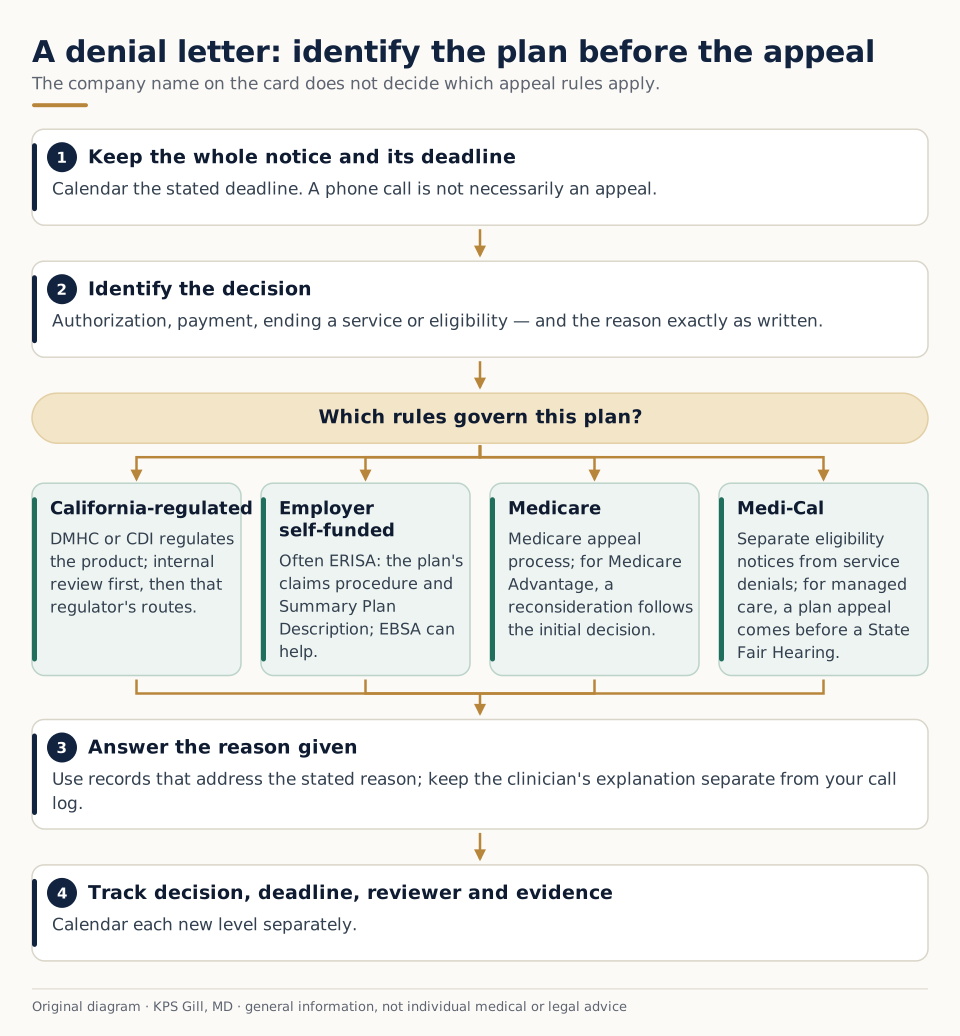
A denial letter should lead to two immediate questions: what decision is being challenged, and which rules govern the plan? The company name on the insurance card does not answer either question by itself. A company may sell insurance, administer an employer's self-funded plan, or offer a Medicare product. These arrangements can use different appeal routes. [S1, S2]
Keep the entire denial notice, including the appeal instructions. Save the envelope or electronic delivery information when available. Calendar the stated deadline immediately. Asking for information, making a complaint, or speaking with a representative does not necessarily count as filing an appeal.
If a delay threatens your health, contact your treating clinician and ask the plan about urgent review. An administrative dispute is not a reason to postpone emergency care.
First identify the decision
Is the plan refusing authorization before treatment, refusing payment after treatment, ending a service, or saying you were not eligible on the service date? Is the stated reason missing information, lack of medical necessity, a network issue, an exclusion, or a coding problem?
Write the reason as the notice states it. A medical-necessity denial may need clinical records addressing the decision criteria. A claim rejected for incomplete information may need a corrected submission. An eligibility problem may require a different office entirely. Avoid sending the same general argument to every department.
Create a one-page case summary with the member and claim identifiers, service date, decision date, requested outcome, and attachments. Keep the clinical explanation from the treating clinician separate from your account of calls and delays.
California-regulated coverage: DMHC or CDI?
California's Department of Managed Health Care and Department of Insurance regulate different health coverage products. The familiar HMO or PPO label is not a complete jurisdiction test. CDI's guidance notes that some PPO products are regulated by DMHC. Consult the Evidence of Coverage or insurance policy, and ask the regulator if the answer remains unclear. [S1]
DMHC's Help Center addresses issues within its authority including delayed appointments, referrals, authorizations, bills and access to language services. Some denials may qualify for Independent Medical Review, while other issues are handled as consumer complaints. Eligibility for a particular process depends on the decision and plan, not simply the fact that care was denied. [S3]
CDI has its own consumer complaint and medical-review processes for products it regulates. Its consumer guidance explains the role of an insurer's internal review and how to obtain help identifying jurisdiction. Follow the current instructions applicable to your policy and the notice you received. [S4]
The practical question is: “Which agency regulates this exact product, and where does the policy state that?” Record the answer. Do not conclude that all coverage sold by a company has the same regulator.
Employer coverage: check whether it is self-funded
A private employer may fund health benefits itself and hire a familiar insurer to administer claims. CDI explains that it does not regulate self-insured health plans merely because an insurance company administers them. Many private-sector employer plans are governed by ERISA and fall within the federal Department of Labor's benefits framework. ERISA can also apply to an employer plan that buys insurance; state regulation of the insurance policy and federal regulation of the employer plan can coexist. [S1, S2, S9]
Governmental plans and qualifying church plans are generally outside ERISA. Ask the administrator which framework actually applies rather than inferring it from the employer's name or religious affiliation. [S9]
Ask the plan administrator for the Summary Plan Description and claims procedures. Ask who funds the benefits and who makes the appeal decision. The Department of Labor's guide explains that plan documents should describe the benefits, limitations, claims process and relevant rights. EBSA can provide assistance with plans within its jurisdiction. [S5]
Avoid relying on a statement such as “we use Company X” from payroll as the final answer. Ask the benefits office to identify the legal plan and its funding arrangement. Preserve that written response with the denial.
Medicare has its own appeal framework
Original Medicare, Medicare Advantage and Medicare drug coverage use Medicare appeal processes. Medicare.gov explains that members can challenge coverage or payment decisions and obtain supporting information from their clinicians. The relevant notice and plan documents explain how to proceed. [S6]
For a Medicare Advantage service decision, the initial coverage decision is called an organization determination, and a first-level appeal is a reconsideration. The current Medicare instructions explain the sequence and urgent-review options. An appeal about a prescription may involve a different benefit and notice. [S7]
If a person also has Medi-Cal, list both coverages and identify which one made the disputed decision. Having two cards does not mean a complaint sent to either program will automatically preserve the correct appeal.
Medi-Cal: distinguish eligibility from service denial
DHCS's public help page distinguishes managed-care service appeals from fee-for-service hearing routes. A county notice about eligibility is another kind of decision. Read the agency and decision identified on the notice before selecting the process. [S8]
For a managed-care denial, the usual route begins with an appeal to the plan before a State Fair Hearing. A plan's failure to meet applicable response requirements can affect that sequence. Fee-for-service service denials can allow a direct hearing request. Follow the notice and current DHCS instructions for the particular decision. [S8] If continued services are at stake, promptly ask whether special rules allow services to continue during an appeal and what deadline applies. Do not assume that an ordinary appeal deadline also governs continuation of benefits.
When uncertainty remains, ask the appropriate program to explain the notice. A navigation office may help identify the route, but it is still important to submit the required request through the actual appeal channel.
Build the appeal around the reason given
Use a short opening: “I appeal the decision dated [date] concerning [service or claim]. I request [specific outcome].” Then explain why the stated reason is incorrect or incomplete, using records that address that reason.
If the dispute concerns medical necessity, ask the clinician which findings, prior treatments, functional effects or clinical recommendations matter. If it concerns a missing document, identify and supply that document through the approved channel. If it concerns network access, document the attempted appointments and the plan's responses.
Attach a numbered list rather than a pile of unexplained files. Keep originals. Retain confirmation of submission and a complete copy of what was sent. If a telephone appeal is permitted, ask how it will be acknowledged and how additional documents can be added.
Use a record that makes the next decision easier
Track four things: the actual decision; the deadline; the person or agency responsible for the next review; and the evidence that addresses the denial. Add the review outcome when it arrives. If the response opens another appeal level, calendar its deadline separately.
A strong appeal is understandable to someone who has never spoken with you. It identifies the governing plan, states the disputed decision accurately, and connects the requested correction to the relevant evidence. That organization cannot guarantee approval, but it can prevent avoidable misrouting and missing information from obscuring the issue.
Sources for this section
- CDI, Health Care Providers Guide to the Complaint Process: https://www.insurance.ca.gov/01-consumers/105-type/95-guides/05-health/healthcareguidecomplaintprocess.cfm
- CDI, Overview: Healthcare Coverage in California: https://www.insurance.ca.gov/01-consumers/110-health/10-basics/overview.cfm
- DMHC, Complaint Frequently Asked Questions: https://www.dmhc.ca.gov/FileaComplaint/FrequentlyAskedQuestions.aspx
- CDI, What to Do if You Have a Problem with Your Policy: https://www.insurance.ca.gov/01-consumers/110-health/30-have/prob-with-pol.cfm
- Department of Labor, Filing a Claim for Your Health Benefits: https://www.dol.gov/agencies/ebsa/about-ebsa/our-activities/resource-center/publications/filing-a-claim-for-your-health-benefits
- Medicare, Filing an Appeal: https://www.medicare.gov/providers-services/claims-appeals-complaints/appeals
- Medicare, Appeals in Medicare Health Plans: https://www.medicare.gov/providers-services/claims-appeals-complaints/appeals/medicare-health-plans
- DHCS, Medi-Cal Help: https://www.dhcs.ca.gov/medi-cal/help/
- Department of Labor, ERISA overview: https://www.dol.gov/general/topic/health-plans/erisa
Section added . Reviewed and approved for publication by Kanwar Partap Singh Gill, MD on . The rest of this page keeps its own dates and review record.
Sources and Authorities
Each source below was verified against the official publisher, current through August 10, 2026. Laws, proposed rules, and agency pages change; every link is re-opened live at deployment, and time-sensitive requirements should be checked against the current official source.
U.S. Department of Labor — Internal Claims and Appeals and External Review
HHS OIG — Some Medicare Advantage prior-authorization denials raise access concerns
HHS OIG — Medicare Advantage skilled-nursing prior-authorization appeals
World Health Organization — Universal Health Coverage
OECD Regulatory Policy Outlook 2025 — Regulating for effectiveness
CMS — 2025 Notice of Benefit and Payment Parameters Final Rule
World Health Organization — Health Ethics and Governance
U.S. House of Representatives — United States Code
HHS Office of Inspector General — Reports and Publications
U.S. Government Accountability Office — Reports and Testimonies
Office of the Federal Register — FederalRegister.gov
eCFR — Electronic Code of Federal Regulations
Related Articles
Educational information notice: this article provides general educational information for physicians, medical staff, and policy audiences and is not legal or medical advice. It does not create an attorney-client or physician-patient relationship. Statutes, regulations, proposed rules, and agency guidance change; individual matters require qualified counsel.