Published · revised as medical fiction
54 min story · sources in the notes checked through (Pacific)
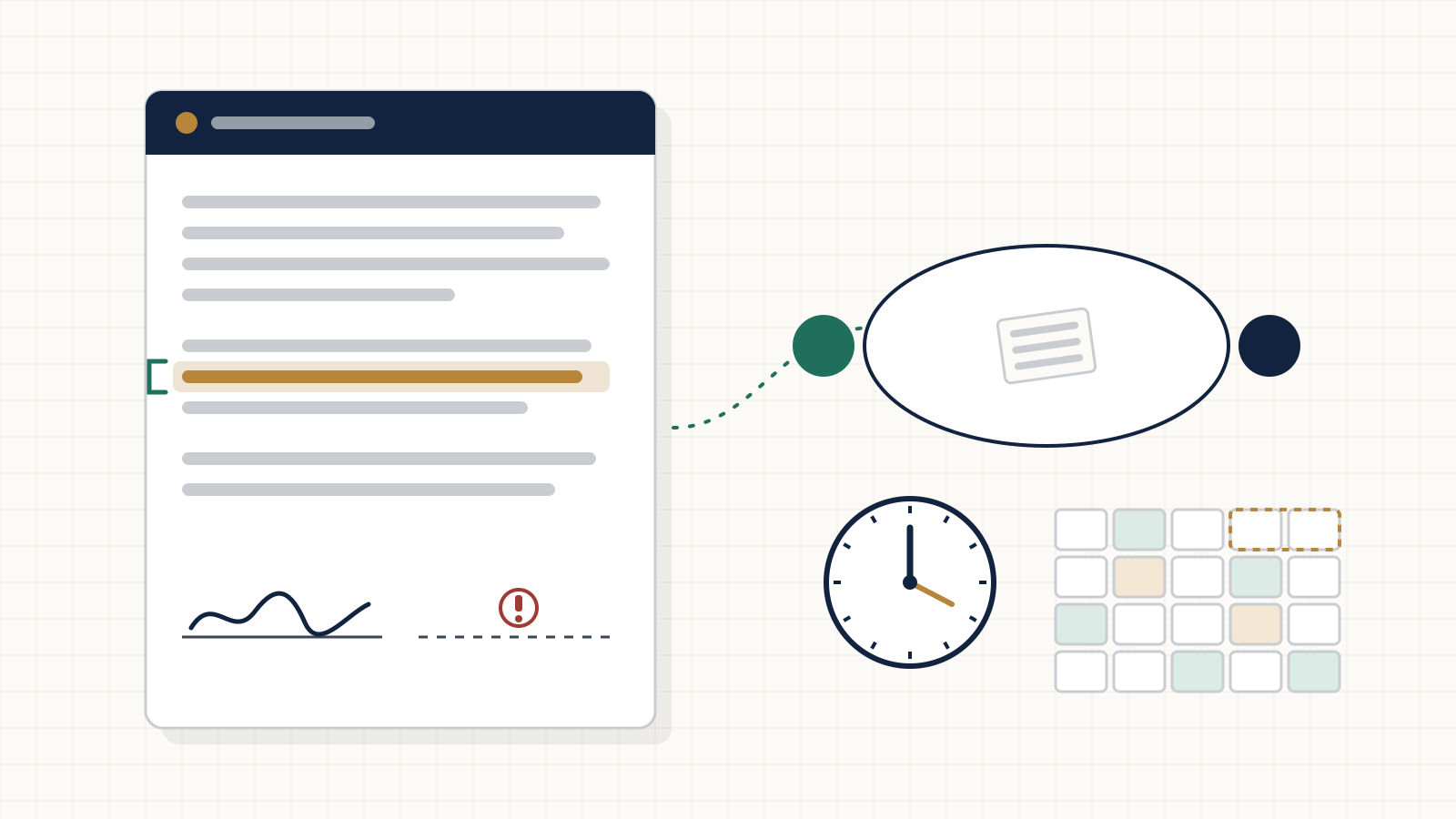
Dr. Lena Rowan has been asked to comment on a review of her work. One criticism is fair. Another depends on a sequence of events she cannot make sense of. While a quality director prepares his findings, a patient reads something in her portal that she does not remember saying.
Across a community health network, a nurse informaticist, an operations director and two clinicians begin following the same questions through different screens. A correction does not always reach the next record. A completed step does not always mean someone has accepted the next task. Everyone has work they believe they finished.
Before the review closes, they will have to decide what the evidence supports, what still needs doing, and whose account will travel forward.
Read the story in order, or go straight to the clinical and governance notes that follow each episode.
The seven episodes
Episode 1 · about 7 min
An Informal Matter
Rowan recognizes a real omission. The summary adds a conclusion she cannot reconcile with the dates.
Notes: The Meeting Before the Warning
Episode 2 · about 7 min
The Sentence
A correction appears in one draft. The signed version tells a different story.
Notes: Examining the Witness: How an AI-Assisted Note Becomes Evidence
Episode 3 · about 7 min
The Setting
The test encounter is complete. The patient’s next step still has no owner.
Notes: The People Who Configure the Practice of Medicine
Episode 4 · about 7 min
The Empty Square
Two screens show the same clinic day. Neither shows all the work.
Notes: The Schedule Is a Clinical Decision
Episode 5 · about 8 min
The Second Signature
A colleague asks Rowan to sign. First, they must agree what the signature will mean.
Notes: The Second Signature
Episode 6 · about 8 min
The Patient’s Version
Mara opens her record and finds an account she cannot recognize.
Notes: The Patient Who Inherits the Error
Episode 7 · about 9 min
The Finding
The conference has enough evidence to reach some conclusions. It must resist reaching others.
Notes: An Algorithm Is Not the Standard of Care



The people
The story is set at Calder Bay Community Health, an invented nonprofit outpatient network with two sites in an invented coastal district of California.
- Dr. Lena Rowan, a general internist who spent eleven years in hospital medicine before coming to the clinic. She believes most misunderstandings can be repaired with a careful written explanation.
- Dr. Julian Vale, the clinical quality director. He has to identify real deficiencies and run a process his colleagues can trust.
- Inez Park, a nurse informaticist. She knows which questions the record system can answer and which it cannot.
- Celia Ward, the operations director. She is responsible for access, staffing and a waiting list of people who have no clinician yet.
- Mara Ellison, a patient. She runs the overnight bake at a wholesale bakery and wants to know which office to call.
- Eli Navarro, a physician assistant with nine years at the clinic.
- Ava Chen, a nurse practitioner whose practice arrangement is her own.
- Tomas, who runs the referral desk, and Noor Haddad, who assembles the review packet.
About this story
Medical fiction. This series explores recurring questions in clinical practice through an invented narrative. Characters, dialogue, documents, institutions and the sequence of events have been constructed for the story. The narrative is not presented as a factual account of a particular clinician, patient, employer or proceeding, and its scenes should not be treated as evidence about anyone’s real conduct.
The notes that follow each episode discuss real clinical, technical and legal issues using identified sources. They distinguish established information, unresolved questions and proposed safeguards. A fictional event does not establish a factual claim about a real person, organization, product or deployment. The drafting tool in the story is generic; real product names appear only in the sourced notes, where vendor documentation is cited for what a product is documented to do and never for how any organization configured it.
The series was first published on November 19, 2026 as seven essays under the title Clinical AI, Physician Autonomy, and the Record of Care, and was revised the same day as a serialized work of medical fiction. The earlier edition is retained in the site’s editorial archive. Every analytical section of that edition is carried into the notes, under each essay’s original title. Legal status in the notes is stated as of November 19, 2026. California’s AB 1979, AB 1637 and SB 503 were enacted in 2026 and take effect on January 1, 2027; nothing in the story or the notes applies them to earlier conduct.
The clinical and governance framework
Each episode is followed on the same page by a section called The questions behind this episode. It contains the full analysis, the counterarguments, practical tables and checklists, and dated sources. Three kinds of statement are kept distinct throughout.
- Cited authority. Statutes, regulations, agency guidance, published studies and vendor documentation, each listed with its scope and limits.
- Analysis and proposals. The notes’ own arguments and recommended safeguards, labeled as proposals and never presented as existing legal requirements.
- Illustration. The story. It shows how a process might unfold. It demonstrates a risk and does not establish that the risk materialized anywhere.
The question behind the series
Every physician learns early that the medical record must support the care it describes. A diagnosis needs a basis. A plan needs to match the orders. A statement that something was done needs evidence that it was done.
This series asks whether institutions apply the same discipline to their own records about physicians.
Clinical AI makes the question urgent. Ambient documentation tools now draft notes, propose diagnoses and suggest plans. Electronic health records are configured by people who may never meet the patient whose care they shape. Quality programs score charts that software helped to write. Supervisory signatures are requested on notes the signer never heard being created. And the same generative tools that write clinical documentation can summarize a performance meeting or draft the memorandum that follows it.
At each of those points, something becomes evidence. A meeting becomes a record of counseling. A score becomes a finding. A generated sentence becomes the physician’s account of the encounter. A configuration becomes part of the practice of medicine. A signature becomes a certification. The argument running through all seven episodes and their notes is that each of these transformations should be supported as carefully as a clinical conclusion, because each can shape a patient’s care and a physician’s professional future.
That argument is not a plea for immunity. Several episodes set out the strongest institutional explanation beside the physician’s concerns, and every episode preserves the possibility that a review identified a real deficiency. The claim is narrower and, for that reason, more durable: when a record carries consequences, the record should be able to explain itself.
Ten principles that run through the series
- An institution’s account of a physician should be as carefully supported as the physician’s account of a patient.
- The date of a review is not the date of the conduct being reviewed. “Failure to improve” requires a measurement taken after an opportunity to improve.
- A signature establishes adoption of a record. It does not, by itself, establish how every sentence was created or which parts another person verified.
- A missing source limits the conclusions a review can reach. It neither proves the most unfavorable version of events nor clears an error that other evidence establishes.
- Fidelity, clinical appropriateness, action status and provenance are different findings, and each deserves its own answer.
- A configuration that changes what a clinician sees, accepts or sends is a clinical decision and deserves clinical participation before it reaches patients.
- A finished note is one kind of completion. The work that remains after the note, including results, referrals, transitions and corrections, needs an owner and time.
- Every signature should describe an action someone actually performed.
- Uncertainty is information. It should survive every transformation of the record until evidence changes it, and the patient should have a usable way to correct what the record gets wrong.
- A generated recommendation can raise a question. It cannot establish the standard of care, which requires clinical evidence, contemporaneous facts and explained reasoning.
A consolidated fair-review checklist
For organizations, reviewers and physicians who want to apply the series in practice, the following questions collect the proposals from the episode notes in one place. They are governance recommendations, not a statement of any existing legal requirement.
- Is the process named, whether educational feedback, focused review, employment action or formal professional review, and does the physician know which it is?
- For each finding, are the criterion, the encounter period, the evidence relied on and the clinical significance stated?
- Are the encounter, finding, feedback and reassessment dates kept separate?
- Does the review distinguish a workflow omission, a documentation defect, a clinical failure, a system problem and an unresolved question?
- Was the documentation method for each relevant encounter established from evidence rather than inferred from writing style?
- Were the records needed to answer the specific question examined in full, and is the conclusion phrased at the level the evidence supports?
- Did the physician receive an intelligible account of the findings and a route to respond, consistent with legitimate confidentiality?
- Did a software behavior or configuration contribute, and has it been reported to the people who can reproduce and correct it?
- Does the version of the system under evaluation match the version in use on the date of care?
- Does any patient need follow-up now, independent of how responsibility is allocated?
- Is the response, whether education, correction, system change, further review or formal action, proportionate to what was established?
- Can either participant correct the record of a meeting, and is the correction preserved beside the original?
What the series does not claim
The series does not allege that any identifiable organization conducted a sham review, retaliated against a physician, configured software unlawfully, engaged in the corporate practice of medicine or harmed a patient. It does not claim that physicians should be insulated from fair assessment, that AI documentation tools are unsafe as a class, or that a below-threshold score is meaningless. It does not offer legal advice to any reader about any particular matter.
What it offers instead is a method: separate what is established from what is alleged and what is inferred, keep the clocks distinct, ask what each signature means, and require every consequential conclusion, about a patient or about a physician, to show its evidence.
Now also a novel
Record of Care: A Novel retells these seven episodes at length in twenty chapters, gives the characters lives outside the clinic, and follows the months after the finding. Its cover maps every chapter to the notes on these pages and to the reporting beneath them.
Related reporting and resources on this site
- Who Owns the Decision?
- When the AI Scribe Becomes the Witness
- When the AI Scribe Starts Shaping the Medical Record
- UNFAITHFUL: Clinical Judgment’s Illicit Affair With Artificial Intelligence
- The AI Scribe Goes to Court
- Dragon Copilot 6.0 and the Next Test of AI Record Transparency
- The November AI Accountability Turn: What the AMA–FSMB Report Changes for Physicians
- Review a Clinical AI Tool Before Purchase, After Changes, and When Something Goes Wrong
- Methodology
About this page. This page introduces Record of Care, a fictional medical drama in seven episodes with clinical and governance notes. The story is fiction: its characters, clinic, documents and events are constructed, and nothing in it is evidence about a real person, organization, product or deployment. The notes cite real sources with their limits and label their proposals as proposals. First published 19 November 2026 as part of the essay series Clinical AI, Physician Autonomy, and the Record of Care; revised as a serialized work of medical fiction on 19 November 2026. The earlier edition is retained in the site’s editorial archive. Drafted with AI assistance and published on the author’s instruction. Sources were carried over from the first edition, checked through 19 November 2026 (Pacific). General information, not individualized medical or legal advice. Corrections: editorial standards · methodology.