Published · fiction
about 3.1 hours of reading in twenty chapters
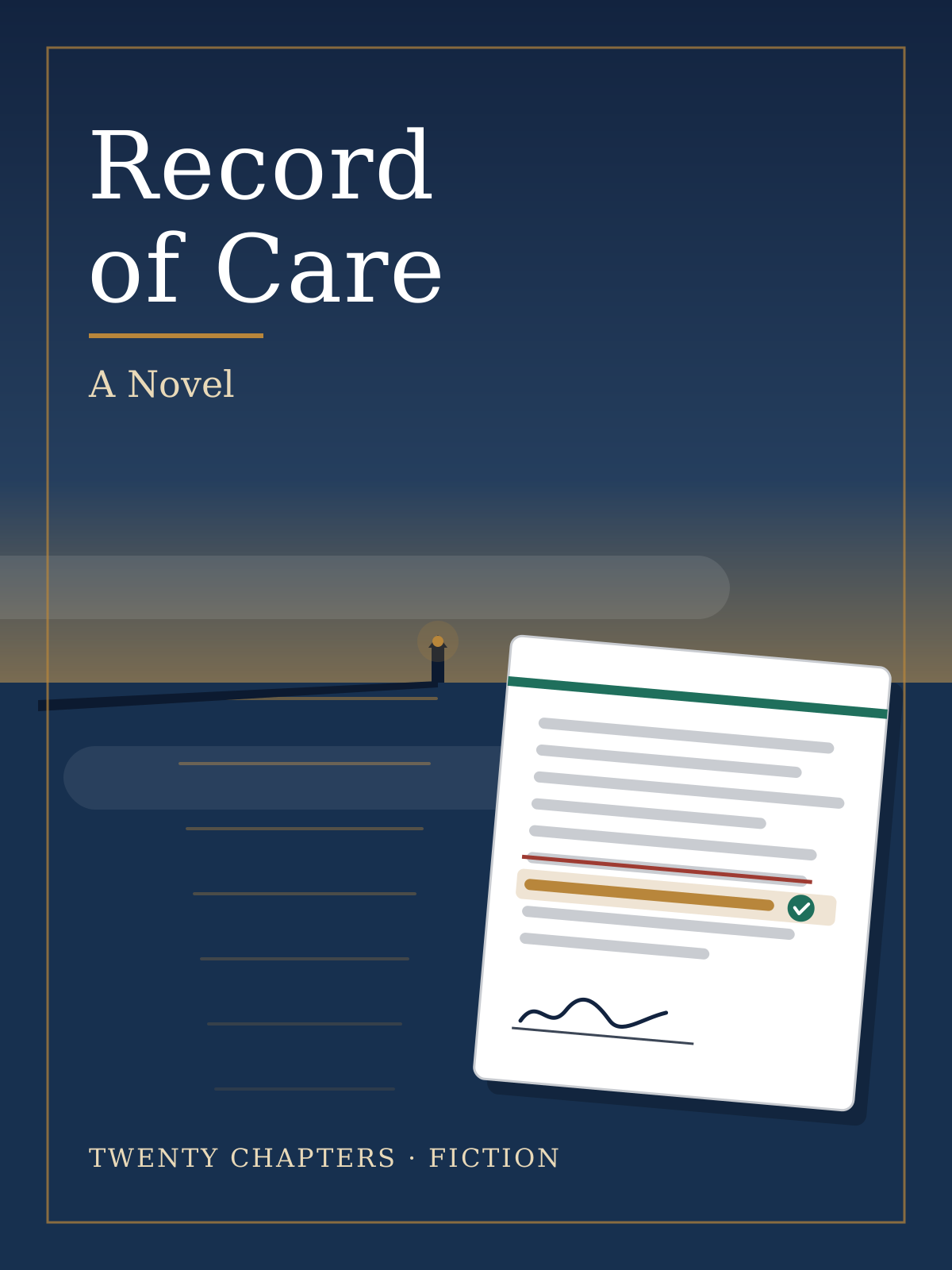
About this novel
Record of Care is a novel in twenty chapters set at Calder Bay Community Health, an invented two-site clinic on the California coast. Over one foggy summer and into the following January, a software update changes how visit notes are drafted and how referrals are closed. A physician signs a note that says her patient refused care when the patient had asked for two weeks. The people around them, from the referral coordinator to a board member who drives a school bus, work out what the record actually shows, what it cannot show, and who should put it right.
It is the third form of the same material. The first was a series of seven physician essays. The second rebuilt those essays as a seven-episode medical drama, with full clinical and governance notes after each episode. The novel retells that drama at length, gives its people lives outside the clinic, and follows the threads the episodes could only point to: consent recorded by default, a records outage, a machine transcript, a governing board, a reassessment, and an old man’s discharge summary. Each chapter ends with a short note that points to the episode notes and the reporting on this site that examine the real questions behind it.
Everything in the story is invented: the clinic and the town, the people, the software and its vendor, every document quoted, the law the board discusses and the events. Nothing in it is evidence about a real person, organization, product or deployment.
Contents
Part One · Green
Weeks five to eight · chapters 1 to 5
A software update is applied before dawn, a referral turns green before anyone has accepted it, and a baker with stiff hands asks for two weeks.
- Chapter 1 · The UpdateWeek five · about 10 min
At 6:09 a.m. a setting is applied. By the end of lunch, a referral that no one has accepted has turned green.
- Chapter 2 · An Informal MatterWeek six · about 10 min
A quality director calls it an informal matter. A fisherman's tracing is normal on a Friday. A discharge summary says an old man declined.
- Chapter 3 · Three ChairsWeeks five to seven · about 10 min
A nurse practitioner gives a talk about interpreters, then finds a family member's words in her own patient's mouth.
- Chapter 4 · No Setting for the PastWeek eight · about 8 min
A lawsuit up the coast, a consent line on four thousand notes, and a fisherman who does not remember being asked.
- Chapter 5 · Two WeeksWeek eight · about 10 min
A baker asks for two weeks to arrange her X-rays. The note says she refused.
Part Two · The Sentence
Weeks nine and ten · chapters 6 to 10
A fax comes back with nowhere to go, a review packet carries a sentence nobody checked, and the version history shows what a signature covered.
- Chapter 6 · Returned, Nowhere to Put ItWeek nine · about 8 min
A fax comes back with nowhere to go, a fisherman's heart races at two in the morning, and a review packet goes out with a sentence nobody checked.
- Chapter 7 · The SentenceWeek ten, Monday · about 8 min
Dr. Lena Rowan reads the review packet, and then she reads her own signed note to the end.
- Chapter 8 · When Instruments DisagreeWeek ten · about 8 min
A retired harbor pilot is handed two instructions that disagree, and does what he was taught in 1979.
- Chapter 9 · Version HistoryWeek ten, Tuesday · about 9 min
The version history shows what the tool wrote, what the doctor changed and what was lost. It cannot show why.
- Chapter 10 · Page NineWeek ten, Wednesday · about 9 min
In a test environment, a ninety-four-year-old patient named Zzztest Marigold shows the clinic what page nine meant.
Part Three · Corrections
Week ten · chapters 11 to 15
An empty square on a calendar, a button that says agree, a patient's own fifty-nine words, and a conference that separates what happened from what was printed.
- Chapter 11 · The Empty SquareWeek ten, Wednesday and Thursday · about 9 min
An operations director sees an empty square on the calendar. A physician shows her what is in it.
- Chapter 12 · Reviewed and AgreeWeek ten, Thursday · about 8 min
A button says Reviewed and agree. Two clinicians work out what it is asking them to say.
- Chapter 13 · Her Own WordsWeek ten, Wednesday and Thursday · about 8 min
A patient is handed three pages of apology and no telephone number, and writes fifty-nine words of her own.
- Chapter 14 · Section CWeek ten, Thursday night · about 9 min
The night before the conference, everyone reads what they wrote, and one man opens the tracing.
- Chapter 15 · The FindingWeek ten, Friday · about 13 min
The quality conference separates what happened from what the template said, and decides what each finding is.
Part Four · The Long Record
Week twelve to January · chapters 16 to 20
An outage, a transcript, a board that asks plain questions, a reassessment drawn only from after the feedback, and a baker's hands in the dough.
- Chapter 16 · DowntimeWeek twelve · about 10 min
Six hours without a writable record, forty-one phones holding recordings, and the quality director signs the thing he warned about.
- Chapter 17 · The TranscriptWeek twelve · about 10 min
A machine transcript establishes what was said. Nobody can make it say why.
- Chapter 18 · The BoardWeek fourteen · about 12 min
A school-bus driver who chairs the quality committee asks three questions, and a board votes.
- Chapter 19 · ReassessmentOctober · about 11 min
The reassessment is drawn only from after the feedback. A fisherman goes back to sea with a laminated card.
- Chapter 20 · Mara’s HandsJanuary · about 10 min
In January the mixer starts on the first try, and an old ferry engineer initials his correction.
The people of Calder Bay
All invented.
- Dr. Lena Rowan
- Physician at the Pier Street site; eleven years in hospital medicine before six at the clinic. Keeps a yellow pad.
- Mara Ellison
- Overnight baker at the Tern Street Bakery for nineteen years. Her hands are stiff in the mornings.
- Julian Vale
- Quality director; a former critical-care physician who keeps one walk-in session a week. Runs the breakwater at five.
- Inez Park
- Clinical informatics lead and a former nurse. Reads release notes three times.
- Celia Ward
- Director of operations. Grew up four streets from the Marsh Road clinic, where her mother cleaned.
- Tomas Alvarado
- Referral coordinator. Sings bass at St. Brendan’s. Wrote the safety report that started it.
- Dr. Sam Okoye
- Physician at Marsh Road for twenty years; second reviewer in the quality sample.
- Dr. Helen Pruitt
- Physician at Marsh Road who sits on the quality committee and asks whether you opened the tracing.
- Eli Navarro
- Physician assistant at Pier Street for nine years.
- Ava Chen
- Nurse practitioner at both sites; spoke at a regional meeting about interpreters and three chairs.
- Noor Haddad
- Quality coordination. Turns her badge backward when she does not want to be stopped.
- Dr. Amari
- Medical director, sixty, who still keeps a clinic at Marsh Road.
- Joan Mercer
- Executive director, who reads dashboards aloud line by line.
- Marguerite Bell
- Compliance officer, formerly a hospital auditor. Keeps paper.
- Daniel Ruiz
- Clinical success manager for the vendor of the drafting tool; a former respiratory therapist.
- Arturo Reyes
- Black-cod fisherman whose heart races after the second coffee; his brother Hector has atrial fibrillation.
- Harlan Pike
- Retired harbor pilot who says things twice and keeps his readings on graph paper.
- Rosa Delgado
- School-bus driver who chairs the board’s quality committee and checks the tires.
- Walter Rowan
- Retired ferry engineer at the Bayview care home; Lena’s father; keeps a spiral notebook.
The material beneath this novel
The novel rests on three layers of earlier work. Two are published on this site. One is kept in its editorial archive. The story borrows their questions, not their facts.
1. The serial: seven episodes, each with notes
Record of Care, a fictional medical drama in seven episodes, is the fiction the novel expands. Each episode is followed by clinical and governance notes with numbered sources, an evidence summary that separates what the sources establish from what they do not, and labelled proposals. The novel keeps the serial’s characters and events and adds to them; where the two differ in a detail, the serial’s notes remain the place where the real questions are argued.
2. The first edition: seven essays, archived
Before the serial, the same material was published on 19 November 2026 as seven physician essays under the title Clinical AI, Physician Autonomy, and the Record of Care. Later that day the essays were rebuilt as the serial at the same addresses, and every analytical section was carried into the notes after the episodes. The essay text is retained in the site’s editorial archive and is not published separately; its arguments, sources and limits now live in the serial’s notes.
3. The reporting underneath
The serial and the novel both draw on the clinical-AI reporting published on this site between late October and 19 November 2026. These pages are factual reporting and analysis, each with its own sources, dates and limits. Where they name real products, lawsuits or laws, the novel does not: its software, vendor, lawsuit and statute are invented composites.
- Who Owns the Decision?
- Signed but Not Written
- When the AI Scribe Starts Shaping the Medical Record
- UNFAITHFUL: Clinical Judgment’s Illicit Affair With Artificial Intelligence
- Review a Clinical AI Tool Before Purchase, After Changes, and When Something Goes Wrong
- Artificial intelligence in California care: current duties and the 2027 changes
- Medical Records, EHR Evidence and the History Behind a Signed Note
- Who Is Responsible When the Algorithm Enters the Exam Room? California’s New Test for Clinical AI
- What Happens When AI Writes Your Medical Note? A Patient Checklist
- A Wrong Detail in Your Medical Record: How to Request a Correction and Keep a Paper Trail
- Healthcare AI Oversight in November: What Changed Across Six Jurisdictions
- The November AI Accountability Turn: What the AMA–FSMB Report Changes for Physicians
- The AI Scribe Goes to Court
- Dragon Copilot 6.0 and the Next Test of AI Record Transparency
- AI Scribes, Interpreters and the Difference Between Finishing a Note and Verifying Care
- Medical Records and Clinical AI Come Together on California's November Board Agenda
- When the AI Scribe Becomes the Witness
- Companion A · Who can replay an AI-generated clinical note a year later?
- The discharge summary a doctor would sign
- The clinical AI docket: five cases and the evidence each one adds
- Companion B · Paid, pending or merely visible? The receipt to keep when a service comes back
Chapter by chapter
For each chapter, the episode notes and the reporting that examine the questions it dramatizes. Every chapter page carries the same links in a closing section, Behind this chapter.
How this novel was made
The novel was drafted with AI assistance and published on 20 November 2026. Its characters were first created for the serial; no character is based on a real person, and the clinic is not modelled on any real organization. Corrections and questions follow the site’s editorial standards.
Related on this site
About this page. This page is the cover and contents of Record of Care: A Novel. The novel is fiction: its characters, clinic, software, documents, law and events are constructed. It retells and extends Record of Care, a seven-episode medical drama with clinical and governance notes, which itself grew from a series of physician essays first published on 19 November 2026 and now kept in the site’s editorial archive. Drafted with AI assistance and published on 20 November 2026. General information, not individualized medical or legal advice. Corrections: editorial standards · methodology.