Published
Medically reviewed · sources checked through 9 November 2026
Your clinician may use software that listens during a visit and prepares a draft medical note. The purpose is to help turn a conversation into documentation. The practical question for a patient is whether the final record faithfully describes the symptoms, history, decisions, and follow-up that mattered.
Ambient documentation is not the same as an ordinary audio recording. A system may transform speech into a structured account, group statements by topic, or produce a summary. Different products and clinic configurations have different functions. Ask what the particular system does rather than assuming every tool works alike. Research on these systems has documented both possible workflow benefits and errors that require review; findings from one product or study do not establish the performance of every installation. [1,2]
You can participate without trying to become the clinic's software auditor. A few questions before the visit and a focused review afterward can make the process clearer.
Before the conversation begins
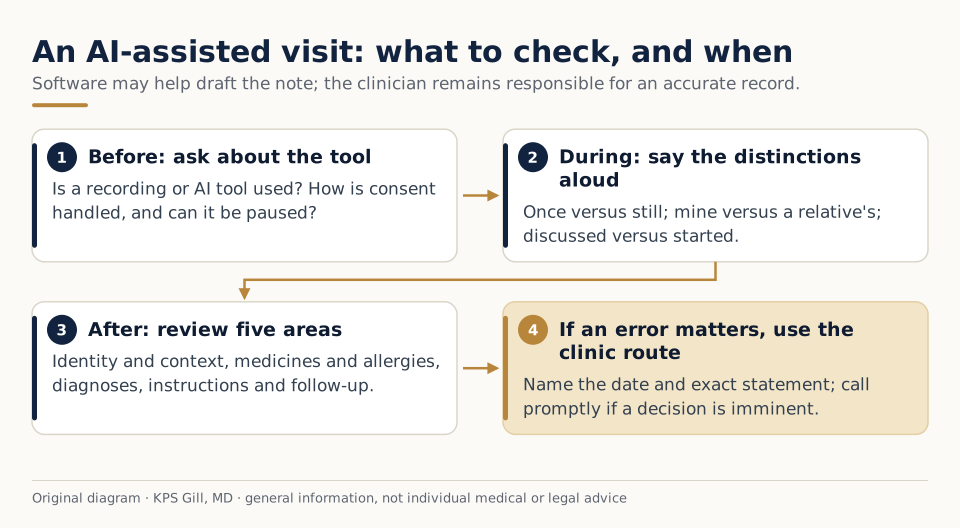
Start with a simple question: “Are you using a recording or AI documentation tool for this visit?” If so, ask how the clinic explains its use to patients and what consent process applies. State any concerns before sharing particularly sensitive information. Ask what alternatives are available and whether the recording can be paused for part of the discussion. Do not assume every clinic offers the same choices or that one consent rule applies to every setting.
The next questions concern the information itself. What is recorded? Is audio retained, or is it deleted according to a stated policy? Who can access the recording and draft? Is information used only for the visit documentation, or for additional purposes? The clinician may need a privacy or information-technology colleague to answer detailed questions. An accurate explanation is more useful than a hurried assurance that the system is simply “secure.”
Finally, ask who reviews the note and where you can read the final version. A useful answer identifies the responsible clinician and the clinic's correction process. A patient should not have to infer that a fluent, professional-looking document has already received a careful review.
During the visit: make the important distinctions audible
Clinical conversations are full of qualifiers. “I had this problem once” differs from “I still have it.” “My mother takes that medicine” differs from “I take it.” “We discussed starting treatment” differs from “I started treatment.” These distinctions matter whether documentation is written by a person or assisted by software.
Give a clear sequence when possible: when a symptom began, what changed, and what is happening now. Bring a current medication list, including the dose and how you actually take each medicine. If the list in the chart is wrong, point out the specific difference. Ask the clinician to clarify whether a diagnosis is established, suspected, historical, or still being evaluated.
If a family member or interpreter participates, identify who is speaking and whose history is being discussed. Tell the clinician if translation misses an important detail. An interpreter helps communicate the encounter; the clinical record still needs to preserve the meaning of the patient's account. Research on documentation quality does not justify assuming perfect performance across every language or interpreter workflow. [1]
You do not need to speak unnaturally for a computer. The aim is a clear conversation with your care team. Before leaving, ask for the plan in plain language: what you should do, what the clinic will do, and how you will learn the result.
After the visit: review the details that could change care
If a note is available through your portal, begin with five areas. First, check identity and context: the visit date, the main concern, and whether a family member's history has been attributed to you. Second, review medications and allergies. A wrong drug, dose, or reaction deserves prompt clarification because later clinicians may rely on that information.
Third, look at diagnoses. A note may legitimately contain a working diagnosis or a condition being considered. Ask if the wording makes an uncertain issue appear confirmed. A question about a diagnosis is often best resolved through clinical clarification before a formal record dispute.
Fourth, check the plan against what you understood. Was a medicine prescribed or merely discussed? Was a referral placed? Is a test ordered, pending, or already completed? Fifth, check follow-up responsibility. Who will review a result, when should you expect a response, and whom should you contact if nothing arrives?
Do not judge a note only by its length or medical vocabulary. A concise note can be useful, and a long note can omit the next step. The important test is whether the record supports the care actually discussed and accurately identifies what remains unresolved.
If you find a consequential error
Use the clinic's established contact route. Identify the date of service and the exact statement. Explain the correction you believe is needed and why it matters. For example, a hypothetical message might say: “The note lists medicine A as current, but we discussed that it was stopped last month. Please confirm the medication list and the instructions I should follow.”
If the error could affect an imminent prescription, procedure, or other decision, contact the clinical team promptly rather than relying only on a routine portal message. A formal amendment process is not a substitute for addressing a present clinical problem. If symptoms are severe or rapidly worsening, seek the level of care your situation requires; do not wait for a record correction.
For HIPAA-covered organizations, patients can request an amendment to information they believe is inaccurate or incomplete. A request does not guarantee that the original entry will be deleted or that a disputed clinical opinion will be changed. There is also a process for a statement of disagreement when an amendment is denied. California has additional provisions for patient addenda. The site's separate correction guide explains those routes. [3,4]
Protect the record when asking for help
Avoid posting an identifiable medical note publicly to ask strangers whether the AI made a mistake. A portal, the clinic's records department, or another approved channel is usually a better starting point. Keep your own copy of the relevant note and your correspondence.
Be cautious about uploading records into an unrelated consumer app. The fact that a tool discusses health does not establish that HIPAA applies to it. HHS explains that privacy protections depend on the entities involved and their relationship to the information. A clinic's contracted documentation workflow and a consumer app you independently select may have very different obligations. [5]
Keep the conversation practical
The most useful questions are concrete: What does this tool do? Who checks the note? What happens to the recording? Where do I report an error? How do I confirm that the medication and follow-up plan are correct?
A patient's careful reading can reveal a misunderstanding, but it does not replace a clinician's responsibility to produce and use an accurate record. The goal is a documented plan that the patient and care team can understand, check, and carry forward.
Sources for this section
- Taylor SL and colleagues. Quality of Clinical Notes Created by Ambient Listening Generative AI: Pragmatic Prospective Pilot Study. JMIR Medical Informatics. April 17, 2026;14:e86474. https://pubmed.ncbi.nlm.nih.gov/41996389/ and https://pmc.ncbi.nlm.nih.gov/articles/PMC13089619/
- Lukac PJ and colleagues. Ambient AI Scribes in Clinical Practice: A Randomized Trial. NEJM AI. December 2025;2(12). doi:10.1056/AIoa2501000; PMID 41497288. Primary research, 238 outpatient physicians assigned to DAX Copilot, Nabla or usual care. https://pmc.ncbi.nlm.nih.gov/articles/PMC12768499/
- HHS, Your Medical Records. https://www.hhs.gov/hipaa/for-individuals/medical-records/index.html
- Medical Board of California, medical-record complaint FAQs. https://www.mbc.ca.gov/FAQs/default.aspx?cat=Consumer&;topic=Complaint%3A+Medical+Records
- HHS, Protecting the Privacy and Security of Your Health Information When Using Your Personal Cell Phone or Tablet. https://www.hhs.gov/hipaa/for-professionals/privacy/guidance/cell-phone-hipaa/index.html