
Published
Medically reviewed · sources checked through 9 November 2026
An inaccurate medication, an incorrect date, or a diagnosis attributed to the wrong person can make a medical record harder to use. The first task is to identify the exact statement and the effect it could have on current care. The second is to use the organization's correction process while keeping a clear record of your request.
Patients generally have rights to request amendments to protected health information in a designated record set maintained by a HIPAA-covered organization. Those rights have limits and procedures. A correction request is not an automatic right to erase the original entry, remove an accurately recorded historical event, or compel a clinician to adopt a different medical opinion. California also provides a patient-addendum route that is distinct from a request that the author change the record. [1–3]
Protect current care first
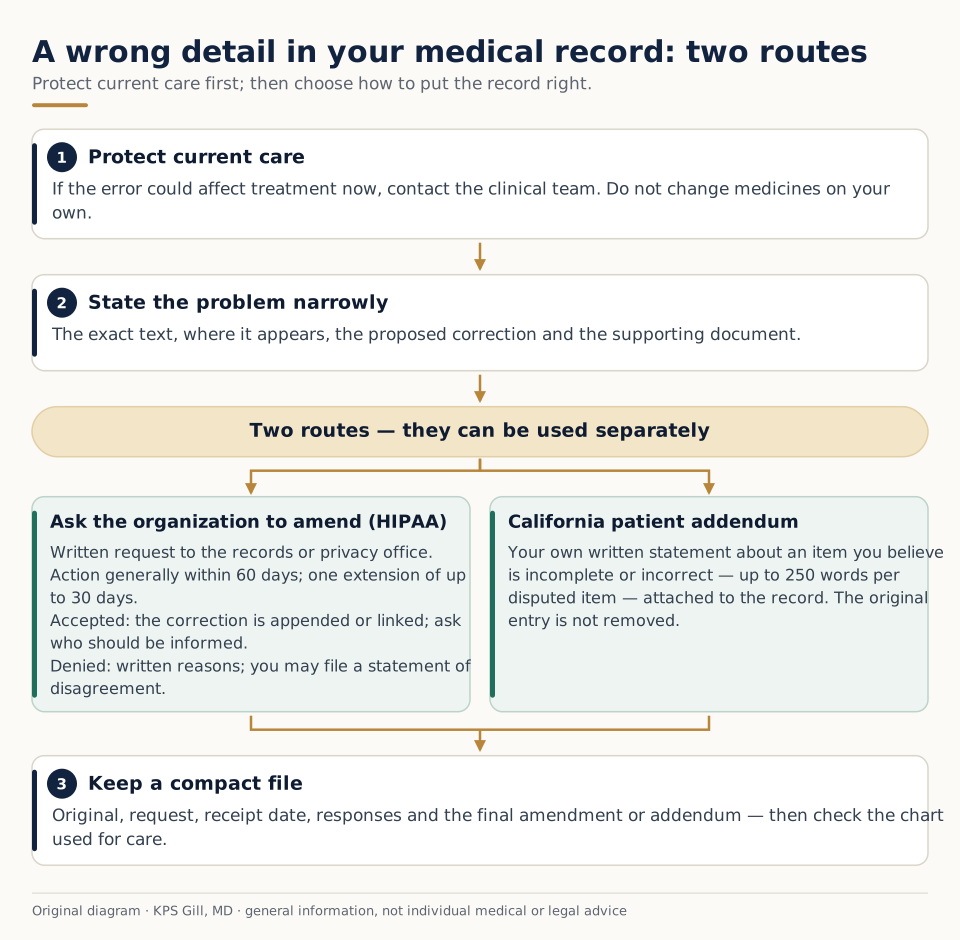
If the problem could affect treatment now, contact the clinical team promptly. An incorrect allergy entry, medicine dose, or procedure history may need attention before the formal amendment process is complete. Ask the clinician to clarify the instructions you should follow and to alert the relevant care team as appropriate.
Do not stop, start, or change a medicine solely because you see a discrepancy in the portal. Describe the discrepancy and seek a clinical answer. Keep administrative follow-up and clinical follow-up on separate lines in your notes so that one does not disappear inside the other.
For a less urgent issue, obtain the actual document rather than relying on a brief portal preview. Record the encounter date, document title, author, and the location of the disputed statement. If a problem appears in several places, such as a visit note and the active medication list, identify both. They may require different corrections.
State the problem narrowly
A useful request distinguishes the existing text from the proposed correction and the supporting information. “My record is wrong” gives the reviewer very little to investigate. “The visit note dated June 12 says I take medicine A twice daily; my prescription and the medication review documented once daily” is a focused factual question.
Use a dated list for more than one item. Attach relevant supporting documents when available, such as a prescription label, outside report, or prior correction. Do not assume that a screen capture alone establishes the entire context. The organization may need to review the underlying record and ask the author to assess it.
Some disputes concern meaning rather than a transcription error. A diagnosis may be listed as a possibility, a billing code, a historical problem, or a current condition. Ask which of those the entry represents. Clarification may resolve the concern; if it does not, the formal request can describe the remaining disagreement precisely.
Use the organization's amendment process
Ask the medical-records department, health information management office, or privacy office how to submit an amendment request. HIPAA permits the organization to require a written request and a reason when it has informed patients of that requirement. Keep a copy of what you submit and evidence of the date it was received. [2]
The HIPAA amendment rule generally requires action within 60 days after receipt. One extension of no more than 30 days is allowed if the organization provides the required written explanation and completion date within the initial period. These are formal amendment rules; they should not be used as a reason to delay a clinically urgent discussion. [2]
Here is an original template to adapt:
“I request an amendment to the following information in my medical record: [document, author, date, and exact item]. The existing entry states [brief quotation]. I believe it is inaccurate or incomplete because [specific explanation]. The information I ask you to consider is [proposed correction or clarification], supported by [attached document, if any]. Please confirm receipt, identify any additional information you require, and provide your written decision. Please also advise how an accepted amendment will be linked to the affected record and communicated to relevant recipients.”
Send identifying details through the organization's approved secure channel. A public website comment or social-media message is a poor substitute for a traceable records request.
What acceptance and denial mean
An accepted amendment is generally incorporated by identifying the affected record and appending or linking the correction. This preserves an understandable record of what changed. HIPAA also addresses reasonable efforts to inform identified recipients who need the amendment and others known to have relied, or potentially to rely, on the inaccurate information to the person's detriment. Ask how that process applies to your situation. [2]
The organization may deny a request on specified grounds. Examples include determining that the information is accurate and complete, that it falls outside the designated record set, or that the organization did not create it. For that last ground, an exception applies when the patient provides a reasonable basis to believe the original creator is no longer available to act. The rule also addresses information that would not be available for inspection under the access provisions. A denial must explain the basis and the available response process in writing. [2]
If you disagree, HIPAA provides a right to submit a written statement of disagreement. The organization may reasonably limit its length and may prepare a rebuttal, which must be provided to you. The rule governs how the disputed information, request, denial, disagreement, and any rebuttal are linked and handled in later disclosures. If you do not submit a statement of disagreement, you may request that your amendment request and the denial accompany future disclosures of the information at issue. Ask for the specific instructions rather than assuming that an ordinary complaint completes either step. [2]
California's separate patient-addendum option
California Health and Safety Code section 123111 provides an addendum right for a patient who inspects records under section 123110. The patient may provide a written statement concerning an item believed to be incomplete or incorrect, limited to 250 words per disputed item, and clearly request that it become part of the record. The provider must attach it and include it when disclosing the disputed portion to a third party. The Medical Board of California explains that the original information is not removed through this process. [3]
This is useful when your goal is to place your factual account beside a disputed entry. It should remain specific and restrained. Identify the item, explain the disagreement, and state the information you believe completes or corrects the account. Sign and date the addendum, as the Medical Board's guidance describes. Accusations about motive rarely make the medical facts clearer.
Keep a compact follow-up record
Your file should contain the original document, your request, the delivery or receipt date, supporting evidence, responses, and any final amendment or addendum. Note the name or department handling the request. When another clinician needs the information, explain that a correction is pending or provide the linked correction when available; do not silently alter an original report yourself.
Check that the important change reached the part of the chart used for care. An appended note may not automatically correct every medication list, problem list, or outside system. Ask the relevant team to reconcile those items. The result you want is a record that makes the history, the correction, and the present plan understandable to the next person who relies on it.
Sources for this section
- HHS, Your Medical Records. https://www.hhs.gov/hipaa/for-individuals/medical-records/index.html
- 45 C.F.R. § 164.526, Amendment of protected health information, current eCFR text. https://www.ecfr.gov/current/title-45/subtitle-A/subchapter-C/part-164/subpart-E/section-164.526
- Medical Board of California, Complaint: Medical Records FAQs, explaining Health and Safety Code § 123111. https://www.mbc.ca.gov/FAQs/default.aspx?cat=Consumer&;topic=Complaint%3A+Medical+Records
- Medical Board of California, Patient Access to Medical Records. https://www.mbc.ca.gov/Resources/Medical-Resources/Access-Records.aspx